
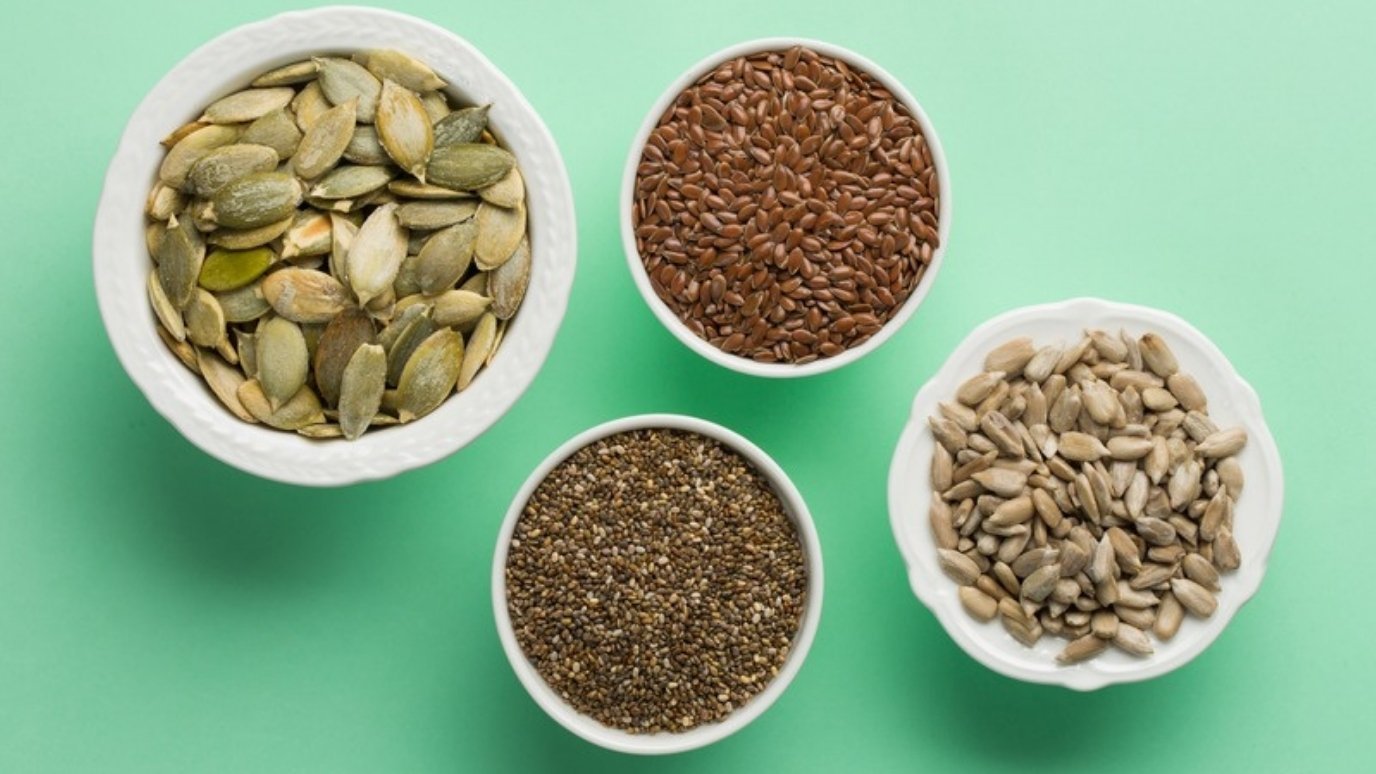
Quick answer
Seed cycling means eating 1 tablespoon each of ground flax and pumpkin seeds a day from your period to ovulation (about days 1–14), then 1 tablespoon each of sesame and sunflower seeds until your next period (about days 15–28). Does it work? The seeds are good food, and a 2025 systematic review found small studies linked to better cycle regularity and milder PMS. But no study has ever tested whether switching seeds by phase does anything that eating all four every day wouldn’t.
Bottom line: it’s cheap and low-risk, so try it if you like the ritual. Just don’t skip a medical work-up for missed periods, PCOS or heavy symptoms because of it.
Seed cycling is everywhere on Pinterest: pastel charts, moon icons, little jars labeled “follicular” and “luteal.” It’s one of the most saved hormone tips out there. What the charts don’t tell you is how little research sits behind them.
I’m Nada. I have a background in medicine and a Nutrition Science certification, and I went through the human studies on seed cycling one by one. Below you’ll find the chart (because you came for it), followed by an honest check of each claim the chart makes. I also ran the USDA numbers on what these seeds actually add to your day, and some of those numbers will surprise you.
What is seed cycling and how does it work?
Seed cycling is a food habit, not a supplement protocol. You split your menstrual cycle into two halves and eat a different pair of seeds in each half. The idea is that the nutrients in each pair “support” the hormone that’s supposed to lead in that half.
- Follicular phase (period to ovulation): flax and pumpkin seeds. The claim is that flax lignans help balance estrogen and pumpkin seed zinc gets you ready for the progesterone that comes next.
- Luteal phase (ovulation to period): sesame and sunflower seeds. The claim is that sesame lignans and zinc, plus sunflower seed vitamin E and selenium, support progesterone.
There is a real piece of science underneath the idea. Lignans are plant compounds that your gut bacteria turn into enterodiol and enterolactone, which have weak estrogen-like and anti-estrogen-like effects. Flax is one of the richest food sources. Everything after that point (which seed lines up with which hormone, and the idea that timing matters) is theory that has never been tested head to head.
If you want the bigger picture of eating around your cycle, my cycle syncing diet guide covers the full approach. Seed cycling is one small slice of it.
The seed cycling chart
Save this one. It’s the standard protocol, with the caveats the pretty versions leave out.
| Phase | Days (28-day cycle) | Daily seeds | What to watch for |
|---|---|---|---|
| Follicular | Day 1 (first day of bleeding) to ovulation, about day 14 | 1 tbsp ground flaxseed + 1 tbsp pumpkin seeds | Grind the flax. Whole seeds often pass through you intact. |
| Luteal | Day after ovulation to the day before your next period, about days 15–28 | 1 tbsp sesame seeds + 1 tbsp sunflower seeds | Sesame is a major allergen. Skip it if you react. |
| Irregular or no cycle | New moon to full moon, then full moon to new moon (a popular convention) | Same pairs as above | The moon method is folklore, not physiology. More on that below. |
What is day 1 of seed cycling?
Day 1 is the first day of real bleeding, not spotting. That’s the same day 1 your doctor and every period-tracking app use. You start flax and pumpkin that day.
The switch to sesame and sunflower is supposed to happen at ovulation. The “day 14” on most charts only works if you have a textbook 28-day cycle. If your cycle runs 24 or 35 days, ovulation moves, and the luteal phase (usually around 12–14 days) is the half that stays steadier. A simple fix is to count back about 14 days from when you expect your next period, or use ovulation test strips. My guide to eating by menstrual phase walks through how to spot each phase.
Does seed cycling actually work? Claim by claim
This is the part Pinterest skips. Here is each claim, with what the human research really shows.
Claim 1: “Seed cycling balances your hormones.” Partly supported, but not by cycling
The most quoted study behind seed cycling is a 1993 trial in the Journal of Clinical Endocrinology & Metabolism. Eighteen women with normal cycles ate flaxseed powder for three cycles and their usual low-fiber diet for three cycles, in random order. On flax, their luteal phase was longer (12.6 vs 11.4 days on average). Three of the 36 control cycles had no ovulation, compared with none of the 36 flax cycles. Their progesterone-to-estradiol ratio in the luteal phase was higher too, although estradiol and progesterone levels on their own didn’t change (Phipps et al., 1993).
Here’s the twist: those women ate flax every day of the cycle, including the luteal phase, which is exactly when seed cycling tells you to stop. So the best-known evidence actually supports eating flax all month, not rotating it out.
Claim 2: “Seed cycling helps PCOS.” Weak evidence, mixed with diet changes
The only trial built around the full four-seed protocol was a 12-week study in women with PCOS, published in Food Science & Nutrition in 2023. There were three groups of 20: a control group, a group on a portion-controlled diet plus metformin 500 mg, and a group on a portion-controlled diet plus seed cycling. The seed group’s FSH and LH levels dropped and the authors called the approach effective (Rasheed et al., 2023).
Read the design closely, though. No group did seed cycling without the portion-controlled diet, so you can’t tell how much of the change came from the seeds and how much from eating less. The groups were small, and the abstract leaves out details like blinding. It’s a starting point, not proof. If you have PCOS, my natural PCOS treatment guide covers the levers with stronger evidence: weight, insulin resistance, movement and sleep.
Claim 3: “Science proves seed cycling eases PMS.” Promising, small, early
A 2025 systematic review in Cureus pulled together 10 studies with 635 women, covering PMS and PCOS. It found seed cycling, especially the flax and sesame parts, was associated with more regular cycles, milder PMS, better hormone markers and better metabolic numbers. The authors were clear that this rests on “small sample sizes and moderate-quality evidence” and called for larger randomized trials (Nagarajan et al., 2025).
Note that many of the included studies tested single seeds, like flax alone, not the rotating protocol. A 2026 trial of seed-cycling capsules that also contained chasteberry reported fewer PMS symptoms, but it had no comparison group, and chasteberry is an herb with its own research on PMS. You can’t credit the seeds for that result.
Claim 4: “Switching seeds at ovulation is the key.” No evidence at all
I couldn’t find a single human study comparing seed cycling with eating the same four seeds every day. That’s the one experiment that would show whether the timing matters, and nobody has run it. There’s also no known mechanism by which a tablespoon of seeds “knows” what phase you’re in. Your hormones change phase because of signals between your brain and ovaries, not because of what’s in your breakfast that week.
Claim 5: “Sesame seeds give you the calcium and zinc your luteal phase needs.” The numbers are tiny
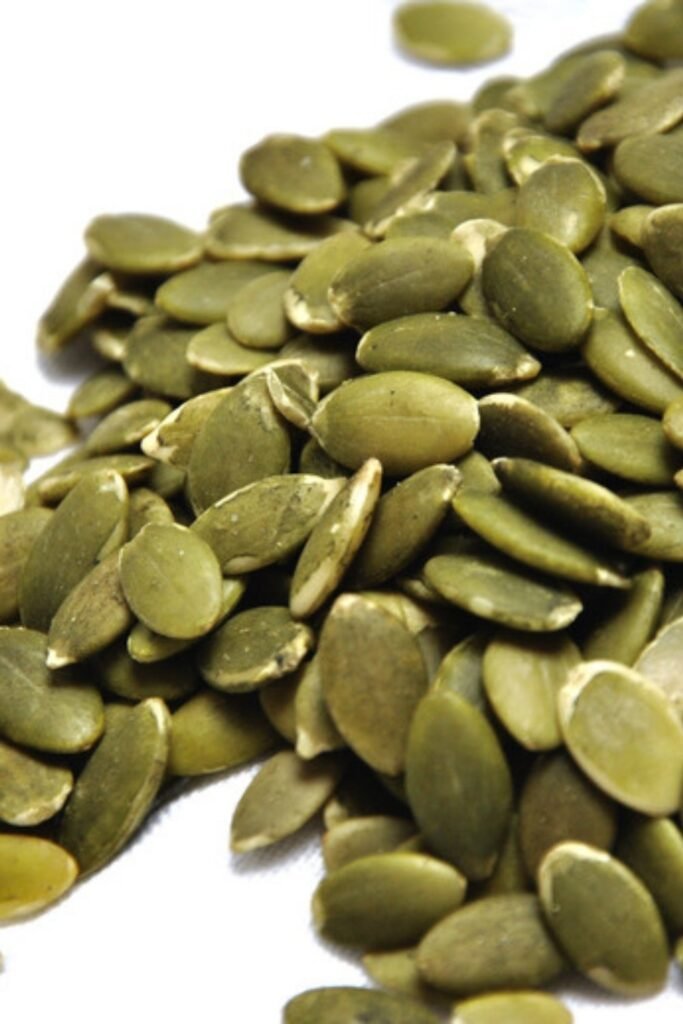
This is where I did the math, using USDA FoodData Central values. Pinterest graphics love to call sesame a “calcium powerhouse.” Per 100 grams it is. But a tablespoon of whole sesame seeds weighs about 9 grams, which works out to roughly 88 mg of calcium. That’s about 9% of the 1,000 mg most women aged 19–50 need, and about 7% of the 1,200 mg recommended after 50. It’s nice, but it isn’t a calcium plan.
What do the seeds actually add to your day?
I worked these out from USDA data per 100 grams, scaled to a level tablespoon (ground flax about 7 g, pumpkin seed kernels about 8 g, sesame about 9 g, sunflower kernels about 9 g). The percentages use the adult women’s RDAs: 320 mg magnesium (age 31+), 8 mg zinc, 15 mg vitamin E. Values are rounded.
| 1 tablespoon | Calories | Magnesium | Zinc | Standout nutrient |
|---|---|---|---|---|
| Ground flaxseed | 37 | 27 mg | 0.3 mg | 1.9 g fiber, 1.6 g plant omega-3 (ALA) |
| Pumpkin seeds | 45 | 47 mg | 0.6 mg | 2.4 g protein, 0.7 mg iron |
| Sesame seeds | 52 | 32 mg | 0.7 mg | 88 mg calcium, 1.3 mg iron |
| Sunflower seeds | 51 | 28 mg | 0.4 mg | 3.1 mg vitamin E, 4.6 mcg selenium |
Put each pair together and here’s what a seed-cycling day gives you:
- Follicular day (flax + pumpkin): about 82 calories, 74 mg magnesium (around 23% of your daily need) and 0.9 mg zinc (around 11%).
- Luteal day (sesame + sunflower): about 103 calories, 60 mg magnesium (around 19%), 1.1 mg zinc (around 14%) and 3.1 mg vitamin E (around 21%).
- Across a 28-day cycle: about 2,600 extra calories in total.
Two things stand out. First, the “zinc for progesterone” pumpkin seeds give you less than a tenth of your daily zinc per spoon. If low zinc is a real concern for you, seeds alone won’t fix it. Second, that 2,600 calories is more than a full day’s worth of food for many women, added every month. That’s fine if you swap the seeds in (for croutons, granola or a second slice of toast). If you’re working on weight and just add them on top, it can quietly slow you down.
The real win is magnesium. Many US adults fall short of it, and a pumpkin-seed day covers almost a quarter of it. My hormone balancing food list has more foods that pull their weight like this.
How to do seed cycling (if you want to try it)
Seed cycling is low-risk for most people. If the ritual helps you eat more seeds and pay attention to your cycle, that alone has value. Here’s how to do it well:
- Buy raw or dry-roasted, unsalted seeds. Avoid honey-roasted or heavily salted mixes, since the sugar and sodium add up over a month.
- Grind your flax. Grind a week’s worth at a time and keep it in a sealed jar in the fridge. The oils in ground flax go stale faster than whole seeds. Don’t eat raw or unripe flaxseed; the US National Center for Complementary and Integrative Health warns it may contain potentially toxic compounds.
- Start with half portions. Two tablespoons of seeds is a lot of fiber if you’re not used to it. Start with half a tablespoon of each for the first week and drink extra water.
- Put them where you already eat. Stir into yogurt or oats, blend into a smoothie, sprinkle on salads and soups, or mix into energy balls. Sesame works well as tahini, too: about 2 teaspoons of tahini weighs roughly the same as 1 tablespoon of seeds.
- Track your cycle and symptoms. Without tracking you won’t know if anything changed. Note cycle length, PMS symptoms, bloating and sleep.
How long should you seed cycle?
Most seed cycling guides tell you to give it three to four months, and you’ll see that number repeated everywhere. It’s not based on a dose-finding study. That said, it lines up with the research that does exist: the 1993 flax trial measured results over three cycles, and the 2023 PCOS trial ran for 12 weeks.
So a fair test looks like this: three full cycles, tracked. If your cycle length, PMS or energy hasn’t changed by then, the timing isn’t doing anything for you. Keep the seeds if you enjoy them, and drop the chart.
Seed cycling for menopause and irregular cycles: does the moon method make sense?
If you’re in perimenopause, past menopause, on hormonal birth control or have very irregular periods, you’ll see advice to follow the moon instead: flax and pumpkin from new moon to full moon, sesame and sunflower from full moon to new moon.
There’s no evidence that the moon sets your hormone levels, and none of the trials above used it. After menopause there’s no follicular or luteal phase to “support,” and on combined birth control your natural cycle is paused. The moon method just gives you a calendar to follow. That’s useful if it helps you stay consistent, but that’s all it does.
What I’d suggest instead: eat a tablespoon or two of mixed seeds every day, with ground flax as the base. Flax lignans are the one part with human data behind them. For hot flashes, sleep and the menopause belly, the bigger levers are protein at each meal, strength training and fiber. My perimenopause belly fat diet and printable menopause meal plan lay those out day by day.
Track what actually changes
Whether you try seeds or anything else, writing down your symptoms is how you find out what works. My 28-Day Menopause Reset Journal ($5) gives you a daily page for hot flashes, sleep, mood, food and energy, so after four weeks you have patterns instead of guesses.
What are the side effects of seed cycling?
For most people the side effects are digestive and mild, but a few groups should be careful.
- Bloating, gas or looser stools. NCCIH notes that higher doses of flaxseed can cause bloating, fullness and diarrhea. Starting with half portions usually prevents this.
- Sesame allergy. Sesame became the ninth major food allergen in the US in 2023. If you’ve ever reacted to tahini, hummus or sesame bagels, skip it and use a double portion of sunflower seeds instead.
- Blood thinners. NCCIH says there are theoretical reasons flaxseed might interact with anticoagulant or antiplatelet drugs. Check with your doctor or pharmacist first.
- Thyroid medication. If you take levothyroxine, keep high-fiber foods like ground flax a few hours away from your dose, since fiber can interfere with how well it’s absorbed. Your pharmacist can give you the exact timing for your tablet.
- Pregnancy. NCCIH describes flaxseed in pregnancy as “possibly unsafe,” based on inconclusive evidence. Talk to your doctor before you start.
- Hormone-sensitive conditions. If you’ve had a hormone-sensitive cancer or are being treated for one, ask your oncology team before adding concentrated lignan sources.
On a GLP-1 medication? Seeds are calorie-dense and high in fat and fiber, so they can sit heavy when your stomach empties more slowly. Start with a teaspoon of each and take them with a meal, not on an empty stomach. They’re a good way to sneak in fiber and a little protein when your appetite is small. My high-fiber diet for GLP-1 users shows how to build up fiber without making nausea worse, and the GLP-1 Kickstart Kit ($27) gives you ready-made meal plans sized for a smaller appetite.
When seed cycling isn’t the answer
I want to be direct about this, because Pinterest often presents seed cycling as a fix for hormone problems. See a doctor instead of (or as well as) trying seeds if you have:
- No period for three months or more when you’re not pregnant, breastfeeding or past menopause
- Very heavy bleeding (soaking a pad or tampon every hour or two) or bleeding between periods
- Any bleeding after menopause
- Signs of PCOS: irregular cycles plus acne, excess hair growth or trouble with weight
- PMS that disrupts your work or relationships, which may be PMDD and is very treatable
- Trouble getting pregnant after 12 months of trying (or 6 months if you’re 35 or older)
Seeds can sit alongside proper care. They shouldn’t replace it.
My take
Seed cycling is a good habit wrapped in a story the science hasn’t caught up with. The seeds themselves are worth eating: magnesium, fiber, plant omega-3s, vitamin E and lignans. The small studies we have point in a hopeful direction, especially for flax. But the part that makes seed cycling seed cycling, switching pairs at ovulation, has never been tested.
If you enjoy the chart, use it. If you find it fussy, put all four seeds in one jar and eat a heaping tablespoon or two a day. Based on what we know today, you’re not missing anything proven.
Seed cycling FAQs
Can I eat all four seeds every day instead of cycling them?
Yes. No study has shown that rotating the seeds works better than eating them together, and the best-known flaxseed trial gave flax every day of the cycle. A daily mix of about 1 tablespoon ground flax plus 1 tablespoon of the other seeds is a simple alternative.
What is the recommended dosage for seed cycling?
The standard protocol is 1 tablespoon of each seed in the pair per day, so 2 tablespoons total. That amount comes from tradition, not dosing studies. Start with half portions if you’re new to high-fiber foods.
Do the seeds have to be raw?
Raw or dry-roasted are both fine for pumpkin, sesame and sunflower seeds. Flax should be ground, and you shouldn’t eat raw or unripe flaxseed. Choose unsalted versions without added sugar.
Can seed cycling help me get pregnant?
There’s no evidence that seed cycling improves fertility. One small 1993 study found daily flax was linked to fewer cycles without ovulation, but it didn’t measure pregnancy. If you’ve been trying for a year (or six months if you’re 35 or older), see a doctor.
Can I seed cycle on birth control?
You can eat the seeds, but on combined hormonal birth control your natural cycle is paused, so there’s no follicular or luteal phase to match. Eating a daily seed mix makes more sense than following a chart.
Can seed cycling cause weight gain?
It can if you add the seeds on top of what you already eat. The standard protocol adds roughly 80–100 calories a day, or about 2,600 calories per 28-day cycle. Swapping seeds in for other toppings or snacks avoids this.
Can I use tahini or seed butter instead of whole seeds?
Yes. Tahini works for the sesame portion and sunflower seed butter for the sunflower portion. About 2 teaspoons replaces 1 tablespoon of seeds, since nut-style butters are denser. Check the label for added sugar and oils.
