

If you’ve come across the Military Egg Diet, you’ve probably seen bold promises — lose several pounds in just a few days and jump-start your metabolism.
And I understand the appeal. When progress feels slow, a strict 3-day plan can seem like the solution.
When calories drop very low, the scale often moves quickly — largely due to water loss and glycogen depletion, not just body fat. That doesn’t mean the diet “doesn’t work,” but it does mean the results need context.
In this guide, we’ll look at how the Military Egg Diet actually works, what kind of fat loss is realistic, whether the 4-day phase protects your metabolism, and what a more sustainable approach looks like.
The goal isn’t to hype or criticize the diet — it’s to help you understand it clearly so you can make an informed decision.
Contents
- 1 What is the Military Egg Diet?
- 2 What Do You Eat on the Military Egg Diet?
- 3 Why the Military Egg Diet Causes Rapid Weight Loss
- 4 How Much Fat Can You Realistically Lose in 3 Days?
- 5 The 4-Day Phase: Does 1200 Calories Prevent Weight Regain?
- 6 What Happens to Your Metabolism on Very Low Calories?
- 7 Risks and Safety Considerations
- 8 Why Weight Is Often Regained After Crash Diets
- 9 A More Sustainable Alternative for Fat Loss
- 10 Frequently Asked Questions
- 10.1 Can I repeat the Military Egg Diet every week?
- 10.2 Is the Military Egg Diet considered keto?
- 10.3 Can I exercise while following the Military Egg Diet?
- 10.4 Will the Military Egg Diet permanently damage my metabolism?
- 10.5 Is 1200 calories safe for women?
- 10.6 How long does the weight loss from the Military Egg Diet last?
- 10.7 Final Perspective
- 11 Before Starting Hard Diets
- 12 Struggling with unsustainable diets and frustrated by the lack of results?
What is the Military Egg Diet?
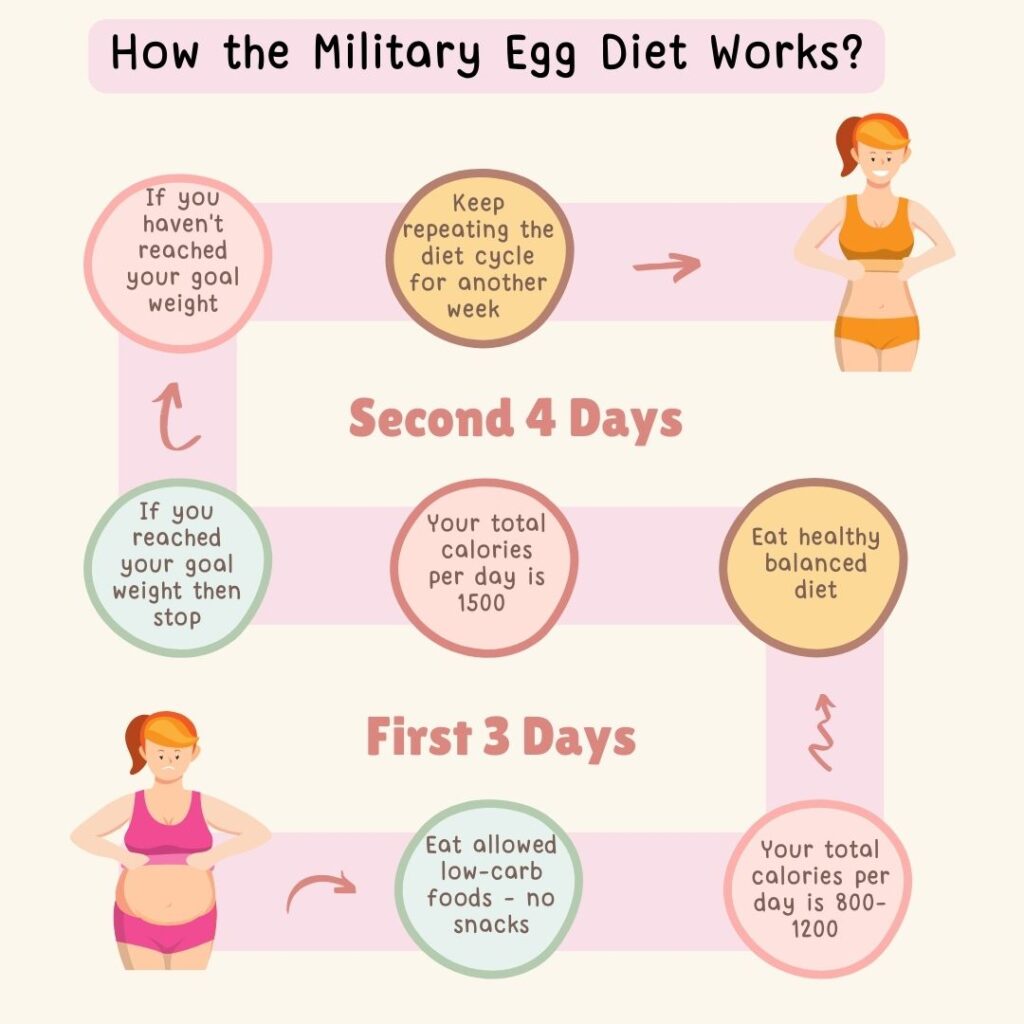
The Military Egg Diet is a short-term, low-calorie eating plan typically followed for three days at a time. It’s often presented as a variation of the popular “Military Diet,” with a stronger emphasis on eggs and other high-protein foods.
Despite the name, it has no official connection to the military.
In fact, there’s no evidence that it was created by or endorsed by any branch of the armed forces. The name likely comes from the idea that the plan is “strict,” “disciplined,” and structured — qualities often associated with military routines. From a marketing perspective, the name simply sounds authoritative.
The structure of the diet is straightforward:
- Three days of strict calorie restriction, usually between 900 and 1,400 calories per day
- Followed by four days of less restrictive eating, often suggested to stay around 1,200–1,500 calories
During the first three days, meals are pre-planned and limited. Eggs are commonly included at one or more meals, along with small portions of lean protein, vegetables, fruit, and sometimes toast or crackers. Snacks are typically discouraged.
The “4 days off” phase is meant to provide more flexibility while still maintaining a calorie deficit. Some versions recommend keeping intake at 1,200 calories during those days, while others simply suggest eating “normally” but avoiding overeating.
At its core, this is a very low-calorie diet cycle that people repeat weekly in hopes of accelerating weight loss.
The appeal is obvious: it feels structured, simple, and time-limited. But understanding how it affects your body requires looking beyond the name and into the physiology behind it.
What Do You Eat on the Military Egg Diet?
The Military Egg Diet follows a fixed, low-calorie meal structure during the 3-day phase.
Meals are pre-planned and portions are limited. Snacks are typically not allowed.
Common foods included are:
- Eggs (often at breakfast, sometimes multiple times per day)
- Lean protein such as tuna, chicken, or small portions of meat
- Small servings of fruit (like grapefruit, apples, or bananas)
- Non-starchy vegetables (such as broccoli, green beans, carrots, or lettuce)
- Limited carbohydrates like toast or crackers in small portions
- Black coffee, tea, or water
During the 4-day phase, the diet suggests eating more “normally,” but often recommends keeping calories around 1,200–1,500 per day to continue weight loss.
Foods Commonly Restricted
The plan significantly limits:
- Processed foods
- High-calorie snacks
- Sugary beverages
- Large portions
- Refined carbohydrates
While it is not strictly low-carb or ketogenic, carbohydrate intake is lower than typical during the 3-day phase due to overall calorie restriction.
Why the Military Egg Diet Causes Rapid Weight Loss
If you follow the Military Egg Diet for three days, the scale will likely drop.
But that rapid change isn’t due to a special fat-burning effect. It’s mainly the result of three physiological responses to sharp calorie restriction.
1. Glycogen Depletion and Water Loss
When you reduce calories — especially carbohydrates — your body uses stored glycogen for energy. Glycogen holds water (about 3–4 grams of water per gram), so as glycogen levels fall, water is lost quickly.
This is why weight can drop fast. When normal eating resumes, some of that water typically returns.
2. Reduced Food and Sodium Intake
The strict phase limits portion sizes, fiber, and sodium. With less food volume in the digestive system and lower sodium intake, scale weight temporarily decreases.
Again, this reflects fluid and digestive changes — not just fat loss.
3. Calorie Deficit
Some fat loss can occur, since intake may drop to 900–1,200 calories per day. But losing one pound of body fat requires roughly a 3,500-calorie deficit.
In three days, most of the weight lost will not be pure fat.
Rapid scale changes can feel motivating. But short-term drops don’t always reflect long-term fat loss.
The more important question is what this level of restriction does to your metabolism, hunger, and energy — which we’ll look at next.
How Much Fat Can You Realistically Lose in 3 Days?
This is the question that really matters: how much actual body fat can you lose in three days?
Losing one pound of body fat requires roughly a 3,500-calorie deficit. If your maintenance intake is around 2,000–2,400 calories and you reduce it to 1,000–1,200, you create a daily deficit of about 800–1,200 calories.
Over three days, that totals approximately 2,400–3,600 calories — enough for at most about 0.5 to 1 pound of fat, under ideal conditions.
So if the scale drops 3, 5, or even 7 pounds, most of that change is not pure fat. It’s largely:
- Water loss
- Glycogen depletion
- Reduced digestive volume
That doesn’t make the progress “fake.” It simply means early weight loss is often misunderstood.
True fat loss is slower. A realistic and sustainable rate is about 0.5–1% of body weight per week.
Understanding this helps set expectations — and prevents discouragement when some weight returns after normal eating resumes.
The next question is what happens metabolically when calories stay very low — and that’s where things become more important.
The 4-Day Phase: Does 1200 Calories Prevent Weight Regain?
One reason the Military Diet feels appealing is the “4 days off” phase, where intake often increases to around 1,200 calories.
The idea is to cycle between restriction and moderate intake to avoid regain. But for most adults, 1,200 calories is still a deficit — not maintenance. True maintenance needs are typically much higher.
So the body often remains in restriction. Weight may continue to drop short term, but hunger and fatigue can increase, raising the risk of later compensation.
Does Calorie Cycling Protect Your Metabolism?
Metabolic adaptation doesn’t reset in a few days. With aggressive calorie cuts, the body conserves energy by:
- Reducing daily movement
- Lowering thyroid activity
- Increasing hunger signals
Slightly higher-calorie days may help temporarily, but they don’t fully reverse these adaptations if intake remains below maintenance.
Why Weight Often Returns
When carbohydrates increase, glycogen and water stores refill, causing a temporary rise on the scale — even without fat gain.
If restriction continues, weight may drop again. But if hunger builds and intake increases significantly, regain becomes more likely.
The typical cycle:
Restrict → Rapid drop → Hunger → Rebound eating → Frustration.

What Happens to Your Metabolism on Very Low Calories?
When calories drop significantly — especially below 1,200 per day — your body doesn’t simply burn more fat.
It adapts.
Metabolism is dynamic. With sharp calorie restriction, the body shifts into energy-conservation mode.
Here’s what that looks like.
Reduced Daily Movement
One of the first changes is a drop in non-exercise activity (NEAT) — the small movements you make throughout the day. You may fidget less, walk less, or generally move less without noticing. This lowers total energy expenditure.
Hormonal Adaptations
Thyroid activity (particularly T3) may decrease during aggressive restriction, slightly reducing metabolic rate. At the same time, hunger hormones like ghrelin rise while leptin declines, increasing appetite.
These are normal survival responses — not signs of a “damaged” metabolism.
Muscle Preservation Matters
If calories and protein are too low — especially without resistance training — some lean tissue may be lost. Because muscle is metabolically active, losing it can slightly reduce daily energy needs.
Lower Energy and Performance
Very low intake often leads to fatigue, reduced workout performance, irritability, and difficulty concentrating. This reflects reduced energy availability, not lack of discipline.
Short-term restriction doesn’t permanently damage metabolism in healthy individuals. But repeated cycles of aggressive dieting and rebound eating can make weight regulation harder over time.
Extreme restriction forces adaptation.
Moderate, structured deficits are easier to sustain — and more protective of metabolic stability.
Risks and Safety Considerations
For a healthy adult, a short 3-day low-calorie phase is unlikely to cause serious harm. The body can tolerate brief periods of reduced intake.
But tolerable is not the same as ideal — especially if the cycle is repeated frequently.
At 900–1,200 calories per day, the body adapts quickly. Hunger increases, energy expenditure decreases, and overall nutrient intake becomes limited. Over time, repeated cycles can raise the risk of:
- Nutrient gaps (particularly fiber, iron, magnesium, B vitamins, and essential fats)
- Constipation and digestive discomfort
- Fatigue and reduced exercise performance
- Increased hunger and rebound overeating
- Potential lean muscle loss without resistance training
Three days alone may not cause major problems. The concern arises when aggressive restriction becomes a recurring strategy.
This approach is not appropriate for:
- Pregnant or breastfeeding women
- Individuals with diabetes or blood sugar instability
- People with kidney or metabolic conditions
- Anyone with a history of disordered eating
- Adolescents or those still growing
- Athletes with high energy demands
Even for healthy adults, the more important question isn’t just whether the diet is safe — but whether it’s necessary.
There’s no strong evidence that extreme short-term restriction produces better long-term fat loss than a moderate, structured calorie deficit. In fact, repeated cycles of aggressive restriction may make appetite regulation and weight maintenance more difficult over time.
Short-term restriction may not be inherently dangerous. But it’s rarely the most effective or sustainable approach to fat loss.
Why Weight Is Often Regained After Crash Diets
If you’ve ever tried a very restrictive diet and then watched the weight come back, you’re not alone.
And it’s not because you lack discipline.
Crash diets create rapid changes in the body — but they also trigger powerful biological responses designed to protect you.
Here’s why weight regain is common.
1. Water Weight Returns Quickly
As we discussed earlier, a large portion of early weight loss on very low-calorie diets comes from glycogen depletion and water loss.
When you begin eating carbohydrates normally again, glycogen stores refill. And since glycogen binds to water, the scale naturally rises.
This can feel discouraging — but it’s a normal physiological response, not fat gain.
2. Hunger Signals Increase After Restriction
Aggressive calorie restriction raises hunger hormones and lowers satiety signals.
After several days of eating very little, your body increases the drive to eat. This is not weakness — it’s biology.
The stronger the restriction, the stronger the rebound appetite tends to be.
For many people, this leads to overeating during “off” days or after the diet ends.
3. Metabolic Rate May Temporarily Decrease
When calories stay very low, the body adapts by reducing energy expenditure.
You may move less without realizing it. Your resting metabolic rate may decrease slightly. Your body becomes more efficient at using energy.
So when normal eating resumes, calorie needs may temporarily be lower than expected — making weight regain easier if intake increases quickly.
4. Muscle Loss Can Reduce Calorie Needs
If protein intake and resistance training aren’t adequate, some muscle mass may be lost during extreme restriction.
Because muscle tissue burns more calories than fat tissue, losing muscle can slightly lower daily energy needs.
Over time, this makes maintaining weight loss more difficult.
5. Psychological Restriction Backfires
Strict diets often create an all-or-nothing mindset:
“I’m on the diet”
or
“I’m off the diet”
When structure disappears, people may swing in the opposite direction — not because they lack willpower, but because restriction builds pressure.
Sustainable fat loss rarely happens through extremes. It happens through consistency.
The Pattern to Watch For
Crash dieting often creates this cycle:
Restrict → Rapid drop → Increased hunger → Regain → Restart
Breaking that cycle usually requires shifting from aggressive short-term restriction to a moderate, structured plan that you can maintain long term.
And that’s what we’ll look at next.
A More Sustainable Alternative for Fat Loss
If your goal is true fat loss — not just a temporary drop on the scale — the approach needs to be consistent, not extreme.
Instead of cycling between aggressive restriction and partial refeeding, a more sustainable strategy focuses on steady progress and metabolic stability.
Here’s what that typically involves:
Create a Moderate Calorie Deficit
A daily deficit of 300–500 calories is usually enough to promote steady fat loss without excessive fatigue or muscle loss. This often leads to about 0.5–1% of body weight per week, which is more maintainable long term.
Prioritize Protein
Aim for adequate protein intake (roughly 1.6–2.2 g/kg body weight in fat-loss phases). This helps preserve muscle mass, control hunger, and support recovery.
Include Resistance Training
Strength training helps maintain lean tissue while losing fat. Preserving muscle supports metabolic rate and long-term weight maintenance.
Maintain Fiber and Food Variety
Vegetables, fruits, and whole foods support digestion, satiety, and nutrient intake. Fat loss should not come at the expense of nutritional adequacy.
Short-term restrictive diets can move the scale quickly.
But sustainable fat loss is built on moderate deficits, adequate protein, structured training, and consistency over time.
Your metabolism doesn’t need extremes — it needs support.
Frequently Asked Questions
Can I repeat the Military Egg Diet every week?
Repeating very low-calorie cycles weekly is not ideal. While short-term restriction may not be harmful for healthy adults, repeated cycles can increase hunger, reduce energy expenditure, and make long-term weight regulation more difficult. A moderate, consistent deficit is usually more sustainable.
Is the Military Egg Diet considered keto?
Not strictly. While it is lower in carbohydrates during the 3-day phase, it does not consistently meet the fat-to-carbohydrate ratio required for a true ketogenic diet. It is better described as a short-term low-calorie plan rather than a structured keto approach.
Can I exercise while following the Military Egg Diet?
Light activity is usually manageable, but high-intensity workouts may feel difficult due to low calorie intake. Energy levels often decrease during aggressive restriction. If performance declines significantly, calorie intake may be too low for your activity level.
Will the Military Egg Diet permanently damage my metabolism?
Short-term restriction does not permanently “damage” metabolism in healthy individuals. However, repeated extreme dieting combined with frequent weight regain can make appetite regulation and weight maintenance more challenging over time.
Is 1200 calories safe for women?
For many women, 1,200 calories is still below maintenance needs and represents a calorie deficit. While some may tolerate it short term, it may be too low for active individuals, taller women, or those with higher muscle mass. Individual energy needs vary.
How long does the weight loss from the Military Egg Diet last?
Initial weight loss often includes water and glycogen depletion. If normal eating resumes without structure, some of that weight commonly returns. Long-term results depend on what happens after the diet ends, not just the three-day phase.
Final Perspective
The Military Egg Diet is structured and can produce quick scale changes.
But rapid weight loss isn’t the same as sustainable fat loss.
Most early results come from water loss and aggressive calorie restriction — not a unique metabolic effect. While short-term restriction may be tolerated by healthy adults, repeating extreme cycles rarely leads to lasting progress.
Your body adapts to severe calorie cuts. Hunger rises, energy drops, and weight often returns when normal eating resumes.
Sustainable fat loss doesn’t require extremes. It requires a moderate calorie deficit, adequate protein, resistance training, and a structure you can maintain long-term.
Consistency will outperform intensity every time.
