

Ozempic and Wegovy get compared constantly, and for good reason — they’re often confused for the same medication. Both contain semaglutide, made by Novo Nordisk, and both work by mimicking GLP-1, a hormone that affects appetite and blood sugar. But they’re approved for different purposes and typically prescribed at different doses, which changes what to expect from each.
This guide breaks down how they actually work, what people commonly experience, where they meaningfully differ, and how to think about choosing between them safely — without the hype.
How Ozempic and Wegovy Actually Work
Both medications help your body feel full sooner, stay full longer, and support more stable blood sugar — for many people, this makes eating feel less like a constant struggle.
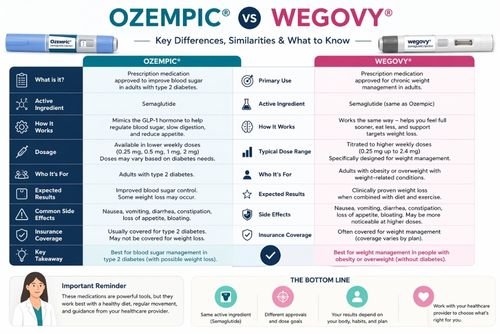
The real difference is approval and dosing. Ozempic is FDA-approved for type 2 diabetes and is typically used at lower doses (up to 2 mg weekly). Wegovy is FDA-approved specifically for weight management and reaches higher doses over time (up to 2.4 mg weekly). Because Ozempic isn’t officially approved for weight loss, any weight-loss use of it is off-label — common in practice, but worth knowing when discussing options with your doctor.
The higher maximum dose is largely why clinical trials show somewhat greater average weight loss with Wegovy (around 15% of body weight over about a year) compared to Ozempic’s off-label results (commonly cited around 10–12%). But the right choice depends on your specific health situation and how your body responds — not just which number is bigger.
Why One Can Feel Different From the Other
Some people notice a real difference switching between the two, even with the same active ingredient — this usually comes down to dose. At Ozempic’s typically lower doses, appetite changes tend to feel more gradual. At Wegovy’s higher doses, especially early on, the fullness effect can feel stronger and more noticeable.
People switching from Ozempic to Wegovy often describe getting full faster than expected or needing time to adjust to a stronger “full” signal. Others switching the other direction describe things feeling more relaxed. Feeling different isn’t a sign something’s wrong — it usually just reflects the dose change. Because everyone adjusts differently, any switch between the two should happen with your provider’s guidance, not on your own.
What Appetite Changes Feel Like
Many people describe food becoming “quieter” — smaller portions feel satisfying, meal-to-meal thinking about food decreases, and cravings feel more manageable.
At Ozempic’s typically lower doses, the shift tends to be gradual: skipping snacks without trying, feeling satisfied with simpler meals, still enjoying food in smaller amounts.
At Wegovy’s higher doses, the effect can feel stronger, especially at first: getting full very quickly, needing to be more intentional about portions, less interest in heavy or rich foods. This can feel intense early on but often becomes more balanced as the body adjusts.
There’s no “normal” timeline — some people notice changes within days, others over weeks. Think of either medication as a tool that supports your body’s signals, not a replacement for listening to them. For food ideas that work well alongside either, see what to eat while taking Ozempic.
Side Effects: What to Expect When Starting
Most people don’t feel dramatically sick, but the body does feel different at first. Common early experiences: mild nausea (especially after eating), getting full much faster than expected, a heavier or slower-feeling stomach, and sometimes mild bloating or constipation.
If you’re on Wegovy, especially as the dose increases, fullness and early nausea often feel stronger. If you’re on Ozempic, especially at lower doses, the adjustment tends to feel more gradual. Your specific experience won’t match anyone else’s exactly, and that’s normal.
What tends to help: eating smaller portions without forcing it, avoiding heavy meals early on, and giving your body time to adjust rather than pushing through. If something feels too intense or doesn’t improve, that’s a reason to check in with your provider — not to tough it out. For rarer but more serious risks, see our guide on whether Ozempic can cause pancreatitis.
Protecting Muscle Mass on Either Medication
A real concern with any GLP-1 medication is that some of the weight lost comes from lean muscle, not just fat — research on GLP-1-related weight loss has found this varies significantly by individual and by how much protein and resistance training are part of the picture. This matters regardless of which medication you’re on.
What generally helps preserve muscle:
- Adequate protein intake — many clinicians recommend roughly 1.2–1.6g per kg of body weight daily during active weight loss, spread across meals
- Resistance training 2–4 times weekly, even at a light-to-moderate intensity
- Not losing weight faster than your body and provider are comfortable with
For a fuller breakdown of side effects specific to Ozempic, see our 14 Ozempic side effects guide.
Frequently Asked Questions
Can kids or teens use Ozempic or Wegovy?
Wegovy has FDA approval for ages 12 and up with a BMI at or above the 95th percentile for age (or the 85th percentile with a weight-related health condition). Ozempic remains approved for adult diabetes management; off-label use in youth would need to be discussed carefully with a pediatric provider given the more limited data.
How do I switch from Ozempic to Wegovy safely?
This should be managed by your provider, who can guide the transition and dose based on your response — self-managing a switch isn’t recommended given how much dose affects the experience.
Is either safe during pregnancy or while trying to conceive?
No — both are generally recommended to be stopped at least 2 months before a planned pregnancy, since effects on fetal development aren’t established. Talk to your doctor about safe alternatives if you’re trying to conceive.
Can I travel with injection pens?
Both can typically be kept at room temperature for a limited window (check your specific product’s guidance, generally up to about 4 weeks) if refrigeration isn’t available, which makes travel manageable — refrigeration is still preferred when possible. Airlines generally allow prescription medications in carry-on bags; bring your prescription documentation.
Does insurance cover Wegovy more than Ozempic?
Coverage patterns differ: Ozempic is more consistently covered when prescribed for its approved use (diabetes), while Wegovy often requires prior authorization demonstrating BMI and health criteria for weight-loss coverage. Coverage varies significantly by plan — check directly with your insurer.
Conclusion
🥗 Ozempic or Wegovy — Either Way, You Still Need a Meal Plan
Whichever one you and your doctor land on, the food side of things barely changes — smaller portions, more protein, and meals that won’t fight the nausea. The GLP-1 Kickstart Kit is a full 28-day meal plan built for people on either medication, so you’re not guessing what to eat while you and your doctor figure out which one works best for you.
Get the GLP-1 Kickstart Kit — $27 →Ozempic and Wegovy share the same active ingredient but serve different approved purposes and are typically dosed differently — Ozempic for diabetes management at lower doses, Wegovy for weight management at higher doses with correspondingly stronger average results. Neither is inherently “better” outside the context of your own health history, goals, and how your body responds. Whichever you and your doctor decide fits your situation, combining it with adequate protein, movement, sleep, and realistic expectations makes the biggest difference in how the experience goes and how well results hold up over time.