
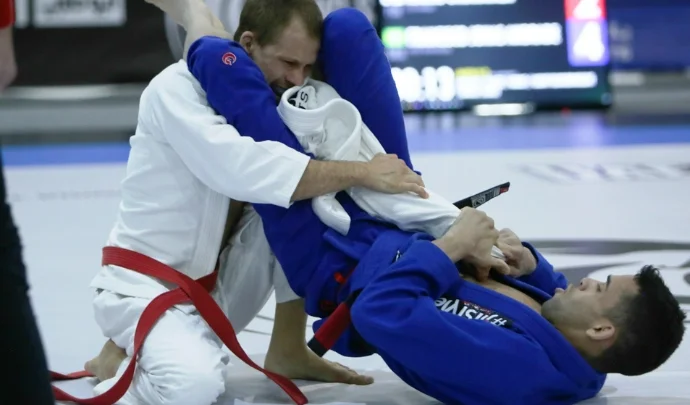
A researcher strapped heart rate monitors to Brazilian jiu-jitsu practitioners for a full training session and found something most people would not guess: across 62 minutes, average heart rate sat at 134 bpm — about 69% of maximum. That is moderate. It is roughly what a decent uphill walk does to you.
Then the rolling starts, and the picture changes. During the live sparring phase the average climbed to 151 bpm, and peaks hit 189 — 96% of maximum. Same session, same person, two completely different demands on your heart.
That split is the whole story if you have a heart condition and you are wondering whether you can train. The answer is not yes or no. It is: which part of the class, and in what order.
Check out our latest posts:
- Anti-Inflammatory Diet for Joint Pain: 15 Foods That Help (and 7 That Make It Worse)
- Fibermaxxing Diet Guide: High-Fiber Foods List, 7-Day Plan & How to Start Without Bloating
- Cortisol Belly: How to Get Rid of Stress-Related Belly Fat Without Another Crash Diet
- 7 Best Protein Shakes for GLP-1: 7 Easy Options for Better Nutrition, Strength, and Energy
- Zepbound Constipation Relief: A Pharmacist’s Guide to Restoring Your Gut Flow
What a BJJ Session Actually Does to Your Heart Rate
Researchers monitoring a standard BJJ training session broke it into its three parts, and the numbers make the structure of a class visible in a way that watching one does not.
| Phase | Duration | Mean heart rate | Peak |
|---|---|---|---|
| Warm-up | 12 min | 119 bpm (63% HRmax) | 157 bpm (80%) |
| Technical drilling | 21 min | 119 bpm (63% HRmax) | 149 bpm (76%) |
| Live rolling | 29 min | 151 bpm (81% HRmax) | 189 bpm (96%) |
| Whole session | 62 min | 134 bpm (69% HRmax) | 189 bpm (96%) |
The researchers concluded the session as a whole carries a moderate cardiovascular demand — enough to build aerobic fitness in a general population, and consistent with mainstream exercise guidelines. But they added a specific caution, and it is the most useful sentence in the paper: they recommended cardiovascular screening for new students before they take part in the combat phase.
That is the honest version of “is BJJ good for your heart”. The warm-up and drilling are moderate exercise. Rolling is near-maximal interval work, and it arrives with no warning — one bad scramble and you are at 96% of your maximum heart rate while someone is trying to pass your guard.
Why Cardiac Patients Avoid BJJ — and Why “Rest” Is the Wrong Instinct
Get a diagnosis and the instinct is to stop moving. It feels responsible. It is also, for most people, the opposite of what the evidence supports.
Structured exercise after a cardiac event is not an optional extra — it is a formal treatment called cardiac rehabilitation, and the outcomes attached to it are substantial. Cleveland Clinic reports that cardiac rehab can add up to five years to life expectancy, cut cardiovascular death risk by 58%, lower heart attack risk by 30%, reduce stroke risk by 60%, and reduce depression symptoms by 63%. Most insurance and Medicare cover a 12-week programme of 36 supervised sessions.
It runs in three phases: supervised sessions beginning in hospital, then outpatient sessions at a medical centre, then independent exercise you maintain yourself. That third phase is where a sport like BJJ can enter the conversation — after the supervised work, not instead of it.
So the sequence is not “rest, then hope”. It is: get assessed, do the supervised programme, and then talk to your cardiologist about what you want to go back to. Plenty of people return to demanding sport. The route there runs through the clinic.
BJJ Training Benefits Worth the Name
Below is what training regularly plausibly does for you, separated carefully from what gets claimed for it. I have cut several claims that used to sit on this page — that martial arts improves “all chronic health issues”, that you will approach your ideal BMI within three months, that people who practise martial arts have very low rates of heart disease. None of those were supported, and vague promises help nobody make a decision.
It Is Aerobic Exercise You Will Actually Turn Up For
This is the underrated one. The American Heart Association asks adults for 150 minutes of moderate aerobic activity a week, or 75 minutes of vigorous, plus muscle-strengthening work on at least two days. Two BJJ classes gets you most of the way there.
The reason that matters is adherence. Treadmills get abandoned. Training partners who notice you missing for two weeks do not let you abandon anything. The best cardiovascular exercise is the one you keep doing on a wet Tuesday in February, and a sport with people in it beats a machine on that measure almost every time.
It Helps With Weight — Through Effort, Not Magic
An hour of grappling is real work, and carrying less weight reduces the load on your heart. But no training session outruns a poorly planned diet, and BJJ is unusually good at making people ravenous afterwards.
The people who see body composition change are the ones who train consistently and pay attention to what they eat. If you want the eating side handled properly, my heart healthy diet guide covers the pattern that matters for cardiovascular risk, and the foods that lower cholesterol piece gets specific about what to put on the plate.
Regular Exercise Improves Cholesterol and Blood Sugar
This is a well-established effect of regular physical activity in general rather than something special about jiu-jitsu, and it is worth stating that way round. Regular aerobic exercise is part of standard advice for improving blood lipids and glucose control, and BJJ qualifies as regular aerobic exercise.
What training will not do is replace medication or make a diagnosis go away. Keep taking what you are prescribed, keep the follow-up appointments, and treat the training as one input among several. If blood sugar is your concern, my insulin resistance diet guide covers the food side of that.
It Is Genuinely Good for Stress
Here is the mechanism, and it is more interesting than “exercise releases endorphins”. Rolling demands total attention. You cannot rehearse an argument with your boss while someone is setting up an armbar — the sport forcibly evicts everything else from your head for an hour.
For a lot of people that hour is the only genuinely uninterrupted part of the week, and the effect afterwards is closer to the aftermath of meditation than to a workout. Cardiac rehabilitation programmes include emotional support for exactly this reason: the psychological side of a heart diagnosis is part of the condition, not separate from it. If stress and cortisol are where your problems show up, I have written about cortisol belly and stress-related weight in more detail.
It Builds Strength and Mobility Without a Gym
Grappling is isometric strength work under load, plus hip mobility, plus the specific skill of getting off the floor repeatedly — which turns out to matter enormously as people age. That covers the AHA’s two-days-a-week muscle-strengthening recommendation without you touching a dumbbell.
If you want a structured plan around your classes, my walkthrough on how to make a workout plan for a woman shows how to fit training days, recovery and strength work into one week without over-reaching.
🥋 Track the sessions, not just the stripes
If you are easing back into training after a diagnosis, a written record is worth more than memory — how many rounds you did, how you felt, what your recovery looked like. My 4-Week Fitness Tracker gives you a printable page per week, and it is the thing to bring to your next appointment.
How to Start BJJ If You Have a Heart Condition
This is the practical section, and every step of it assumes you have your cardiologist’s agreement first.
- Get cleared, specifically. Not “is exercise okay” but “is near-maximal effort okay, and what heart rate should I stay under”. The BJJ study itself recommends cardiovascular screening before new students spar — you are asking for exactly what the researchers suggest.
- Finish cardiac rehab first if it is offered. Twelve weeks of supervised exercise tells you and your medical team far more about what your heart tolerates than any gym trial will.
- Tell the coach before your first class. Not during. A good coach will pair you with sensible partners and keep you out of the wrong rounds; a coach who shrugs at this information is telling you something about the gym.
- Start with fundamentals classes only. Warm-up and drilling sat at 63% of maximum heart rate in the study — moderate, predictable, and the part where you learn everything anyway.
- Add positional rolling before free rolling. Starting from a set position, with a defined goal and a short round, keeps the intensity spikes far smaller than an open scramble.
- Tap early and often. Ego costs beginners their shoulders and their knees. Tapping is how you get to train again on Thursday.
- Wear a heart rate monitor. If your cardiologist gave you a ceiling, this is the only way to know whether you are respecting it. It also shows you which rounds are actually hard.
- Stop for the obvious signals. Chest pain, unusual breathlessness, dizziness, palpitations — you stop, you sit down, you get it checked. No round is worth finishing.
The gear question is straightforward: a gi, a belt, and a rash guard for no-gi classes. BJJ gear is inexpensive relative to most sports, and most gyms will lend you a gi for the first few sessions so you can find out whether you like it before spending anything.
Mistakes That Send People Back to the Doctor
- Treating “I feel fine” as clearance. Feeling fine is not the same as being assessed. The assessment exists precisely because symptoms are unreliable.
- Going straight into open mat. Open mat is unstructured rolling with whoever turns up. It is the highest-intensity, least predictable session in the week and the worst possible entry point.
- Rolling with the wrong partners. A newer, larger, more competitive training partner is where beginners get hurt. Ask the coach who to roll with, and take the answer seriously.
- Training through a chest symptom. Grappling makes it easy to explain away breathlessness and pressure. Do not explain them away.
- Skipping the warm-up. Arriving late and joining at the drilling stage removes the exact 12 minutes designed to raise your heart rate gradually.
- Ignoring sleep and recovery. Two hard sessions and five bad nights is not a training plan. Recovery is where the adaptation happens.
Frequently Asked Questions
Is BJJ safe after a heart attack?
That is a question only your cardiologist can answer, and the answer depends on what happened, what was done about it, and how you responded to cardiac rehab. Many people return to demanding sport afterwards — through a supervised programme first, not by turning up at a gym and hoping.
How hard is a BJJ class, really?
Moderate on average, near-maximal in bursts. Mean heart rate across a full session was 134 bpm (69% of maximum), but rolling averaged 151 bpm and peaked at 189 bpm (96%). The averages hide the spikes, which is exactly why the phase you join matters.
Can I do BJJ if I only want the fitness, not the competition?
Yes, and most people in any gym are doing exactly that. Fundamentals classes and positional drilling will keep you in the moderate range indefinitely if that is what you want.
Is BJJ better than running for heart health?
Neither is better in the abstract. Running is easier to dose precisely, which matters a lot if you have a heart rate ceiling. BJJ is easier to keep doing for years. Pick the one you will still be doing in a year, and dose it appropriately.
What age is too old to start?
People start in their fifties and sixties routinely. Age is far less relevant than training history, existing conditions and picking a gym that runs a proper fundamentals programme.
Bottom Line
BJJ is moderate cardiovascular exercise wrapped around short bursts of near-maximal effort — and that combination is either well suited to you or genuinely risky, depending on a conversation you have not had yet.
If you have any diagnosed heart condition, high blood pressure, or a family history of cardiac problems, get cleared by your doctor before your first class, and ask specifically about sparring rather than about “exercise” in general. Do cardiac rehab if it is offered to you. Then start with fundamentals, tell your coach, tap early, and let the intensity climb over months rather than weeks.
The sport will still be there in six months. So, with any luck, will you.
References
- Heart rate behaviour during a Brazilian jiu-jitsu training session — study PDF
- Cleveland Clinic — Cardiac Rehab: Phases & Exercises To Help Your Heart
- American Heart Association — Recommendations for Physical Activity in Adults
- Elite Sports — Brazilian jiu-jitsu articles
