

Many people discover ketogenic diets because they want fast fat loss, better blood sugar control, or relief from constant hunger. For some, keto works well—at least in the beginning. For others, energy drops, workouts suffer, or weight loss stalls once the initial water weight is gone. That’s often when terms like keto cycling or cyclical ketogenic diet start appearing as possible solutions.
As a nutritionist, I see a lot of confusion around these approaches—especially when keto cycling is compared to carb cycling. On the surface, they sound similar. Both involve changing carbohydrate intake across the week. But metabolically and practically, they are not the same thing, and misunderstanding that difference can lead to frustration, stalled progress, or unrealistic expectations.
Another common concern I hear is about weight fluctuations. Keto is built on sustained very low carbohydrate intake, which depletes glycogen and reduces water weight. When carbohydrates are reintroduced—even strategically—glycogen and water return. This is normal physiology, not fat gain, but it can feel discouraging if it’s not clearly explained from the start.
This article is not written to promote keto cycling or to discourage it. Instead, the goal is to give you the full picture:
- What a keto cycle diet actually is
- How it differs from general carb cycling
- Who may benefit from each approach
- And who may be better served by a different strategy altogether
Rather than focusing on trends or promises, we’ll look at how these diets work in real bodies, how they affect energy, performance, fat loss, and scale weight—and how to choose an approach that aligns with your health goals, lifestyle, and long-term sustainability.
Contents
- 1 What Is a Keto Cycle Diet Plan and How It Works
- 2 What a Keto Cycle Diet Plan Typically Looks Like
- 3 Keto Cycling vs Carb Cycling: A Metabolic Difference, Not a Marketing One
- 4 What Happens to Weight, Glycogen, and Water
- 5 Who Keto Cycling Is Often Not Appropriate For
- 5.1 If You’re New to Keto or Low-Carb Diets
- 5.2 If Scale Weight Strongly Affects Your Motivation or Mood
- 5.3 If You Have a History of Disordered Eating or Dieting Burnout
- 5.4 If You’re Managing Blood Sugar or Hormonal Conditions
- 5.5 If You Don’t Actually Need to Be in Ketosis
- 5.6 If You’re Looking for Fast, Predictable Scale Results
- 5.7 My Perspective as a Nutritionist
- 6 Who Keto Cycling May Be Appropriate For
- 7 Final Thoughts
What Is a Keto Cycle Diet Plan and How It Works
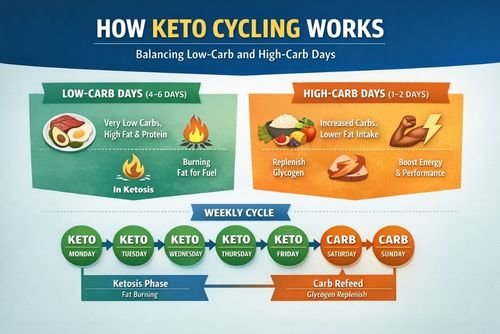
If you’ve tried keto and felt burned out, low on energy, or stuck, you’re not alone. A keto cycle diet plan is designed to make the ketogenic lifestyle more flexible while still supporting weight loss and metabolic health.
Instead of staying low-carb every day, this approach rotates between low-carb days and planned high-carb days to better support energy, workouts, and long-term adherence.
What a Keto Cycle Diet Plan Typically Looks Like
While there’s no single way to structure a keto cycle diet plan, most follow a similar weekly pattern. The aim is to spend the majority of the week in ketosis while using short, planned periods of higher carbohydrate intake.
A Common Weekly Structure
In practice, many keto cycling approaches use:
- 4–6 consecutive low-carbohydrate (ketogenic) days
- 1–2 planned higher-carbohydrate days
This balance allows time for ketosis and fat adaptation while periodically restoring glycogen.
Low-Carb (Ketogenic) Days
On low-carb days:
- Carbohydrate intake is kept very low
- Meals focus on whole foods, healthy fats, and adequate protein
- The body relies primarily on fat and ketones for fuel
These days form the foundation of the keto cycling approach.
Higher-Carb (Refeed) Days
Higher-carb days are planned and controlled:
- Carbohydrates are increased to replenish glycogen
- Fat intake is usually reduced compared to keto days
- Carbohydrate sources are typically whole, fiber-rich foods
These days may support training performance, recovery, and adherence.
How It Differs From a Strict Keto Diet
A strict keto diet keeps carbs extremely low at all times. While effective short term, it can affect energy levels and sustainability for some people. Keto cycling allows more flexibility and may reduce issues like keto flu and burnout.
What Happens on Low-Carb Days
On low-carbohydrate days, your body enters a fat-burning metabolic state. It relies more on dietary fats and fatty acids, often leading to reduced appetite and improved focus.
Why High-Carb Days Are Included
High-carb days are planned—not cheat days. Increasing grams of carbs from whole foods like sweet potatoes and whole grains helps restore glycogen, support workouts, and protect muscle mass.
Keto Cycling vs Carb Cycling: A Metabolic Difference, Not a Marketing One
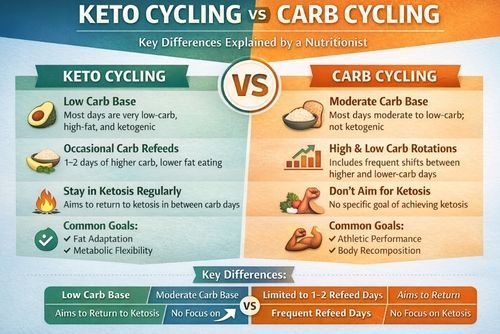
Keto cycling and carb cycling are often grouped together or even used interchangeably online. From a nutrition science perspective, that’s misleading. While both approaches involve varying carbohydrate intake, they are built on different metabolic assumptions, and they place very different demands on the body.
Understanding this distinction is essential before deciding whether either approach makes sense for you.
Carb Cycling: Managing Fuel, Not Ketosis
Carb cycling is a broad dietary strategy commonly used in sports nutrition and body recomposition. The primary goal is to match carbohydrate intake to activity level, training demands, and calorie needs—not to induce or maintain ketosis.
In carb cycling:
- Carbohydrate intake increases on training or high-intensity days
- Carbohydrate intake decreases on rest or low-activity days
- Fat intake adjusts inversely, but ketosis is not required
Most people following carb cycling remain primarily glucose-adapted. Glycogen stores are regularly replenished, insulin is expected to rise on higher-carb days, and water weight fluctuates within a relatively stable range. This approach is often used by:
- Athletes
- Physically active individuals
- People prioritizing performance, muscle gain, or flexibility
From a metabolic standpoint, carb cycling works within the body’s normal glucose-based energy system.
Keto Cycling: Periodic Exit From a Ketogenic State
Keto cycling—also known as the cyclical ketogenic diet—is fundamentally different. It is designed for those who spend most of their time in ketosis and then intentionally exit that state for short, planned periods.
In keto cycling:
- Multiple consecutive days are spent at true ketogenic carb levels (typically under 30–50 g per day)
- 1-2 days include significantly higher carbohydrate intake
- The expectation is a return to ketosis shortly after the high-carb phase
This approach assumes you are already fat-adapted, meaning your body efficiently uses fat and ketones as primary fuel. Without this adaptation, frequent carb refeeds can delay ketosis, increase fatigue, and reduce the intended benefits of the ketogenic phase.
Metabolically, keto cycling asks the body to switch between two distinct fuel states—ketone-dominant and glucose-dominant—on a repeating schedule. That transition is not seamless for everyone.
The Critical Difference Most People Miss
The key distinction is not how often carbs change, but whether ketosis is the foundation of the diet.
- Carb cycling adjusts carbohydrates around activity while remaining glucose-based
- Keto cycling temporarily disrupts ketosis and relies on the body’s ability to re-enter it efficiently
This difference matters because it affects:
- Energy levels during transitions
- Hormonal responses to carbohydrates
- How long it takes to return to fat-burning mode
- How much water weight fluctuates week to week
Keto cycling is not simply “a more flexible keto diet,” and carb cycling is not “lazy keto.” They are different tools designed for different metabolic contexts.
Why This Distinction Matters for Real-World Results
When people confuse keto cycling with carb cycling, expectations often don’t match outcomes. Someone new to keto may expect performance benefits from carb refeeding but instead experience weight regain, cravings, or delayed ketosis. On the other hand, someone who does not want to be in ketosis at all may struggle unnecessarily by choosing a cyclical keto approach.
From a nutritionist’s perspective, the right question isn’t which diet is better, but:
- How metabolically adapted are you right now?
- How much structure versus flexibility do you need?
- Are you prioritizing fat loss, performance, adherence, or metabolic health?
Answering those questions honestly is far more important than choosing a diet based on trend or terminology.
What Happens to Weight, Glycogen, and Water
One of the most important—and most misunderstood—effects of keto cycling has nothing to do with fat loss. It has to do with glycogen and water, and how quickly both can change when carbohydrates are removed and reintroduced.
If this isn’t clearly explained upfront, people often assume they’re gaining fat or “doing something wrong,” when in reality they’re seeing normal physiology at work.
Glycogen: The Storage Form of Carbohydrates
When you eat carbohydrates, your body converts a portion of them into glycogen, which is stored primarily in the muscles and liver. Glycogen is a readily available fuel source for:
- Exercise and physical activity
- Brain function
- Stress responses and recovery
Each gram of glycogen is stored with approximately three to four grams of water. This relationship is critical to understanding weight changes on both keto and keto cycling.
What Happens on Very Low-Carb (Ketogenic) Days
On a strict ketogenic intake:
- Carbohydrate intake drops low enough to deplete glycogen stores
- As glycogen is used, the water stored with it is released
- Body weight can decrease rapidly within the first one to two weeks
This early drop is mostly water, not body fat. While fat loss can and does occur on keto, it happens more gradually. The scale, however, moves quickly because water loss happens quickly.
This is why many people feel encouraged early on—and why expectations need to be managed carefully.
What Happens When Carbohydrates Are Reintroduced
On planned higher-carb days in a keto cycling approach:
- Glycogen stores begin to refill
- Water is stored alongside that glycogen
- Body weight often increases within 24–72 hours
This is not fat gain. It is a predictable and temporary shift in body water. Even when calories are controlled, the scale can move upward simply because glycogen is being restored.
From a nutrition standpoint, this is neither good nor bad—it’s neutral. The issue arises when people aren’t expecting it.
Why Keto Cycling Causes Repeated Weight Fluctuations
Unlike a standard ketogenic diet, keto cycling intentionally creates repeated cycles of:
- Glycogen depletion
- Glycogen repletion
- Water loss
- Water regain
As a result, scale weight often fluctuates more dramatically than it does with carb cycling or balanced diets. This can be mentally challenging, especially for individuals who closely monitor daily weight.
For some people, this fluctuation is manageable and expected. For others, it leads to frustration, unnecessary restriction, or abandoning the approach altogether.
Fat Loss vs Scale Weight: Why the Difference Matters
Fat loss occurs when the body uses stored fat over time, driven by energy balance, metabolic adaptation, and consistency. Water weight, on the other hand, can change in days—or even hours.
On keto cycling:
- Fat loss may be steady
- Scale weight may look unstable
- Progress can be misinterpreted if scale weight is the only metric used
This is why nutrition professionals often encourage tracking:
- Waist or hip measurements
- Strength or performance
- How clothing fits
- Weekly averages instead of daily weigh-ins
Who This Matters Most For
Understanding glycogen and water shifts is especially important for:
- Beginners to ketogenic diets
- Anyone with a history of dieting frustration
- People who are highly reactive to scale changes
If frequent weight swings feel discouraging or triggering, keto cycling may not be the most supportive approach—even if fat loss is occurring underneath those fluctuations.
Who Keto Cycling Is Often Not Appropriate For
When I talk with clients about keto cycling, one of the first things I explain is that this approach isn’t automatically better—or even appropriate—just because it sounds more flexible. In practice, I see certain people struggle with keto cycling far more than they benefit from it.
If you see yourself in any of the situations below, keto cycling may not be the most supportive option for you.
If You’re New to Keto or Low-Carb Diets
If you haven’t followed a ketogenic diet consistently before, keto cycling usually makes things harder, not easier. Your body needs time to adapt to using fat and ketones as its primary fuel. When high-carb days are added too early, I often see:
- Difficulty returning to ketosis
- Low energy and brain fog during transitions
- Increased hunger and cravings
For beginners, I typically recommend choosing one consistent approach first—either a structured ketogenic diet or a balanced, moderate-carb plan—before experimenting with cycling strategies.
If Scale Weight Strongly Affects Your Motivation or Mood
This is a big one. Keto cycling causes regular changes in glycogen and water, which means the scale will go up and down even when fat loss is happening.
If stepping on the scale and seeing an increase feels discouraging or stressful for you, keto cycling can quickly undermine motivation. In those cases, I usually suggest an approach with more stable carbohydrate intake so progress feels clearer and less emotionally charged.
If You Have a History of Disordered Eating or Dieting Burnout
Any diet that involves strict phases, “low days” and “high days,” or a sense of earning food can be risky if you’ve struggled with disordered eating in the past.
Some who tried keto cycling finds it:
- Triggers binge–restrict cycles
- Turns high-carb days into loss-of-control eating
- Increases anxiety around food choices
If food rules already feel heavy or exhausting, a less cyclical, more flexible plan is often a healthier place to start.
If You’re Managing Blood Sugar or Hormonal Conditions
Shifting from very low-carb intake to high-carb intake can create significant swings in blood glucose and insulin levels. If you’re managing conditions like diabetes, prediabetes, insulin resistance, or reactive hypoglycemia, keto cycling should never be done without medical supervision.
In many of these cases, I find that a consistent, moderate carbohydrate intake produces better energy, better labs, and better long-term adherence than cycling between extremes.
If You Don’t Actually Need to Be in Ketosis
Not everyone benefits from ketosis. If your goals are general fat loss, improved fitness, or a sustainable way of eating that fits social life and training, keto cycling may add unnecessary complexity.
I often remind clients that ketosis is a tool, not a requirement. Carb cycling or balanced diets can support fat loss and performance just as effectively—sometimes with fewer trade-offs.
If You’re Looking for Fast, Predictable Scale Results
Because water weight returns on high-carb days, keto cycling does not produce a steady downward trend on the scale. If you need predictable weight changes or rely heavily on scale feedback, this approach can feel confusing and frustrating—even when it’s working as intended.
My Perspective as a Nutritionist
Keto cycling isn’t something I default to recommending. It works best for a narrow group of people who are already keto-adapted, emotionally neutral about scale weight, and comfortable with structured planning.
The most effective diet is rarely the most extreme or trendy—it’s the one you can follow consistently without harming your relationship with food or your overall health.
If you’re unsure whether keto cycling fits you, that uncertainty is often a sign to pause and explore simpler options first.
Who Keto Cycling May Be Appropriate For
While keto cycling isn’t suitable for everyone, there are situations where I’ve seen it work well when applied intentionally and with realistic expectations.
If You’re Already Keto-Adapted
Keto cycling tends to work best for people who have spent enough time on a consistent ketogenic diet to become fat-adapted. In these cases, the body can move in and out of ketosis more efficiently, with fewer energy crashes and cravings.
If You’re Physically Active or Training Regularly
For some active individuals—especially those doing higher-volume or endurance training—strategic carbohydrate reintroduction can support performance, recovery, and glycogen replenishment without fully abandoning a ketogenic framework.
If You Understand and Accept Weight Fluctuations
Keto cycling is better suited for people who are comfortable with short-term scale changes and can distinguish between water weight and fat gain. If you track progress using multiple markers—not just daily weight—the approach is often easier to manage.
If You Value Structure but Need Periodic Flexibility
Some people do well with clear dietary structure but find continuous keto mentally or socially difficult. In these cases, planned high-carb days can improve adherence without turning into unstructured overeating.
If You’re Focused on Long-Term Sustainability, Not Rapid Results
Keto cycling is most appropriate for individuals prioritizing consistency, metabolic health, and lifestyle fit over fast or linear weight loss.
Final Thoughts
Keto cyKeto cycling can be a helpful strategy, but it’s not a workaround for the challenges of a ketogenic diet, nor is it a starting point for most people. From a nutritionist’s perspective, it works best as a refinement approach for individuals who are already comfortable with ketosis and want a structured way to reintroduce carbohydrates without fully abandoning a low-carb framework.
When used appropriately, keto cycling may support training performance, energy, and long-term adherence. However, it also comes with trade-offs. Planned high-carb days will refill glycogen and restore water weight, leading to expected scale fluctuations. This is normal physiology, not fat gain—but it requires realistic expectations and emotional neutrality around short-term weight changes.
Keto cycling also requires planning and consistency. Without clear structure, high-carb days can easily undermine the benefits of the ketogenic phase rather than support them.
Ultimately, keto cycling is optional—not essential for fat loss or metabolic health. It can be effective for the right person, but simpler and more consistent approaches often work just as well. The most important factor is choosing a strategy that fits your body, mindset, and lifestyle well enough to sustain over time.
