
You shut the laptop, roll your shoulders, and there it is again: that hot band across the top of your shoulders that no amount of shrugging will shift. If your evening routine has quietly become “finish work, reach for a painkiller,” this one is for you.
Here is the number that reframed the whole problem for me. Your head weighs roughly 10 to 12 pounds when it sits directly over your shoulders. Tilt it forward 15 degrees to read your phone and the load on your neck rises to about 27 pounds. At 60 degrees — the angle most people actually text at — it is around 60 pounds. A 2026 editorial in the European Spine Journal reported those figures alongside a 75% rise in searches for “tech neck” over the past decade, and noted that neck pain now ranks as the eighth leading cause of disability among 15 to 19 year olds.
So your neck is not weak. It is holding a bowling ball at arm’s length for nine hours a day.
A note on who is writing this: I am not a physiotherapist and I do not treat patients. My background is in medicine, and I hold a certification in Nutrition Science from Zewail International Academy. What follows is what the published evidence supports, plus what has genuinely worked on my own very stiff desk-worker neck.

Why Your Neck Gets Stiff In The First Place
Three muscle groups do almost all of the complaining. The upper trapezius runs from the base of your skull out to your shoulder — that is the band that burns. The levator scapulae sits underneath it and is usually the one that makes turning your head to reverse the car unpleasant. And the suboccipitals, four small muscles at the very base of your skull, are the ones that turn a stiff neck into a headache behind the eyes.
None of these are injured in a typical desk-work case. They are simply held at low tension for hours without a break, which is a very different problem from a strain, and it responds to very different things.
That difference matters for what you do about it. A Cochrane review of 27 trials found that strengthening the neck, shoulder and shoulder-blade muscles helped chronic neck pain, while stretching on its own had minimal effect. Massage feels wonderful and buys you relief for an hour or two. Strength is what changes next month.
Stress adds a second layer on top of the mechanical one. When you are braced and shallow-breathing all afternoon, the traps stay switched on even when your posture is fine, which is why tension headaches so often show up during the worst weeks. If that pattern sounds familiar, the same stress load tends to show up elsewhere too — I wrote about what chronically raised stress hormones do to the body in this guide to stress-related belly fat, and you can get a rough read on your own baseline with this quick stress level quiz.
4 Rules To Follow Before You Touch Your Neck
Self-massage is safe when you keep it boring. Four rules cover almost everything that goes wrong:
- Muscle, never bone. Work the fleshy ridge of the traps and the soft area at the base of the skull. Do not press directly on the knobbly line of your spine or on the front or sides of your throat.
- 60 to 90 seconds per spot. Longer does not release anything faster; it just leaves you bruised the next morning.
- Pressure around 4 to 6 out of 10. It should feel like a firm ache you could hold a conversation through. If you are holding your breath, back off.
- Stop immediately for numbness, pins and needles down an arm, dizziness, visual changes, or sharp shooting pain. Those are signals to see a doctor, not to push harder.
5 Self Neck Massage Techniques That Actually Help
Each of these takes two minutes or less and needs nothing you do not already own. I have ordered them from easiest to most technical.
Body Roller Massage
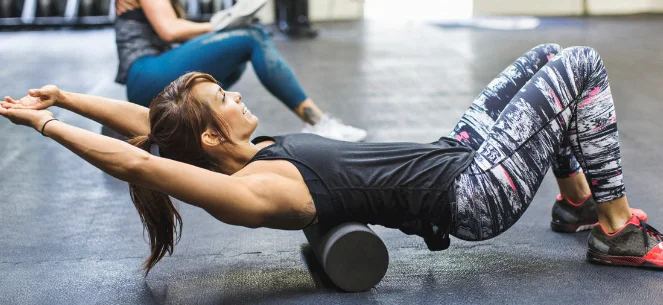
A foam roller is the cheapest useful tool here, usually under $20. The trick almost everyone gets wrong is rolling the neck itself. Do not. Lie on your back with the roller across your upper back at bra-strap height, feet flat, hands supporting your head so the neck stays neutral.
Roll slowly between the base of your shoulder blades and the top of your shoulders — about four inches of travel, roughly six slow passes. Then find one tender spot, stop, and breathe there for 60 seconds. Freeing up the stiff mid-back is what lets your head stack back over your shoulders, which is why this often relieves neck tightness even though you never touched the neck. The same logic applies to the aches that show up when you sit all week and then train hard at the weekend.
If floor work is uncomfortable, sitting and bouncing gently on a stability ball for a few minutes is a low-effort way to get the same mid-back movement — I broke down what that actually does in the real benefits of bouncing on an exercise ball.
Hot Towel Massage
Heat first, pressure second. Cleveland Clinic suggests a hot shower, hot towel or heating pad on the lowest setting for about 15 minutes to the painful area, every few hours. Warm tissue tolerates pressure far better, so this is the step that makes everything after it more comfortable.
Soak a hand towel in hot tap water — hot, not scalding — wring it out, and drape it over the back of your neck and shoulders for 10 to 15 minutes. Then hold one end in each hand, sit the middle of the towel against the back of your neck, and pull alternately left and right in slow rhythmic strokes. Rhythmic is the operative word. Fast vigorous rubbing is what leaves people with a red, tender patch instead of a relaxed neck.
Trap Squeeze (Hand Squeeze Massage)
The simplest one on the list and the one I use most, mostly because you can do it in a meeting. Reach your right hand across to your left shoulder and pinch the thick ridge of muscle between your thumb and fingers — the trapezius, midway between your neck and the point of your shoulder.
Squeeze and hold for five seconds, release, move half an inch, repeat. Work along the whole ridge, then switch sides. Two to three minutes total. Dropping your chin slightly towards the opposite shoulder while you squeeze puts the muscle on gentle stretch and makes each squeeze noticeably more effective.
Oil Rub Massage
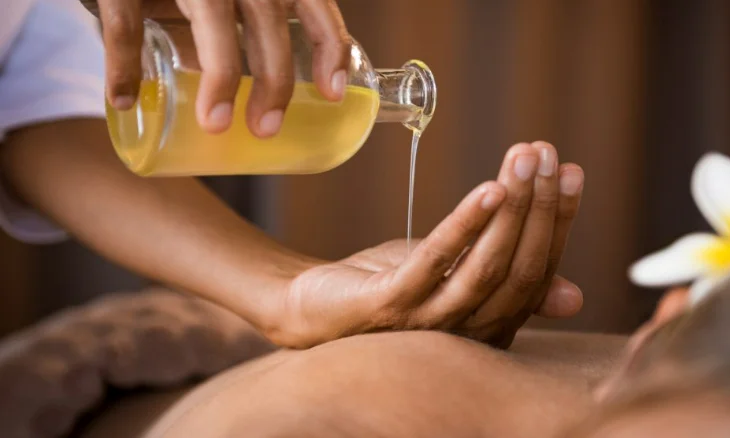
A little glide changes what your hands can do. Any plain oil works — sesame, coconut, sweet almond, or a plain unscented body lotion. Warm about a teaspoon between your palms first; cold oil makes tense muscles tense up further.
Use the flats of your fingers, not the tips, and work upward from the top of your shoulders towards the base of your skull in long slow strokes. Ten strokes each side, then switch to small circles at the base of the skull for 30 seconds. Firm and slow beats hard and fast every time — intense rubbing mostly produces redness and next-day soreness.
Two practical notes: patch-test a new oil on your inner forearm first if your skin reacts easily, and skip the oil entirely if you have broken skin, a rash, or a recent burn in the area.
Suboccipital Tennis Ball Release
This is the one for the stiffness that turns into a headache. Lie on your back on the floor and place two tennis balls (a knotted sock keeps them together) just under the base of your skull, one either side of the spine — not on the bony ridge itself, but in the soft hollows beside it.
Let the weight of your head rest on them and simply breathe for 60 to 90 seconds. Then nod your chin a centimetre towards your chest and back, five slow times. That is the entire exercise. It looks like doing nothing, and it is the technique people message me about most.
Why “Cracking Your Own Neck” Is Not On This List
An earlier version of this article included a self-manipulation move. I have taken it out, and I want to be straight about why.
Cleveland Clinic neurosurgeon Dr. Deborah Benzil puts it plainly: cracking your neck is fine as long as you do it infrequently and without great force. The problem is that people who crack their necks are usually doing it many times a day and forcing the end range, because the relief lasts about four minutes and then the urge comes back. Done that way it risks joint instability and irritated nerves, and it does nothing about the tight muscle that created the sensation in the first place.
Gentle range-of-motion movement is a different thing entirely and is genuinely useful: ear slowly towards one shoulder, hold 20 seconds, repeat the other side; then slow half-circles from shoulder to shoulder, chin down, never rolling the head backwards. No force, no hands pulling, no waiting for a pop.
The 5-Minute Desk Reset That Stops It Coming Back
Massage treats today. This treats next month. Cleveland Clinic’s prevention advice centres on strengthening the upper back to counter forward head posture, and the European Spine Journal editorial lands in the same place: ergonomics, deep neck flexor strengthening, and scheduled screen breaks.
Here is the version I actually do, once mid-morning and once mid-afternoon:
- Chin tucks — 10 reps. Sit tall, look straight ahead, and glide your head straight back as if making a double chin. Hold two seconds. This is the deep neck flexor exercise, and it is the single highest-value item here.
- Scapular squeezes — 10 reps. Pull your shoulder blades down and together, hold five seconds, release.
- Doorway chest stretch — 30 seconds each side. Forearm on the frame, elbow at shoulder height, step through gently. Tight chest muscles are what drag your shoulders forward.
- Screen to eye level. The top of your monitor should sit at or just below eye height. A stack of books works. If you are on a laptop all day, an external keyboard is the cheapest posture fix that exists.
- A 30-minute timer. Stand up, look at something far away, roll your shoulders once. Thirty seconds, not thirty minutes.
Consistency is the whole game, and it is also where nearly everyone loses. If you want structure around it, my free workout plan builder and this anti-inflammatory diet guide and grocery list are both free places to start.
📓 Want the 5-minute reset to actually stick?
The hardest part of a neck routine is not the technique – it is remembering to do it on the days you are busiest. My 4-Week Fitness Tracker gives you one printable page per week to tick off your stretch breaks, movement and training, so you can see the gaps instead of guessing at them.
Do Massage Guns Work On Your Neck?
Percussive massage guns went from athlete gear to a standard desk drawer item in about five years, and the short answer is: they work, with an important boundary.
Cleveland Clinic physical therapist Gary Calabrese, DPT, says that used properly they are generally safe and effective at delivering relief to the areas where you carry stress, increasing blood flow and easing tightness. The warning is about location: stick to muscle, not bone. Dragging the head over a bony spot like the nape of the neck produces kickback and pain rather than relief.
Practically, that means: the meaty part of the traps and the upper back, yes. The back of the neck itself, the base of the skull, and anywhere on the front or sides of the throat, no. Keep it to a minute or two per muscle group, let the weight of the device do the work rather than pressing, and check with your doctor first if you have any circulatory condition or take blood thinners.
Heat, Sleep And Magnesium: The Part Everyone Skips
Stiffness that never fully clears is usually a recovery problem rather than a massage problem. Three things move the needle more than technique does.
Heat before, not after. Fifteen minutes of heat before your stretches means you are working with pliable tissue. Cold is for the first day or two after an actual injury, not for everyday desk stiffness.
Your pillow. The goal is your nose in line with the centre of your chest. Side sleepers usually need a thicker pillow than they think; back sleepers almost always need a thinner one. Front sleeping keeps the neck rotated for hours and is the hardest habit to fix but the most worthwhile.
Magnesium, honestly assessed. Magnesium is genuinely required for normal muscle and nerve function, along with blood sugar and blood pressure regulation, and plenty of adults come in under the recommended 400 to 420 mg a day for men and 310 to 320 mg for women. What I will not tell you is that a magnesium supplement will loosen a tight neck — the evidence for supplements relieving muscle tension or cramps is thin, and food sources such as pumpkin seeds, spinach, black beans and almonds should be your first stop. If you and your doctor decide a supplement makes sense, note that the upper limit from supplements specifically is 350 mg a day, and a well-formulated option such as Magnesium Breakthrough is what I would look at. Check with your doctor first if you take any medication or have kidney problems.
Disclosure: this post contains affiliate links. If you buy through them I may earn a small commission at no extra cost to you.
What Painkillers Actually Do (And What They Don’t)
An older version of this article claimed that regular painkillers make you addicted and force you to keep raising the dose. That is not accurate for the medicines most people reach for, and I would rather correct it than leave it standing.
Over-the-counter anti-inflammatories like ibuprofen and naproxen are not addictive. They do carry real risks with prolonged use — stomach ulcers, and effects on the kidneys, liver and cardiovascular system — which is why Cleveland Clinic advises not taking an over-the-counter NSAID continuously for more than 10 days for pain, or three days for fever unless your provider says otherwise.
Dependence and dose escalation are genuine concerns with opioid painkillers, which are a different class of drug and prescription-only. Muddling the two scares people away from a few days of appropriate ibuprofen while telling them nothing useful about the medicines that actually warrant caution. If you are needing something most days for more than a week or two, that is the signal to see a doctor — not a reason to white-knuckle it.
5 Mistakes That Keep The Stiffness Coming Back
- Massaging only when it already hurts. Two minutes twice a day beats twenty minutes once a week, by a wide margin.
- Going too deep. Bruising is tissue damage, not progress. If you are sore for more than 24 hours, you used too much pressure.
- Stretching without strengthening. Cochrane found stretching alone barely moves chronic neck pain. Chin tucks and scapular work are the half people skip.
- Ignoring the setup. No massage routine survives a laptop balanced on your knees for eight hours a day.
- Rolling your head backwards in neck circles. Full backwards rolls compress the small joints at the back of the neck. Keep circles to the front half only.
Sore muscles anywhere follow the same rules, incidentally — the pattern I described in how to stop calf pain when working out applies just as well to the neck.
It is also worth saying that neck and trap stiffness is not just an office problem. Athletes who train grappling and combat sports deal with it constantly, and the routines above come straight out of that world; if you train, training gear that actually fits is part of the answer too, and my roundup of the highest calorie-burning martial arts is a good place to see how much load those sports put through the upper body.
When To Stop Self-Treating And See A Doctor
Self-massage is for ordinary, mechanical, comes-and-goes stiffness. Book an appointment if any of the following apply:
- Pain lasting more than a week, or not responding to over-the-counter pain relief
- Numbness, tingling or weakness spreading into an arm or hand
- Neck pain after a fall, a car accident or any impact — do not self-treat this
- Fever, unexplained weight loss, or a neck that will not bend forward
- Headaches that are new, severe, or different from your usual pattern
- Dizziness or visual changes when you move your neck
If you are pregnant, have a diagnosed neck condition, osteoporosis, or take blood thinners, check with your doctor before starting any hands-on routine. None of this is medical advice, and it is not a substitute for being examined by someone who can actually look at your neck.
Self Neck Massage FAQ
How often should I do self neck massage?
Twice a day, two to three minutes each time, is more useful than one long session a week. Most people notice a difference in how the neck feels within a few days, though the structural change from strengthening takes six to eight weeks.
Why does my neck feel worse the day after a massage?
Almost always too much pressure. Drop to a level you could talk through and shorten each spot to 60 seconds. Mild tenderness for a few hours is normal; a full day of soreness is not.
Is it safe to massage the front of my neck?
No. Keep to the back and sides, and the ridge of the traps. The front of the neck holds the airway, the thyroid and major blood vessels, and it is not somewhere to apply pressure yourself.
Can a bad pillow really cause neck pain?
It can certainly maintain it. Seven or eight hours a night in a rotated or side-bent position is far more total loading than your desk gives you. If you wake up stiff and loosen up during the morning, look at the pillow before you look at the chair.
The honest summary: a couple of minutes of hands-on work will unlock a stiff neck today, and chin tucks, a screen at eye level and a decent pillow are what stop you needing to do it every day. Start with the trap squeeze this afternoon — it takes two minutes and you do not need to buy anything.
