

You are eating “pretty well,” you have tried cutting carbs, you have probably done more ab workouts than you care to admit—and your stomach still seems to be the first place that holds weight. Then someone on social media tells you, “That is cortisol belly,” and suddenly every difficult week, bad night of sleep, coffee, and stressful meeting feels like the explanation.
There is a piece of truth hidden inside that trend, but there is also a lot of oversimplification. Cortisol can influence appetite, metabolism, blood sugar, sleep, and where fat is stored when levels are abnormally elevated. But having belly fat does not automatically mean you have a cortisol disorder, and there is no drink, supplement, detox, or special “cortisol belly diet” that can selectively melt fat from your waist.
If you searched “cortisol belly how to get rid of it,” I want to give you something more useful than another list of foods to ban: a routine that makes healthy eating, movement, recovery, and gradual fat loss easier to maintain.
I do not think you should fight cortisol as if it were the enemy. From my pharmaceutical medical background and the medical nutrition courses I have taken, I look at this differently: fix the habits that keep your body under constant pressure, and work on sustainable fat loss at the same time. If your plan only works while you are ‘on a diet,’ it is not a good long-term plan.
First: What Is a “Cortisol Belly” Really?
“Cortisol belly,” “stress belly,” and “hormonal belly” are popular phrases, not medical diagnoses. Cortisol itself is an essential hormone produced by your adrenal glands. You need it. It helps your body respond to stress and plays roles in metabolism, inflammation, blood pressure, and blood glucose regulation.
The important distinction is between normal cortisol fluctuations, chronic life stress, and true medical cortisol excess. The National Institute of Diabetes and Digestive and Kidney Diseases explains that Cushing’s syndrome occurs when the body has too much cortisol for a prolonged period. Weight gain around the trunk can be one sign, but Cushing’s syndrome usually involves more than simply having a larger waist.
For most people, stubborn abdominal fat has multiple contributors: total calorie intake, genetics, age, muscle mass, physical activity, sleep, stress, medications, hormonal changes, and sometimes medical conditions. That is why I would never look at someone’s stomach and say, “Your cortisol is high.” You cannot diagnose cortisol levels from body shape.
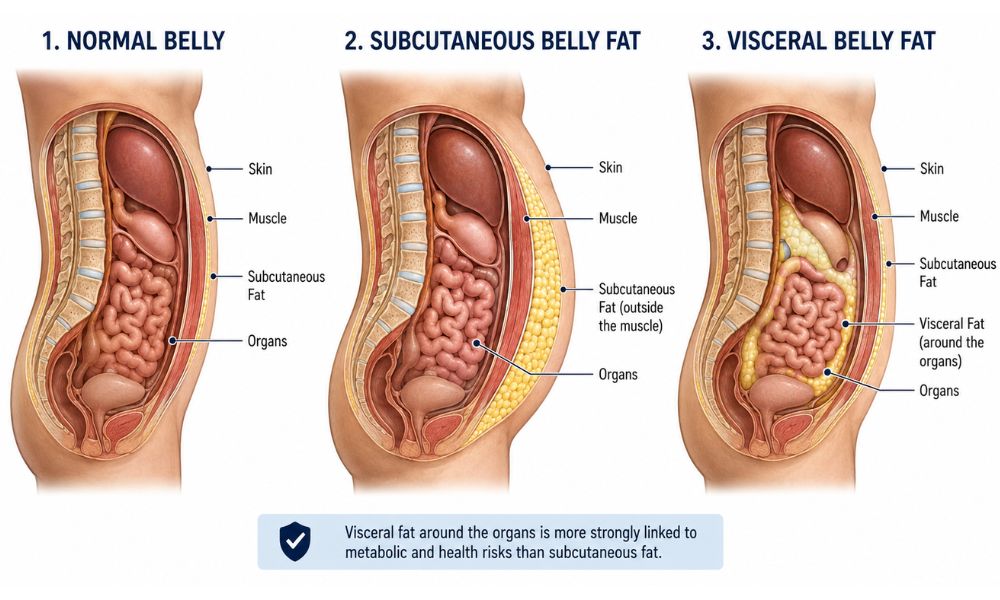
Can Stress Really Make Belly Fat Harder to Lose?
Yes, stress can make weight management harder—but often through several pathways at once. Think about what happens after three nights of poor sleep and a difficult workweek. You may feel hungrier, move less, crave highly rewarding foods, skip exercise, rely on caffeine late in the day, eat dinner very late, then sleep badly again. Even if you never measured cortisol once, that loop is already making your goal harder.
This is why I prefer the term stress-related belly fat rather than pretending every extra inch around your waist is a hormone problem. You do not need to prove that cortisol caused the fat before improving the habits that can help you lose it.
If stress has been controlling more of your day than you realized, try our Stress Level Quiz. Treat it as a self-awareness tool, not a diagnosis. Sometimes seeing your habits written down is enough to show you where to begin.
How to Get Rid of Cortisol Belly: The 7 Habits I Would Start With
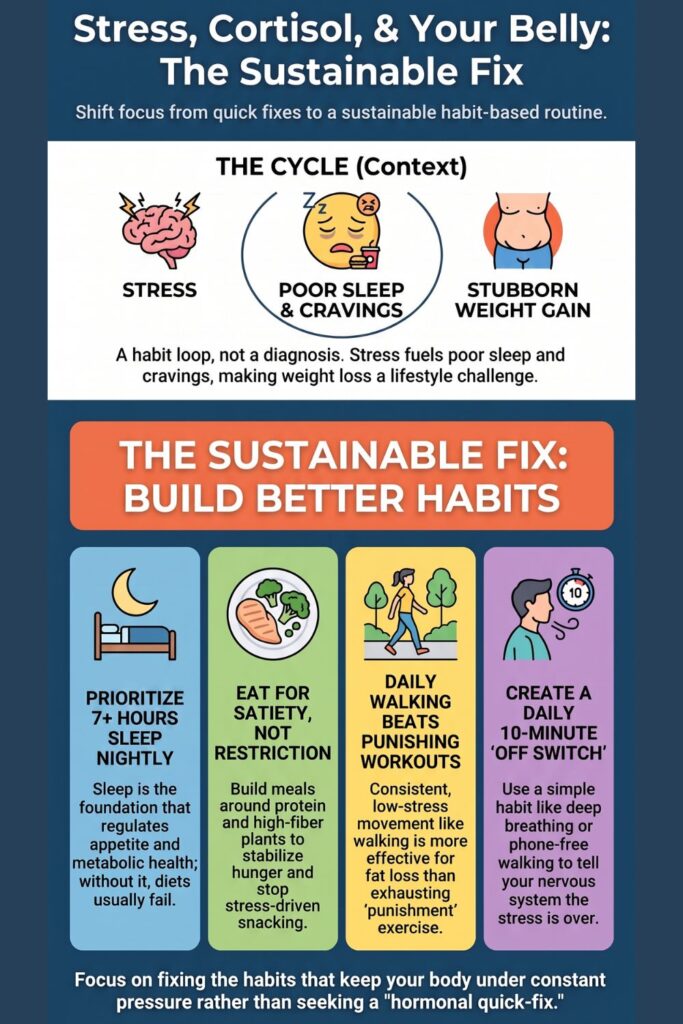
If you want an actionable answer, here it is: do not try to “lower cortisol” in isolation. Build a routine that improves sleep, food quality, appetite control, physical activity, stress recovery, and overall energy balance. Those habits work together.
1. Fix Your Sleep Before You Make Your Diet More Extreme
If you sleep five hours a night and feel exhausted all day, making your diet stricter is probably not the first lever I would pull. The CDC notes that getting enough sleep supports healthy weight, stress management, mood, heart health, and metabolism. For adults ages 18–60, the general recommendation is at least 7 hours of sleep per night.
Do not turn that into another perfection goal. Start with your wake-up time, keep it reasonably consistent, then work backward to create enough time for sleep. If you are far below 7 hours, add sleep gradually instead of chasing a perfect routine overnight.
Also look at the two hours before bed. Late work, scrolling, caffeine, or a huge meal after barely eating all day can make a consistent sleep routine harder.
If this feels familiar, read why sleep deprivation can contribute to weight gain. Do not use sleep as a “fat-burning hack.” Use it as the foundation that makes better decisions easier the next day.
2. Build Meals Around Protein, Fiber, and Real Food
I would rather see you eat three satisfying meals you can repeat than follow a perfect seven-day cortisol menu and quit on day eight.
For most meals, use a simple structure: protein + high-fiber plant food + a sensible carbohydrate + a source of healthy fat. That might look like eggs with whole-grain toast and fruit, Greek yogurt with oats and berries, chicken with rice and vegetables, lentils with salad and olive oil, or salmon with potatoes and greens.
Protein is especially useful when you are trying to lose fat while preserving lean tissue. Your needs vary with body size, age, activity, goals, and health status, so you can use our Protein Calculator as a starting estimate rather than guessing from social media.
Fiber-rich foods such as vegetables, fruit, beans, lentils, oats, and whole grains also make meals more satisfying. And this is where I want you to notice the difference between a “diet” and a habit: a diet tells you what you are allowed to eat this month. A habit teaches you how to build a normal Tuesday lunch for the next five years.
If you want meal inspiration focused on this same stress-aware approach, see the Low Cortisol Diet Meal Plan. Use it for ideas, not as a rigid prescription.
3. Stop Letting Stress Decide Your Snacks
Stress eating is not a character flaw. It is a pattern. And patterns can be redesigned.
Think about your usual high-stress moment. Maybe it is 4 p.m. at work. Maybe it is after the kids go to bed. Maybe it is when you finally sit on the couch, and your brain says, “I deserve something.” If you repeatedly reach that moment tired and hungry, you are asking willpower to do a job your routine should have handled earlier.
Try preparing a default snack before you need it: Greek yogurt and berries, fruit with nuts, cottage cheese, hummus with vegetables, an egg with whole-grain crackers, or another option that combines protein and/or fiber. Our list of low-cortisol snack ideas can give you practical combinations.
If highly processed foods are the bigger problem, read how to control junk food cravings. I would much rather help you change your environment—what is available, what is visible, what you buy, and when you eat—than tell you to “have more discipline.”
4. Walk Every Day Before You Worry About the Perfect Workout
You do not need a punishing workout to prove you are serious about losing belly fat. In fact, if an intense plan leaves you sore, exhausted, and inconsistent, it is not helping much.
The CDC’s physical activity guidance recommends at least 150 minutes of moderate-intensity aerobic activity per week for adults, along with muscle-strengthening activity on at least 2 days each week. That can be built in many ways.
For someone who is currently sedentary, I would start much smaller: a 10-minute walk after lunch, another after dinner, or a 20–30 minute brisk walk most days. You can build from there. A routine that starts below your maximum capacity is often easier to keep.
If steps motivate you, our steps-to-calories calculator can show how daily movement contributes to energy expenditure, but do not obsess over exact calorie numbers.
5. Strength Train So Weight Loss Is Not Just About Becoming Smaller
When people say they want to lose a cortisol belly, what they often want is a different body composition: less fat around the waist and a firmer, stronger body. That is why resistance training deserves a place beside walking.
You can begin with two full-body sessions per week. Squat or sit-to-stand movements, rows, presses, hip hinges, step-ups, carries, and core stability exercises cover a lot of ground. You do not need complicated programming on day one.
If you want help organizing exercises around your current level, use our free workout-plan builder.
And no, doing hundreds of crunches will not selectively burn abdominal fat. Train your core because you want it strong—not because you are trying to punish one body part into becoming leaner.
6. Create a Small Calorie Deficit—Not a Hunger Contest
This is the part some “hormone balance” content avoids: if your goal is to reduce stored body fat, your overall energy intake still matters. Stress management is important, but it does not cancel energy balance.
At the same time, I do not want you eating as little as possible. Aggressive restriction can leave you hungry, tired, socially isolated, and more likely to rebound into overeating. The CDC’s healthy weight-loss guidance emphasizes healthy eating, physical activity, enough sleep, and stress management together—not one extreme tactic.
Use our Calorie Deficit Calculator if you want a starting estimate. Then treat the number as an estimate, not a law. Your real-world trend over several weeks tells you more than a calculator ever can.
My practical rule: “Choose the smallest change that is actually producing progress. If you can lose fat while still eating dinner with your family, enjoying normal foods, sleeping well, and training with energy, why would I make your plan harsher?”
7. Give Your Nervous System a Daily “Off Switch”
You cannot remove every stressful person, deadline, bill, or family responsibility from your life. You can, however, stop letting your body move from one stressor to the next without any recovery.
The National Center for Complementary and Integrative Health discusses approaches such as relaxation techniques and mindfulness as tools that may help some people manage stress. I would keep this very practical.
Choose one 10-minute recovery habit: walk outside without your phone, practice slow breathing, stretch, pray, journal, sit quietly with coffee or tea, listen to music, or do a short mindfulness exercise. The best technique is not the trendiest one. It is the one you will repeat when your day is messy.
This is not about forcing cortisol to stay “low.” Cortisol naturally changes throughout the day. Your goal is to stop living as though your body never gets a signal that the stressful event is over.
What I Would Do for the Next 14 Days
If all of this feels like too much, do not change everything. Use this simple two-week experiment.
- Morning: Eat a protein-containing breakfast or first meal if that suits your schedule. Drink water. Get a few minutes of daylight and movement when possible.
- Lunch: Build your plate around protein, vegetables or another high-fiber food, and a satisfying carbohydrate rather than trying to survive on a tiny “diet lunch.”
- Afternoon: Have a planned snack if you routinely arrive at dinner ravenous.
- Movement: Walk 20–30 minutes most days, even if you split it into shorter walks.
- Strength: Complete two simple full-body resistance sessions each week.
- Stress: Protect one 10-minute period each day for deliberate recovery.
- Evening: Create a repeatable bedtime routine and work toward at least 7 hours of sleep if you are an adult for whom that recommendation applies.
After 14 days, do not ask only, “How much weight did I lose?” Ask better questions: Am I sleeping better? Am I less ravenous at night? Did I walk more? Did I eat more protein and plants? Are my cravings easier to manage? Does my waist feel less bloated? Can I realistically keep doing this?
Those questions tell you whether you are building the system that eventually makes fat loss easier.
Cortisol Belly vs. Bloating: Do Not Confuse Them
A stomach that looks flatter in the morning and dramatically larger at night is not necessarily showing changes in body fat. Bloating, intestinal gas, constipation, food volume, fluid retention, and menstrual-cycle changes can alter how your abdomen looks within hours. Body fat does not appear and disappear that quickly.
If your main issue is temporary abdominal distension rather than a gradual increase in waist size, the solution may be different. Our guide on how to get unbloated explains some practical ways to think about short-term bloating.
Pay attention to patterns. If certain foods consistently trigger pain, severe bloating, diarrhea, constipation, or other gastrointestinal symptoms, speak with a healthcare professional rather than endlessly removing foods from your diet.
What About Coffee, Cortisol, and Belly Fat?
Coffee gets blamed for “cortisol belly” constantly. I would not automatically remove coffee from a healthy person’s routine just because cortisol temporarily responds to caffeine. The more useful question is: what is coffee doing to you?
If you drink several cups late in the day and then cannot sleep, the indirect effect on your routine matters. If coffee makes you jittery, anxious, or replaces breakfast and leaves you starving later, adjust the dose or timing. If you enjoy a reasonable amount and sleep well, there is no reason to panic because a video told you coffee is storing fat directly on your stomach.
If you are unsure how much you are drinking, our Coffee Calculator can help you look at your intake more deliberately.
Supplements for Cortisol Belly: Be Skeptical
I understand why supplements are tempting. A capsule feels easier than changing sleep, meal structure, exercise, and stress habits. But “cortisol support” on a label does not mean a product has been proven to remove abdominal fat.
This is where my pharmaceutical background makes me especially cautious. Ask what the ingredient is, what dose was studied, what outcome was measured, what it may interact with, and whether the advertised claim matches what the research actually tested.
Do not start a supplement just because an influencer connected fatigue, belly fat, and cortisol in a 30-second video. If you take prescription medicines, are pregnant or breastfeeding, or have an endocrine, kidney, liver, cardiovascular, or other medical condition, discuss supplements with a qualified healthcare professional.
When a “Stress Belly” Deserves Medical Attention
Most belly fat is not Cushing’s syndrome. Still, true prolonged cortisol excess is a medical condition, so there are times when you should stop troubleshooting your lifestyle and get evaluated.
According to the NIDDK’s information on Cushing’s syndrome, signs can include weight gain with relatively thin arms and legs, a round face, increased fat around the base of the neck or between the shoulders, easy bruising, wide purple stretch marks, and muscle weakness. Other symptoms can occur as well.
See a healthcare professional if you have rapid or unexplained weight changes, significant muscle weakness, unusual bruising or stretch marks, menstrual changes, worsening blood pressure or blood sugar, or other symptoms that concern you. Also tell your clinician about steroid medicines you use. Long-term exposure to glucocorticoid medicines is one cause of Cushing’s syndrome.
And please do not stop prescribed steroid medication suddenly because you are worried about cortisol. Medication changes should be supervised by the clinician who manages your treatment.
How Long Does It Take to Lose a Cortisol Belly?
There is no medically established “cortisol belly timeline” because cortisol belly is not a diagnosis. If what you are trying to lose is abdominal body fat, think in months rather than days.
You may feel some improvements—better sleep, more stable hunger, less bloating, better energy—before you see a dramatic change in your waist. That is not failure. Those early changes are often evidence that your routine is becoming easier to maintain.
I would track your weight trend, waist circumference, sleep, strength, daily movement, and hunger for at least several weeks. Do not let one salty dinner or one higher scale reading convince you that your cortisol “spiked” and ruined everything.
Common Mistakes That Keep a Stress Belly Stuck
- Going from overeating to extreme restriction. You may see fast scale changes, but you have not learned how to eat normally when the diet ends.
- Cutting entire food groups without a reason. Carbohydrates are not automatically the cause of cortisol-related weight gain.
- Using exercise as punishment. A sustainable walking and resistance routine usually beats repeated cycles of exhausting workouts and quitting.
- Ignoring sleep. You cannot continuously sacrifice recovery and expect appetite and motivation to feel easy.
- Trying five supplements before fixing breakfast. Build the basics first.
- Assuming every abdominal change is fat. Bloating and water retention can change your waist temporarily.
- Expecting spot reduction. You can strengthen your abdominal muscles, but you cannot command your body to remove fat from one precise location first.
Frequently Asked Questions About Cortisol Belly
What does a cortisol belly look like?
There is no validated appearance that can diagnose “cortisol belly.” People usually use the term to describe fat concentrated around the abdomen, especially during stressful periods. True cortisol excess, such as Cushing’s syndrome, can produce a recognizable cluster of symptoms, but abdominal fat alone is not enough to diagnose it.
What is the fastest way to get rid of cortisol belly?
There is no proven quick fix that specifically removes cortisol-related belly fat. Start with consistent sleep, balanced high-satiety meals, daily movement, resistance training, stress-management habits, and an appropriate calorie deficit if fat loss is your goal. If you have symptoms of abnormal cortisol production, seek medical evaluation.
What foods reduce cortisol belly?
No individual food melts stress belly. Build most meals around minimally processed foods, adequate protein, vegetables, fruit, whole grains or other fiber-rich carbohydrates, legumes, and healthy fats. If you want a ready-made structure, our free customized meal plans can help you turn those principles into everyday meals.
Can walking reduce cortisol belly?
Walking can be part of an effective fat-loss and stress-management routine. It increases physical activity, is accessible for many people, and can be combined with nutrition changes and resistance training. It does not specifically target cortisol belly, but it is one of the easiest habits to maintain consistently.
Can you lose cortisol belly without dieting?
You do not need to follow a named diet. If you have excess body fat you want to lose, however, your long-term food intake still matters. I prefer changing portions, meal composition, food quality, and routines in a way that creates an appropriate energy deficit without making you feel as if you are temporarily “on a diet.”
Should I test my cortisol because I have belly fat?
Belly fat by itself does not prove that your cortisol is abnormal. If you have additional symptoms suggesting an endocrine problem, take steroid medication, or have rapid unexplained changes, discuss your symptoms with a healthcare professional. They can decide whether cortisol testing or another evaluation is appropriate.
The Bottom Line: Do Not Build a Better Diet—Build a Better Default Day
If you remember only one thing from this article, make it this: your goal is not to become perfect at lowering cortisol. Your goal is to make your ordinary days healthier.
A normal day where you sleep enough, eat satisfying meals, walk, use your muscles, manage cravings, and take ten minutes to recover from stress is far more powerful than a perfect “cortisol detox” weekend followed by the same habits that made you feel stuck in the first place.
Start with one or two changes. Keep them until they feel boring. Then add another. If you want to see your calorie, protein, body-composition, and other estimates in one place, our All-in-One Body Calculator can give you useful starting numbers—but remember that numbers support habits; they do not replace them.
My final verdict: “The best plan for getting rid of a so-called cortisol belly is the one you would still be willing to follow after you have lost the weight. Build a life that supports the result, instead of borrowing a strict diet that can only produce the result temporarily.”
This article is for general educational purposes and is not a diagnosis or a substitute for individualized medical care. If you are concerned about abnormal cortisol levels, unexplained weight gain, medication effects, or symptoms of an endocrine disorder, speak with a qualified healthcare professional.
