
If you’ve been staring at your Noom app wondering why a chicken breast and a granola bar are both sitting in the same yellow category, you’re not missing something obvious. Yellow foods are the most confusing part of Noom’s entire system, and most explanations gloss over why they exist at all.
I have a background in nutrition science from Zewail International Academy along with a medical background, and when people ask me about Noom, the color system is almost always where the questions start. Green and orange foods are intuitive — vegetables are good, cake is a treat. Yellow is the category that actually requires you to understand the logic behind it, which is exactly what this guide covers.
What Noom’s Color System Is Actually Measuring
Noom sorts every food into green, yellow, or orange based on calorie density — how many calories a food packs per gram, adjusted for its nutritional value. It isn’t a “good food, bad food” list, even though it’s easy to read it that way at first.
- Green foods: the least calorie-dense, most nutrient-dense options — vegetables, fruit, and whole grains. Eat these most often.
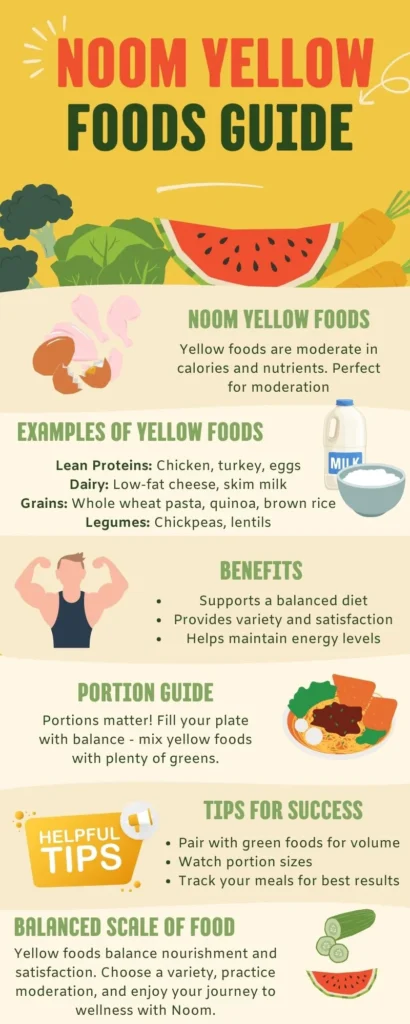
- Yellow foods: moderate calorie density — lean proteins, starches, dairy, and legumes. Eat these in moderation.
- Orange foods: the most calorie-dense options — oils, fried foods, desserts, and fatty cuts of meat. Eat these sparingly.
Registered dietitian Kelli McGrane, reviewing the system for Healthline, put it well: the color-coded approach “gets away from the idea that calories are the be-all and end-all when it comes to weight loss and healthy eating.” It’s a simplified stand-in for tracking calories and macros directly, built so you don’t need a nutrition degree to use it day to day.
Why Yellow Foods Exist as Their Own Category
If Noom only had two categories — eat freely, eat rarely — most of what you actually eat on a normal day would have nowhere to go. Chicken, rice, eggs, beans, and milk aren’t junk food, but they’re also not as calorie-light as spinach. Yellow is where everyday, functional foods live: the proteins and starches that make up the bulk of most people’s actual meals.
That’s also why yellow foods are the category people get wrong most often. Treating “yellow” as a synonym for “limit this” leads to under-eating protein and starches, which backfires — especially if you’re trying to build or preserve muscle while losing fat. The category isn’t a warning label. It’s a portion cue.
Common Yellow Foods on Noom
Here’s where most everyday staples land:
- Lean proteins: chicken breast, turkey, fish, eggs, tofu, low-fat dairy
- Starches: brown rice, whole-grain pasta, potatoes, oats, quinoa
- Legumes: lentils, chickpeas, black beans, kidney beans
- Dairy: milk, yogurt, low-fat cheese
- Nuts and seeds (in smaller portions): almonds, walnuts, chia, flax
Preparation changes everything here. Air-fried chicken and deep-fried chicken start from the same place and end in different categories, because the added oil shifts the calorie density. The same cut of meat can move from yellow toward orange purely based on how you cook it.
If You’re Vegetarian or Vegan
Plant-based eaters sometimes assume yellow foods are mostly an animal-protein category, which isn’t accurate. Lentils, chickpeas, black beans, tofu, tempeh, and quinoa all sit solidly in yellow for the same reason chicken does — moderate calorie density, meaningful protein or starch content. If you’re skipping meat, your yellow-food servings just shift toward legumes and soy-based proteins instead of disappearing.
The Logic Behind Calorie Density, Not Just Calorie Counting
It’s worth understanding why Noom built the system this way instead of just handing you a daily calorie number and a food diary. Calorie density — calories per gram of food — correlates closely with how full a food makes you per calorie consumed. A pound of broccoli and a pound of crackers can carry wildly different calorie counts for the same volume in your stomach, which is the entire reason green vegetables are treated as “eat freely” even though they still technically contain calories.
Yellow foods sit in the middle of that curve on purpose. They’re dense enough to matter for your daily total, but not so dense that small portions blow past your target the way a handful of orange foods can. That middle position is exactly why portion size, not avoidance, is the right lever to pull with yellow foods — shrinking them slightly works, cutting them out usually doesn’t.
How Much Yellow Should Actually Be on Your Plate
Noom doesn’t hand you a fixed yellow-food quota, because the right amount depends on your calorie target, which depends on your size, activity level, and goals. If you want a real number instead of a vague “in moderation,” running your numbers through a TDEE calculator gives you the daily calorie range Noom’s system is quietly built around, and a protein calculator tells you how much of your yellow-food budget should be going toward protein specifically, rather than starches.
As a rough starting shape, most people land somewhere around 45% green, 35% yellow, and no more than 20% orange across a day — though Noom adjusts this per person rather than applying one ratio to everyone. If you’re new to the system entirely, how the Noom diet actually works walks through the full color-logging mechanics from day one.
If you’d rather not do this math freehand every day, a structured plan that maps out portions and calories in advance removes the guesswork. The 4-Week Weight Loss Planner is built for exactly this — it lays out daily targets so you’re not recalculating your yellow-food allowance from scratch every morning.
Yellow Foods, Protein, and the GLP-1 Overlap
One shift since Noom’s early years: a large share of people now using color-coded tracking are doing it alongside a GLP-1 medication like semaglutide or tirzepatide, not instead of one. Noom responded to this directly — Noom Med, the company’s clinician-led program, pairs medical GLP-1 treatment with its existing psychology-based coaching, built on the idea (stated plainly by Noom’s own medical leadership) that medication alone doesn’t produce lasting results without a behavior-change program underneath it.
This matters for yellow foods specifically because GLP-1 medications suppress appetite hard enough that protein intake often drops first — and protein is almost entirely a yellow-category food. If you’re eating less overall, under-eating your yellow foods is the fastest way to lose muscle along with fat. Prioritizing lean protein inside a shrunken appetite, rather than letting it get crowded out, is the main adjustment worth making. These protein shakes built for GLP-1 users and this breakdown of what to eat while on Ozempic both address this same gap.
🥗 On a GLP-1 and losing your appetite for protein?
The GLP-1 Kickstart Kit builds a meal plan around small, protein-first portions — so your yellow-food intake doesn’t quietly disappear while your appetite does.
Get the GLP-1 Kickstart Kit — $27 →Mistakes People Make With Yellow Foods
Treating yellow as “bad.” This is the single most common misread of the whole system. Cutting yellow foods too hard to stay “in the green” usually means cutting protein and starches your body actually needs to function, and it tends to backfire within a week or two as energy and hunger both spike.
Ignoring preparation method. The same chicken thigh can sit in a completely different category depending on whether it’s grilled, baked, or fried in oil. People get frustrated when a “healthy” food logs as orange, without realizing the cooking method is what moved it, not the ingredient itself.
Skipping protein to “save” yellow servings for carbs. Because rice, bread, and chicken are all technically yellow, it’s tempting to spend your whole allotment on starches and skip the protein. This is the single fastest way to end up tired, hungry, and losing muscle instead of fat — protein is what preserves lean mass during a calorie deficit, and starches alone don’t do that job.
Logging by color instead of thinking in portions. A cup of rice and three cups of rice are both “yellow” in the app, but they are not nutritionally interchangeable. The color tells you the category; it doesn’t tell you the amount, and that second part is still on you.
Assuming orange is always worse than yellow. A small drizzle of olive oil (orange, calorie-dense but nutritionally useful) can matter more for satiety and nutrient absorption than an oversized yellow starch portion. Category alone doesn’t capture everything — it’s a simplification, not a complete nutritional ranking.
A Sample Day Built Around Yellow Foods in Moderation
Here’s roughly what balanced yellow-food portions look like across a day, rather than treating the category as something to avoid:
- Breakfast: eggs (yellow) with spinach and tomato (green)
- Lunch: grilled chicken (yellow) over a large mixed salad (green), light olive oil dressing (orange, small amount)
- Afternoon: plain Greek yogurt (yellow) with berries (green)
- Dinner: baked fish (yellow), roasted vegetables (green), small portion of brown rice (yellow)
Notice yellow shows up at every meal — it’s not a once-a-day allowance, it’s a moderation category you’re working with constantly. If you want this kind of day-by-day structure already built out instead of planning each meal yourself, that’s exactly what the 4-Week Weight Loss Planner maps out in advance.
📋 Stop guessing your yellow-food portions
The 4-Week Weight Loss Planner lays out daily meals and portions in advance, so green, yellow, and orange foods are already balanced for you — no recalculating every morning.
Get the Weight Loss Planner — $5 →Eating Out Without Losing Track of Your Yellow Foods
Restaurants are where the color system gets genuinely hard, because you don’t control the oil, the portion, or the preparation. A grilled chicken sandwich sounds identical to a home-cooked grilled chicken breast, but restaurant versions are frequently brushed with butter or oil before grilling, which can quietly push a yellow food toward orange without changing how it looks on the menu.
A few habits make this easier to manage without turning dinner into an interrogation of the server:
- Ask for sauces and dressings on the side rather than assuming a “light” description means low-calorie-density.
- Default to grilled, baked, or steamed preparations when a menu gives you the choice — this is the single biggest lever for keeping a protein in yellow rather than orange.
- Treat restaurant starch portions (rice, pasta, bread) as larger than home portions by default, since they usually are.
- Build the meal around a green vegetable side instead of a second starch, which keeps the plate balanced even if the protein preparation isn’t perfectly yellow.
None of this requires precision — the goal is a reasonable estimate, not a perfect one. Noom’s own logging tools are built around estimation for exactly this reason; the color system was never meant to require a food scale at every meal.
How This Compares to Other Tracking Systems
If you’ve tried point-based or pre-portioned meal systems before, the color system will feel different in one specific way: it never hides the food from you. Weight Watchers assigns points you memorize; Nutrisystem portions the food for you before it reaches your kitchen. Noom’s colors ask you to actually look at what calorie density is doing to each food, which is more effortful upfront but tends to generalize better once you stop using the app. For a direct side-by-side, Noom vs. Weight Watchers covers which approach fits which kind of person, and if pre-portioned meals sound more realistic for your schedule, the Nutrisystem meals and snacks review is worth a look before committing to logging colors yourself.
Whichever system you land on, the two things worth carrying over are a plan for snacks that won’t derail you and a plan for the hours before bed, since both are where most people quietly go off track. A stash of zero-calorie snacks covers the first; knowing which bedtime snacks actually help blood sugar rather than spike it covers the second.
Quick Yellow-Food Swaps Worth Knowing
You don’t need to abandon a yellow food to lighten its calorie density — small swaps usually do the job without changing the meal much:
- Swap fried chicken for grilled or air-fried — same protein, noticeably lower calorie density.
- Swap white rice for a half-and-half mix of rice and riced cauliflower to stretch the portion without adding much density.
- Swap regular yogurt for plain Greek yogurt — more protein for a similar or smaller calorie footprint.
- Swap pasta for a vegetable-forward grain bowl that’s half pasta, half roasted vegetables.
These aren’t rules, just low-effort ways to keep your yellow portions working harder for you without feeling like you’re dieting around them.
Frequently Asked Questions
Are yellow foods bad for weight loss?
No. Yellow foods include most everyday proteins and starches your body needs. The goal is moderation and portion awareness, not elimination.
Can I eat unlimited yellow foods if I stay under my calorie goal?
Technically yes, since Noom is still tracking total calories underneath the colors. In practice, loading up on yellow at the expense of green vegetables tends to leave you less full per calorie, which makes staying under your target harder, not easier.
Why does the same food sometimes show up in different colors?
Preparation method is the usual reason. Oil, breading, and frying all add calorie density, which can push a food from yellow toward orange even though the base ingredient didn’t change.
Should I talk to a doctor before combining Noom with a GLP-1 medication?
Yes — any GLP-1 medication should be managed by the prescribing doctor or clinician, and nutrition adjustments around appetite changes are worth discussing with them directly rather than guessing.
Do yellow foods count differently for vegetarians?
No — the category is based on calorie density, not on whether the protein source is animal or plant-based. Lentils, beans, and tofu are evaluated the same way chicken or fish are.
What happens if I eat too much yellow and not enough green?
You’ll typically feel less full per calorie, since green foods carry more volume and fiber for the same calorie cost. You’re not breaking a rule, but you’ll likely find it harder to stay satisfied within your daily target.
Final Thoughts
Yellow foods aren’t the category to fear on Noom — they’re the category that keeps the system realistic. Green foods alone can’t cover your protein and energy needs, and treating every yellow food like a minor violation is what makes people quit the app faster than any actual food choice does. Get comfortable with moderate, consistent yellow portions, pay attention to preparation method, and the color system stops being confusing and starts being just another way of describing a normal, balanced plate.
If there’s one habit worth taking from all of this, it’s checking preparation method before you check the color itself — that single detail explains most of the “why is this yellow instead of green” confusion people run into. Everything else is just portion awareness applied consistently, meal after meal, without treating any single food as off-limits.
Sources: Healthline, Noom Diet Review, Noom Inc., Noom Med program announcement.

A fascinating discussion is worth comment. I do believe that you need to write more
about this subject matter, it may not be a taboo subject but typically people do not discuss these issues.
To the next! Cheers!!