
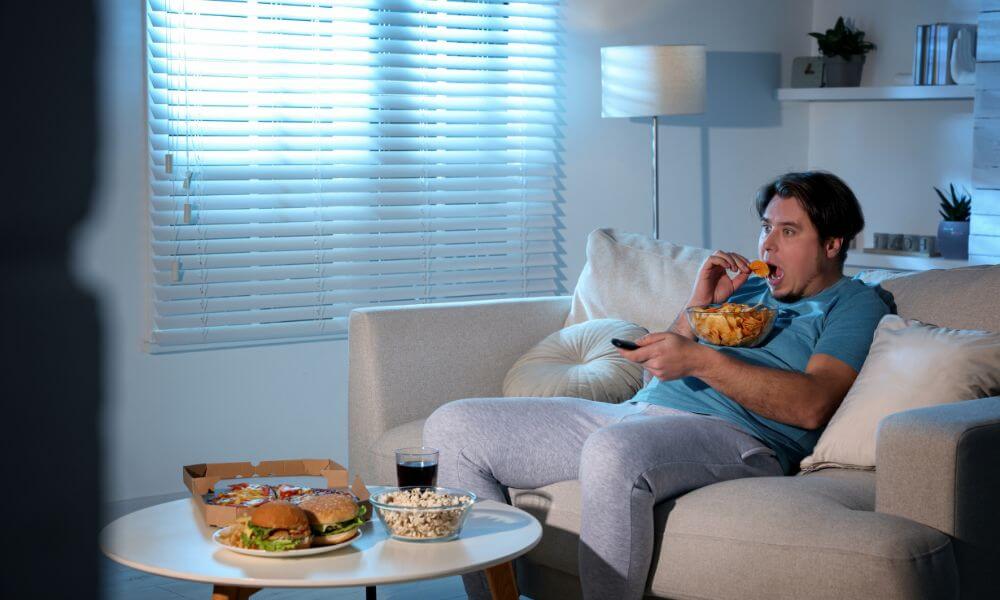
You were fine all morning. Then the afternoon hit, and somewhere between the third handful of crackers and the “I’ll start again Monday” thought, the day was gone. If you’re desperate to lose weight but can’t stop eating, the problem almost certainly isn’t that you want it badly enough — it’s that hunger is a biological signal, and you’ve been trying to out-argue it.
My background is in medicine, and I hold a certification in Nutrition Science from Zewail International Academy. What changed how I eat wasn’t a new rule. It was realising that most of what gets called “no willpower” is actually a meal that was built wrong four hours earlier. Below are the six changes that do the heavy lifting, in the order I’d make them.
First, the number that should take the blame off you
In a tightly controlled study at the NIH Clinical Center, 20 adults lived on site for a month and ate as much as they wanted from two menus — one built from ultra-processed foods, one from unprocessed foods — matched for calories, sugar, fat, fibre and sodium on offer. On the ultra-processed weeks they ate about 500 calories more per day and gained 2 pounds. On the unprocessed weeks they lost about the same amount. Nobody was told to eat more. They just did (NIH, 2019).
Five hundred calories a day is roughly a pound a week. That gap opened up purely from how the food was built — softer, faster to chew, lower in protein per bite. Which means the fix is mostly structural, not moral.
“Food noise” — the term that finally named it
Researchers now use a specific phrase for the thing you’re describing when you say you can’t stop thinking about food: food noise, defined in the research literature as persistent thoughts about food that the person experiences as unwanted or distressing. It’s not the same as a craving. A craving is an episode — you want chocolate, you eat chocolate, it ends. Food noise is closer to background music that never switches off.
The term went mainstream because people taking GLP-1 medications kept reporting the same thing: the chatter went quiet. Matthew Breit, PhD, RDN, a researcher at CU Anschutz who is helping build the questionnaires used to measure it, describes those drugs as working like noise-cancelling headphones — while cautioning that the underlying mechanism is still not well understood (CU Anschutz). Food noise is now being studied as a target in its own right, not just a side note.
Two useful things follow from that. First, if your head is loud around food, you have a describable experience that scientists are actively measuring — not a character flaw. Second, you don’t need a prescription to turn the volume down. Meal composition, sleep and eating rhythm all move the same dial, and several ordinary foods nudge your own GLP-1 response — I’ve listed the evidence-based ones in natural GLP-1 foods that support satiety.
If you are on Ozempic, Wegovy or Zepbound, the appetite problem flips: you have to make the small amount you eat actually count, which is exactly what the GLP-1 Kickstart Kit is built around — 28 days of protein-first meals sized for a suppressed appetite.
Fix 1: Put 25–30g of protein at the front of the day
Cleveland Clinic’s guidance is blunt about the number: roughly 20 to 30 grams of protein at your first meal helps you stay full longer and blunts later cravings, and your body can only use about 25 to 35 grams at a sitting anyway — so spreading it across the day beats one enormous dinner (Cleveland Clinic).
Here’s what 25–30 grams actually looks like, because “eat more protein” is useless without amounts:
- 1 cup (about 225g) plain Greek yogurt — roughly 20g, plus 1 tablespoon hemp seeds gets you to 23g
- 3 large eggs plus a slice of whole-grain toast — about 22g
- 115g cooked chicken breast — about 32g
- 1 cup cooked lentils plus 2 tablespoons pumpkin seeds — about 22g
- 170g can of tuna — about 30g
Your own target depends on your weight and activity, so run it through the protein calculator rather than guessing. Then pair it with fibre, which is the half everyone skips: a bowl of oats with berries and chia digests slowly enough to hold you to lunch, while the same calories in juice are gone in twenty minutes. I’ve put a full list of options in high-fibre breakfast foods.
Fix 2: Eat on the signal, not on the clock
A lot of eating happens pre-emptively — not because you’re hungry, but because you’re worried you’ll be hungry in two hours and won’t be able to do anything about it. That fear is what turns one snack into constant snacking.
Before you eat anything unplanned, put a number on it from 1 to 10, where 1 is faint and 10 is uncomfortably stuffed. Eat at a 3 or 4. Stop at a 6 or 7 — satisfied, not full. Below a 3 you’ll eat too fast to notice fullness; above a 7 you’re eating past the signal. Do this for a week and you’ll find that a genuine share of what you call hunger scores a 6 before you’ve eaten anything, which means it isn’t hunger.
Cleveland Clinic lists the usual culprits behind that phantom hunger: stress, boredom and sadness, evening timing, large portions, social situations, and highly processed food itself (Cleveland Clinic on overeating). Naming which one you’re in is most of the fix — the answer to boredom has never been a second dinner.
Some people find that giving the day a defined eating window removes the negotiation entirely, which is the real appeal of intermittent fasting — fewer decisions, not fewer calories by magic. It suits some people badly, though, so treat it as one option rather than the answer. And if you want a baseline before you change anything, calculate your BMI — it’s a crude screen, not a verdict, but it’s a starting point.
Fix 3: Your brain is about 20 minutes behind your fork
Cleveland Clinic puts it plainly: “You might not notice you’ve been overeating for about 20 minutes or so after you stop eating.” Fullness is a delayed message. Eat a plate in eight minutes and you will finish it before your body has had any chance to object — then eat again, because you still don’t feel full.
Three things that reliably stretch a meal out, in order of how much they help:
- Put the fork down between bites. Not as a ritual — it’s the only mechanical way to slow chewing without thinking about it.
- Start with the vegetables. Cleveland Clinic’s own advice is to fill the plate with vegetables because the fibre slows your eating down. Volume and chewing do the work.
- Eat without a screen. Distracted eating consistently ends in eating more, because you never registered the meal happening.
Serve what you plan to eat and leave the pan in the kitchen. A second helping should cost you a walk, not a reach.
Fix 4: Take the decision out of it entirely
Here’s the pattern I see most often, including in myself: the eating doesn’t fall apart because of a craving. It falls apart at 6:40 p.m. when you open the fridge, see ingredients rather than a meal, and reach for the thing that requires no decisions.
Willpower is not the resource that runs out. Decisions are. Three that remove most of the risk:
- Cook one protein in bulk on the weekend — a tray of chicken thighs, a pot of lentils, a dozen boiled eggs. Not meals, just the hard part, done.
- Decide breakfast once and repeat it. Novelty at 7 a.m. buys you nothing.
- Keep two default dinners you can make from cupboard staples in fifteen minutes, so “there’s nothing in” stops being true.
For structure without the planning work, the 4-Week Weight Loss Planner maps meals, mindset prompts and movement onto each day, so the 6:40 p.m. decision has already been made for you. If you’d rather build your own, my calorie deficit breakfast ideas are a decent starting stack.
📋 Tired of Figuring It Out From Scratch Every Day?
If “can’t stop eating” is the real fight, the fix usually isn’t more willpower — it’s fewer decisions. The 4-Week Weight Loss Planner lays out meals, mindset prompts, and movement day by day, so you’re not white-knuckling it alone.
Get the Weight Loss Planner — $5 →Fix 5: Fix the crash, not the craving
The old version of this advice was “carbs raise insulin, insulin makes you hungry, so cut carbs.” That’s tidier than the evidence supports — the carbohydrate-insulin model of obesity is still actively contested, and controlled feeding studies have not shown that cutting carbs beats cutting fat when calories and protein are matched.
What’s much better established is narrower and more useful: a meal of refined carbohydrate with little protein, fat or fibre digests fast, and the dip that follows arrives right on time to feel like hunger. A bowl of cereal at 7 a.m. and a wall at 10:30 a.m. is that pattern. So the fix isn’t cutting carbohydrate — it’s stopping it from arriving naked:
- Attach protein or fat to every carbohydrate. Toast alone crashes; toast with eggs doesn’t.
- Choose the intact version where you can — steel-cut oats over instant, whole fruit over juice, beans over crackers.
- Use artificial sweeteners if they genuinely help you cut sugar, with an honest look at the trade-offs first.
- Drink water across the day. Not because water is “filling” in any lasting way, but because mild dehydration is easy to misread as hunger.
If sweet cravings specifically are the thing you can’t get past, that has its own playbook — I’ve written it up in how to control junk food cravings.
Fix 6: Three things that fake hunger
Short sleep
Cut your sleep and appetite regulation goes with it. This is the single change with the best effort-to-return ratio on this whole page, and it involves no food decisions at all. If you’re eating “badly” only on the days after a bad night, that’s not a coincidence and it isn’t a discipline problem.
Stress you haven’t named
Stress eating rarely feels like stress in the moment. It feels like wanting something crunchy at 9 p.m. The tell is the specificity: real hunger will accept eggs, stress will only accept the crisps. When you catch that, you don’t need to white-knuckle it — you need ten minutes doing anything else, after which the urge has usually moved on.
Under-eating earlier in the day
The 900-calorie evening is very often the invoice for a 400-calorie day. If you skip breakfast, work through lunch and then can’t stop eating from six o’clock onward, you have not discovered a personal weakness — you’ve discovered accounting. Move calories forward and the evening tends to sort itself out.
What a day that actually holds looks like
Not a prescription — a worked example, so you can see the shape of it:
| When | What | Why it holds |
|---|---|---|
| 7:30 a.m. | Greek yogurt, 1 tbsp chia, a handful of berries, coffee | ~23g protein plus fibre — clears the 20g threshold before the day starts |
| 12:30 p.m. | Chicken or lentils, a big pile of roasted vegetables, olive oil, rice or potato | Protein anchors it; vegetables slow the eating down |
| 4:00 p.m. | Apple with 2 tbsp natural peanut butter | The one snack that decides your evening — make it protein and fat, not crackers |
| 7:00 p.m. | Fish or eggs, vegetables, a starch you actually like | Eaten slowly, plated once, pan left in the kitchen |
Notice there’s no forbidden food on that list and nothing gets eliminated. The 4 p.m. slot is doing more work than any of the rules — an under-fed afternoon is the single most reliable predictor of an evening that gets away from you. If you want lower-calorie options that still hold, I’ve collected them in low-calorie foods that keep you full.
Five mistakes that keep the cycle running
- Cutting too hard on Monday. An aggressive deficit produces an aggressive rebound, usually by Thursday. A deficit you don’t notice beats one you have to survive.
- Banning one food. Restriction reliably increases its pull. Allow it, plan roughly when, and it loses most of its power.
- Buying “diet” versions of snack food. Low-fat and low-sugar versions are often engineered to be just as easy to eat, and you eat more of them because they feel free.
- Weighing yourself daily and reacting to it. Day-to-day movement is water and food volume. Reacting to noise with a stricter plan is how the cycle restarts.
- Treating one bad evening as a verdict. One evening is roughly 1,000 extra calories. The week after it, spent starting over from scratch, costs far more.
For more on the smaller structural changes that stack up, see my weight loss habits that make losing weight easier and the overnight-recovery routine in how to lose weight without exercise.
Questions people actually ask
Why can’t I stop eating even when I’m full?
Because fullness and the desire to eat run on separate systems. Fullness is a stretch-and-hormone signal that arrives late — Cleveland Clinic puts the lag at about 20 minutes. The desire to keep eating is reward-driven, and highly palatable food keeps it switched on well past the point of being full. Eating slower narrows the gap; eating food that takes chewing narrows it further.
Is constant hunger a sign of something medical?
It can be. Thyroid conditions, poorly controlled blood sugar, some medications, pregnancy and several other things all raise appetite. If your hunger changed noticeably and you can’t tie it to sleep, stress or eating less, that’s a conversation with your doctor, not a diet question.
How long before this stops feeling like a fight?
For most people, a protein-and-fibre-forward breakfast changes the afternoon within about a week — that one is fast. The evening habit takes longer, closer to a month, because it’s a routine rather than a hunger signal. Judge the first change on how 4 p.m. feels, not on the scale.
Do I have to count calories?
No. Counting works well for some people and becomes its own problem for others. Everything above changes intake by changing how full you feel, which is why it works without a spreadsheet. If you want a number to aim at anyway, get one — just don’t let it be the only thing you’re managing.
A note on when to get help
This is general information, not medical advice, and I’m not your doctor. Talk to yours before starting a restrictive diet, an extended fast or a weight-loss medication, and especially if you’re pregnant, managing a chronic condition or taking anything that affects appetite or blood sugar. If eating feels out of control in a way that’s distressing rather than just frustrating, that deserves proper support from a qualified professional — it isn’t something to solve with a stricter plan.
References
- National Institutes of Health — Heavily processed foods cause overeating and weight gain
- Cleveland Clinic — Overeating: causes, symptoms and how to stop
- Cleveland Clinic — How much protein to eat to lose weight
- University of Colorado Anschutz — How researchers study “food noise” and GLP-1 use
Keep reading
- Anti-Inflammatory Diet for Joint Pain: 15 Foods That Help (and 7 That Make It Worse)
- Fibermaxxing Diet Guide: High-Fiber Foods List, 7-Day Plan & How to Start Without Bloating
- Cortisol Belly: How to Get Rid of Stress-Related Belly Fat Without Another Crash Diet
- 7 Best Protein Shakes for GLP-1: 7 Easy Options for Better Nutrition, Strength, and Energy
- Zepbound Constipation Relief: A Pharmacist’s Guide to Restoring Your Gut Flow
