

Quick answer: Most people regain weight after stopping Ozempic, Wegovy, Mounjaro or Zepbound because the appetite control stops while the eating habits built around it stay the same. Regain is fastest in the first year. What protects your results is planning the exit with your prescriber, eating protein and fiber at every meal, strength training at least twice a week, weighing in weekly, and deciding in advance what you will do if the scale climbs past a set number.
This guide is for education, not medical advice. Never stop or change a prescription without talking to the clinician who prescribed it.
You worked hard for the weight you lost on a GLP-1. Maybe the cost is climbing, maybe your insurance changed, maybe the side effects wore you down, or maybe you simply want to know you can live without a weekly injection. Whatever the reason, one question sits on top of everything else: what happens to my weight when I stop?
The honest answer is that the research doesn’t look great for people who stop with no plan. The encouraging part is that the same research tells you exactly where the risk sits, which means you can build a plan around it. This guide walks you through what the trials found, why the weight tends to come back, and a month-by-month plan for the first year after your last dose, including the one decision most people forget to make before they stop.
What Actually Happens When You Stop a GLP-1?
There are now several good studies that followed people after they came off these medications. The pattern is consistent across all of them:
| Study | What happened after stopping |
|---|---|
| STEP 1 extension (semaglutide 2.4 mg) | One year after stopping, people had regained about two-thirds of the weight they lost. They were still about 5.6% below their starting weight. |
| STEP 4 (semaglutide) | People who continued the drug lost a further 7.9%; people switched to placebo regained 6.9%. |
| SURMOUNT-4 (tirzepatide, the drug in Mounjaro and Zepbound) | People switched to placebo regained a mean 14% of body weight over 52 weeks. |
| BMJ meta-analysis, 2026 (37 studies, 9,341 adults) | Average regain of 0.4 kg per month after stopping weight-loss medicines. For semaglutide and tirzepatide it was about 0.8 kg (1.8 lb) per month, with a projected return to starting weight in about 1.5 years. |
That last study, published by Oxford researchers in The BMJ in January 2026, found something else worth knowing: weight came back faster after stopping medication than after ending a diet-and-exercise program, by roughly 0.3 kg a month, no matter how much weight people had lost. Blood sugar, blood pressure and cholesterol improvements were also projected to fade within about 1.4 years.
Two things in those numbers should change how you think about stopping. First, in the STEP 1 extension almost half of people were still at least 5% below their starting weight two years in. Regain is common, not guaranteed. Second, most of these trial participants stopped without a structured maintenance plan. That is the gap you can close.
Why the Weight Comes Back
Understanding the “why” matters, because each reason points to a specific fix.
1. Your appetite signals switch back on
GLP-1 medicines quiet hunger and make you feel full faster by acting on appetite centers in the brain and slowing how quickly your stomach empties. When the drug leaves your system, that support fades. Semaglutide has a half-life of about a week, so most people notice hunger creeping back over several weeks rather than overnight. Tirzepatide clears a little faster. Portions that felt huge on the medication start to feel normal again, and “food noise” often returns.
2. Your body defends its old weight
After significant weight loss, your body burns a bit less energy than you would predict from your new size, and hunger hormones push you to eat more. This isn’t a willpower failure. It is a well-documented biological response to weight loss of any kind, which is why obesity is treated as a chronic condition.
3. Some of the weight you lost was muscle
In body-composition studies, a meaningful share of the weight lost on these drugs is lean mass. Less muscle means a slightly lower calorie burn and less metabolic “buffer” when appetite returns. Protecting and rebuilding muscle is one of the most useful things you can do before and after stopping.
4. The habits were built around the drug
On a GLP-1 you could skip breakfast, graze a little and still eat less, because the medication did the portion control. Once it’s gone, the eating pattern that “worked” suddenly doesn’t. The fix is to build the structure while you still have the medication’s help.
Before Your Last Dose: 6 Things to Set Up
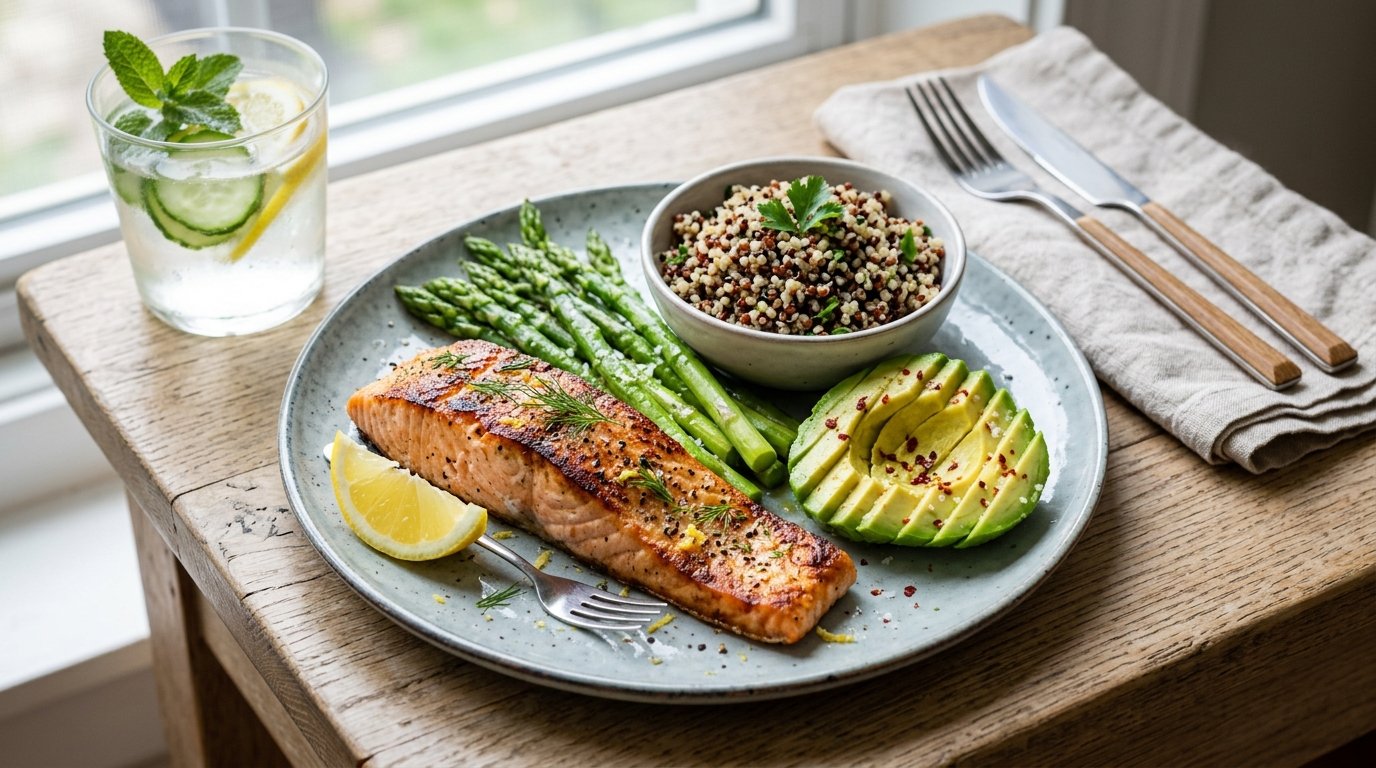
The best time to prepare is while you are still on the medication and hunger is easy to manage. If you already stopped, don’t worry. Start here anyway.
- Talk to your prescriber about how to stop. Some clinicians step the dose down gradually instead of stopping abruptly. The evidence on tapering is still thin, so this is a conversation to have, not a rule to follow on your own. Ask what weight change would make them want to see you again.
- Find your maintenance calories. Your needs are lower than before you started, because you are smaller. Use the maintenance calorie calculator with your current weight so you know roughly what “eating normally” means for the new you.
- Set your protein target. The 2025 joint advisory from four obesity and nutrition societies suggests higher protein during and after major weight loss, with ranges of about 1.2 to 1.6 g per kg of body weight proposed during active weight reduction. Plug your numbers into the protein calculator and aim to hit it most days.
- Start strength training now. Two or three short full-body sessions a week, started before you stop, means you walk into the off-medication phase with a habit already running.
- Record your baseline. Weight (as a weekly average), waist measurement, and a couple of photos. You will use these for your early-warning system later.
- Decide your “regain threshold” in advance. Pick a number, for example 3% above your current weight, that will trigger a specific action. More on this below.
If you are still in the middle of treatment and haven’t built this structure yet, the Complete GLP-1 Journey Bundle pairs the 28-day protein-first plan for while you’re on the medication with the after-plan for when you come off, so both phases follow the same system.
The First 12 Weeks Off: Where Most Regain Starts
The first three months are the danger zone. Hunger is rising, the scale may bounce, and it is easy to decide “it’s not working” and let go. Here is how to handle each part.
Expect a small bump and don’t panic
A kilo or two in the first weeks is often water and more food volume in your gut, not fat. Judge progress by your weekly average, not a single morning. Weigh 3 to 7 mornings a week under the same conditions and look at the trend.
Eat on a schedule, not on hunger alone
On the medication, hunger was a reliable signal because it rarely showed up. Off the medication, it will show up more often and louder. Three planned meals plus one planned snack gives your day a frame, so you’re not making food decisions when you’re at your hungriest.
Build every meal the same way
- Protein first: 25 to 40 g per meal from eggs, Greek yogurt, chicken, fish, lean beef, tofu, lentils or cottage cheese.
- Fiber second: half the plate vegetables, plus beans, oats, berries or chia. Fiber slows digestion and supports fullness, which matters more once the drug isn’t doing that job. The fibermaxxing guide shows how to raise it without bloating.
- Smart carbs third: a fist-sized portion of potatoes, rice, whole-grain bread or fruit, not zero.
- Some fat for taste: olive oil, avocado, nuts, measured with a spoon rather than poured.
Foods that naturally support satiety hormones, like the ones in this list of natural GLP-1 foods, are worth leaning on here. They won’t replace the medication, but they make the plate more filling per calorie.
Plan for the evening
For most people, returning hunger hits hardest after dinner. Decide your evening snack in the morning, something like Greek yogurt with berries or a protein shake, and close the kitchen after it. If you struggle to fit enough protein into a smaller appetite, a shake is a simple fix. Here are some good protein shake options.
What a typical day can look like
Here is a sample day for someone maintaining at roughly 1,800 to 2,000 calories with a protein target near 110 g. Adjust portions to your own numbers.
| Meal | Example | Approx. protein |
|---|---|---|
| Breakfast | 3-egg omelet with spinach and feta, 1 slice whole-grain toast, a handful of berries | 25 g |
| Lunch | Big salad with grilled chicken, chickpeas, cucumber, tomato, olive oil and lemon dressing | 35 g |
| Afternoon snack | Apple with 2 tablespoons peanut butter | 8 g |
| Dinner | Baked salmon, roasted vegetables, a fist-sized portion of rice or potatoes | 30 g |
| Evening | Greek yogurt with cinnamon and chia seeds | 15 g |
Notice what this day does not include: skipped meals, zero-carb rules or “cheat” days. The point is a pattern boring enough to repeat on a busy Tuesday. If you liked how structured your meals felt while you were on the medication, keep the same meal times and swap in slightly larger portions as your hunger and activity require.
Maintenance falls apart in restaurants and at family gatherings more often than at home. Two simple rules help: choose the protein first when you look at a menu, and decide before you arrive whether dessert is part of tonight. Planned treats rarely cause regain. Unplanned grazing across a whole weekend usually does.
Want This Laid Out Step by Step?
The After Plan is a 35-page guide for the months after your last dose of Ozempic, Wegovy, Mounjaro or Zepbound: how to handle returning appetite, protect your muscle, and catch regain early with a built-in early-warning tracker.
Get The After Plan: $27Strength Training: Your Best Insurance Policy

If you only change one thing, make it this. Muscle is the tissue you most want to keep, and resistance training is the main signal that tells your body to keep it. There is also trial evidence on keeping weight off: in the Danish S-LiTE trial, published in the New England Journal of Medicine in 2021, adults who had lost weight and then spent a year on exercise, liraglutide (an older GLP-1), or both, kept off more weight with exercise than without it, and the combination did best. Movement is not optional extra credit in the after-phase. It is part of the treatment.
A simple starting routine, two or three days a week:
- Squat to a chair or goblet squat: 3 sets of 8 to 12
- Push-up (wall, bench or floor): 3 sets of 8 to 12
- Dumbbell or resistance-band row: 3 sets of 10 to 12
- Hip bridge or Romanian deadlift: 3 sets of 10 to 12
- Farmer’s carry: 3 walks of 30 to 40 seconds
Add a little weight or a rep or two every week or two. Then layer daily walking on top. People who keep weight off long term tend to stay consistently active, and walking is the easiest movement to keep for years.
Your Regain Early-Warning System
This is the part most people skip, and it is the part that turns a plan into a safety net. Weight rarely jumps 10 kg at once. It drifts 1 kg, then 2, then 4, and by the time you notice, it feels too late. So decide your responses before you need them.
| Your weekly average is… | What you do |
|---|---|
| Within 2% of your post-medication weight | Nothing new. Keep the routine. |
| 2% to 3% above | Tighten up for two weeks: log food, hit protein daily, plan every evening snack, add one extra walk a day. |
| 3% to 5% above | Run a structured reset: fixed meal plan, three strength sessions, sleep and stress check. Review what changed. |
| More than 5% above, and still rising | Book an appointment with your prescriber. Restarting or switching medication is a legitimate medical option, not a failure. |
Write these numbers down now, with your actual weights in the boxes. Deciding in advance takes the emotion out of it later.
A Month-by-Month Plan for Your First Year
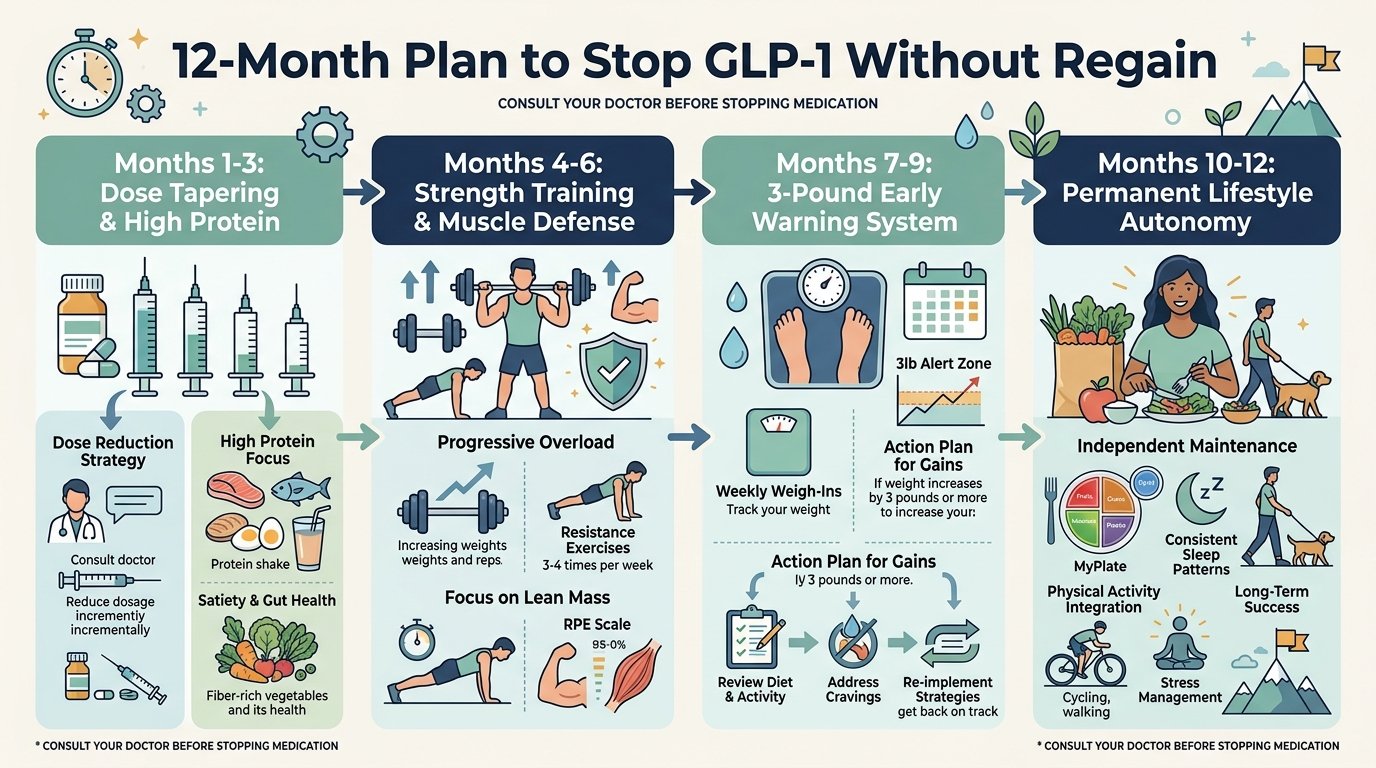
| Phase | Main focus |
|---|---|
| Last 4 weeks on medication | Talk to prescriber, set calorie and protein targets, start strength training, record baseline, write your regain thresholds. |
| Months 1 to 3 off | Scheduled meals, protein at every meal, evening plan, weekly weight average, strength 2 to 3x a week. |
| Months 4 to 6 off | Build flexibility: eating out, holidays, travel. Keep weighing weekly. Progress your strength training. |
| Months 7 to 12 off | Habits should feel normal now. Review the year, re-check your maintenance calories, keep your thresholds in place. |
Sleep and Stress: The Quiet Regain Triggers
Short sleep increases appetite and makes high-calorie food more tempting, which is the last thing you need when the medication’s appetite support is gone. If you have been sleeping badly, read why sleep deprivation causes weight gain and set a fixed wind-down time. Stress works the same way through cortisol and emotional eating. A planned response, like a walk, a call with a friend or a set snack, beats relying on willpower in the moment.
When Restarting Medication Is the Right Answer
Researchers increasingly describe obesity as a chronic, relapsing condition, and the trials above support that view. For some people, the right long-term plan is a maintenance dose, not zero. There’s no shame in that, any more than there is in taking blood pressure medication long term. Some people also switch to a different option, including the newer daily GLP-1 pills. The goal isn’t to prove you can live without the drug. The goal is to stay healthy at a weight you can maintain.
Frequently Asked Questions
How fast do you gain weight after stopping Ozempic?
Averages vary by study. The 2026 BMJ meta-analysis estimated about 0.8 kg (1.8 lb) per month for semaglutide and tirzepatide once treatment stopped, with the fastest regain in the first year. Individual results vary widely, and a structured plan can slow or prevent it.
Can I stop Ozempic cold turkey?
You can physically stop, but it is a decision to make with your prescriber, especially if you take it for diabetes. Stopping without a plan raises the risk of rapid regain and a rise in blood sugar.
When does hunger come back after the last dose?
Usually gradually over several weeks, as the medication clears. Many people notice a clear change within the first month. Planning meals before that point makes the transition much easier.
Does tapering the dose prevent regain?
Tapering may make the transition feel smoother, but there isn’t strong evidence yet that it prevents regain on its own. Nutrition, strength training and monitoring still do the heavy lifting.
Is it the same for Wegovy, Mounjaro and Zepbound?
Yes, the pattern is similar. Wegovy and Ozempic contain semaglutide; Mounjaro and Zepbound contain tirzepatide. Both showed significant regain after stopping in trials, and the same maintenance strategies apply.
The Bottom Line
Stopping a GLP-1 doesn’t mean you’re destined to gain it all back, but stopping without a plan often does. Prepare while you’re still on the medication, eat protein and fiber at every meal, lift something two or three times a week, watch your weekly average, and decide in advance when you’ll act. If you want everything in one place, The After Plan turns this into a week-by-week system with trackers you can print.
References
- West S, et al. Weight regain after cessation of medication for weight management: systematic review and meta-analysis. BMJ, 2026.
- University of Oxford. Stopping weight-loss drugs linked to faster regain than ending diet programmes. January 2026.
- Wilding JPH, et al. Weight regain and cardiometabolic effects after withdrawal of semaglutide: The STEP 1 trial extension. Diabetes, Obesity and Metabolism, 2022.
- Mozaffarian D, et al. Nutritional priorities to support GLP-1 therapy for obesity: a joint advisory. 2025.
