

You’ve just been told your periods are irregular because of PCOS, and the first thing everyone mentions is “watch your diet” — but nobody tells you whether fruit is still allowed. I get asked this constantly, and the short answer is yes, you can absolutely eat fruit with PCOS. The real question isn’t whether fruit is allowed, it’s which fruits keep your blood sugar steady and which ones work against you.
PCOS symptoms tend to cluster together in a way that makes the condition obvious once you know what to look for:
- Missed or irregular periods
- Excess hair growth on the face or chest (hirsutism)
- Oily skin and stubborn acne along the jawline
- Weight that climbs even when you haven’t changed what you eat
- Weight that refuses to come off despite a strict diet and regular workouts
Underneath nearly all of these symptoms is the same mechanism: insulin resistance. Roughly 70% of women with PCOS have some degree of it, and that’s exactly why the fruit you pick matters more here than it would for someone without the condition. A diet built around lower-glycemic foods won’t cure PCOS, but it can meaningfully ease the hormonal knock-on effects: steadier blood sugar, less acne, and periods that show up closer to on time.
Some women land on this through low-carb approaches like the South Beach Diet, the Atkins Diet, or Weight Watchers. If you’re counting carbs for PCOS, the fruit list below is the piece most people get wrong first.
I built the 4-Week Weight Loss Planner for exactly this kind of frustration — the version of weight loss where you’re doing everything “right” and your hormones still aren’t cooperating. It walks you through tracking food, symptoms, and progress side by side so you can actually see what’s working instead of guessing.
What glycemic index actually means for your PCOS symptoms
Glycemic index (GI) ranks how fast a carbohydrate raises your blood sugar compared to pure glucose, on a scale to 100. Foods scoring 55 or under are considered low-GI, 56 to 69 is medium, and 70-plus is high. That’s the number everyone quotes. The one that matters more for PCOS, and that almost nobody mentions, is glycemic load (GL) — which factors in how much carbohydrate is actually in a normal serving. Watermelon has a high GI but a tiny GL per serving because it’s mostly water, which is why a wedge of it won’t spike you the way the number alone suggests.
A 2025 systematic review in Frontiers in Nutrition pooled 16 randomized controlled trials on carbohydrate quality in PCOS and found that low-GI eating patterns measurably reduced fasting insulin and improved HOMA-IR (the standard marker of insulin resistance), while high-fiber diets produced the biggest gains in weight loss, especially for women over 30. The two approaches overlap heavily — most low-GI fruits are also high in fiber — which is exactly why the picks below lean on both.
Cleveland Clinic’s current PCOS nutrition guidance calls a low-glycemic approach “the gold standard for managing blood sugar” for women who aren’t on insulin themselves, and it specifically steers people toward citrus, berries, and melon over higher-sugar tropical fruit. That lines up with what I’m about to walk you through, fruit by fruit.
👉 PCOS Keto Diet Plan: A Safe, Effective Low-Carb Approach for Women | Free PDF Download
The best low-glycemic fruits for PCOS
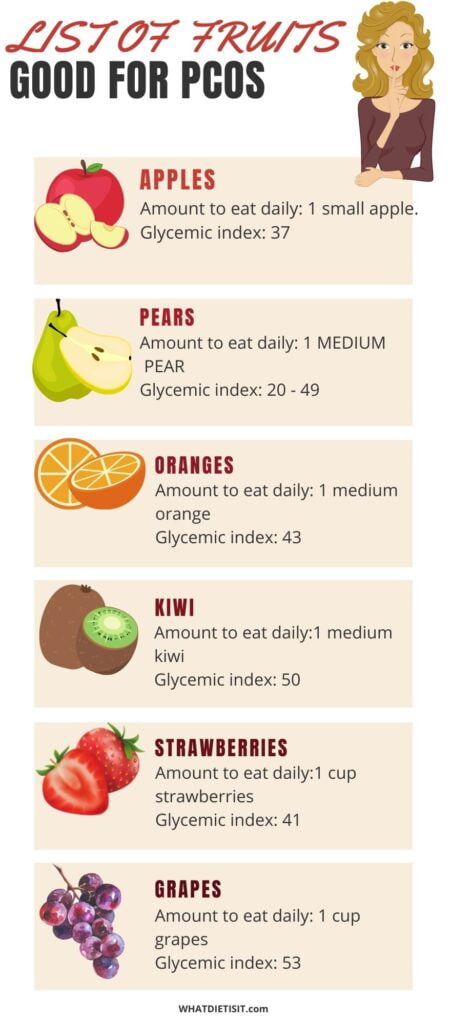
Every fruit on this list earns its place because of fiber, not because it’s “low sugar” in some vague sense. Fiber slows digestion, which blunts the blood sugar spike that would otherwise follow. That’s especially true of fruit you eat skin-on — berries, apples, pears, peaches — where most of the fiber actually lives.
Apples — GI around 36
Daily amount: 1 small apple, skin on
Apples sit near the bottom of the GI scale for a reason: one medium apple carries about 4 grams of fiber, split between soluble pectin (which slows digestion) and insoluble fiber (which helps things move along). Eat the skin — that’s where most of the fiber and the polyphenol antioxidants concentrate, and peeling it strips away the part doing the actual work for your blood sugar.
Pears — GI around 38
Daily amount: 1 medium pear
A medium pear has close to 6 grams of fiber — more than an apple — which is why its GI stays low despite being just as sweet. Pears and apples both contain pectin, the fiber type that feeds beneficial gut bacteria, so alternating between the two instead of eating the same fruit on repeat isn’t just for variety’s sake.
Oranges — GI around 43
Daily amount: 1 medium orange
Eat the orange instead of drinking the juice — juicing removes the pulp fiber that’s keeping the GI down, which is also why a glass of orange juice spikes blood sugar far faster than the whole fruit. A medium orange gives you close to 3 grams of fiber and a full day’s vitamin C.
Kiwi — GI around 50
Daily amount: 1 medium kiwi
Kiwi sits right at the edge of the low-GI range, but it earns its spot with one of the highest vitamin C counts of any fruit on this list — more per gram than an orange. The fuzzy skin is edible too, if you don’t mind the texture, and it adds another gram or two of fiber.
Strawberries — GI around 40
Daily amount: 1 cup, whole
A full cup of strawberries has under 50 calories and roughly 3 grams of fiber, so you get volume and sweetness without much of a glycemic hit. They’re also one of the richest common sources of anthocyanins, the antioxidant compounds linked to lower inflammation markers in several PCOS nutrition studies.
Grapes — GI around 46
Daily amount: 1 cup
Grapes land in the middle of this list’s GI range, which is exactly why portion matters more here than with apples or pears. A cup is a snack; a bowl eaten absentmindedly in front of the TV is closer to a dessert. Red and purple grapes carry resveratrol and other polyphenols that have been studied for their effect on insulin sensitivity, though the amounts in a normal serving are modest.
Peaches — GI around 42
Daily amount: 1 large peach
A peach gives you roughly 2 grams of fiber and a solid dose of vitamin A alongside its natural sweetness, and the skin — again — is where most of that fiber sits. If you’re buying canned peaches, check the label: syrup-packed versions push the GI and sugar load up considerably compared to fresh or water-packed fruit.
Bananas — GI around 51 when ripe
Daily amount: half of a large banana
Here’s the detail most lists skip: a banana’s GI climbs the riper it gets, because the starch converts to sugar as it ripens. A greener banana with a little bit of bite left in it runs meaningfully lower on the GI scale than the fully speckled, soft one. Bananas are also one of the better potassium sources on this list, which matters for blood pressure regulation alongside the blood sugar picture.
Cantaloupe — GI around 65, but a low glycemic load
Daily amount: about 2 slices (120g)
This is the clearest example of why GI alone is misleading. Cantaloupe’s GI looks high next to apples or pears, but it’s roughly 90% water, so a normal 120-gram serving only contains about 6 grams of actual carbohydrate — giving it a glycemic load of around 4, which is low. It’s a good source of vitamin A and a genuinely hydrating snack in hot weather.
Plums — GI around 39
Daily amount: 2 small plums
Plums are sweet, juicy, and still low-GI thanks to a fiber and polyphenol content similar to peaches. Dried plums (prunes) are a different story — drying concentrates the sugar into a much smaller volume, so the serving size that feels “normal” ends up being a much bigger glycemic hit than fresh fruit.
The PCOS diets that actually hold up, beyond just picking fruit
Fruit is one piece of a bigger pattern. Before you build a full PCOS diet plan, it helps to know which overall approaches have evidence behind them for this specific condition, rather than borrowing a diet that was designed for something else entirely.
👉 Best Protein Shakes for PCOS (What Helps vs What Can Worsen Symptoms)
Low glycemic index eating
This is the pattern with the most direct PCOS research behind it right now. Because low-GI foods digest more slowly, insulin doesn’t have to spike as hard to clear the glucose from your blood — and since insulin resistance drives so much of PCOS, that slower insulin response is the whole point. If you want to see exactly what insulin resistance does and how to eat around it specifically, I’ve laid it out in more detail in my insulin resistance diet guide, and there’s a printable insulin resistance shopping list if you’d rather start from a cart than a theory.
Whole grains, legumes, nuts, seeds, and the fruits above all belong in this category. I’d stop short of calling it a cure for anything — no diet reverses PCOS — but the research consistently shows it eases the downstream symptoms: steadier energy, fewer cravings, and in many cases, more regular cycles over a few months.
Because insulin resistance is the mechanism doing most of the damage here, some women pair the dietary changes with something that directly targets insulin sensitivity. Berberine is the one with the most research behind it for this specific purpose — several small clinical trials have compared it to metformin for insulin sensitivity with comparable results — which is why I point PCOS readers toward this berberine supplement when diet changes alone aren’t moving the needle fast enough. Disclosure: this post contains affiliate links. If you buy through them I may earn a small commission at no extra cost to you — see my affiliate disclosure for details.
The DASH diet
DASH was built for blood pressure, not PCOS, but it’s been adapted for PCOS use because the underlying structure — lean protein, lots of produce, limited sodium and added sugar — overlaps with what already helps insulin resistance. If you want the full DASH diet food list, it’s a useful cross-reference against the fruit list above.
Low-fat, high-protein eating
This pattern keeps calories moderate while staying high enough in protein to actually feel full — lean poultry and fish do most of the heavy lifting here, which is part of why the Perricone-style approach of built-in fish at most meals shows up across several PCOS eating plans, not just skincare-driven ones.
PCOS fruits and vegetables, together
Fruit works better paired with vegetables than eaten alone, mostly because the combined fiber load does more to blunt a blood sugar spike than either does by itself. Dark leafy greens, broccoli, and other non-starchy vegetables round out what Cleveland Clinic’s current guidance calls the backbone of a PCOS-friendly plate — and if dairy is something you’re still unsure about with PCOS, I’ve covered that separately, since the answer isn’t as simple as “avoid it.”
The antioxidants in produce also do real work against the low-grade inflammation that shows up in PCOS bloodwork more often than in women without the condition — which is part of why eliminating carbohydrates entirely isn’t actually the fix some women assume it is. Cutting out fruit along with the refined carbs that genuinely work against PCOS throws out the fiber and antioxidants that were helping in the first place.
🥗 Stop guessing what to eat
The 4-Week Weight Loss Planner walks you through tracking food, cycles, and symptoms together, so you can actually see what’s moving the needle on your PCOS weight instead of starting over every few weeks.
Get the Planner — $5 →Common fruit mistakes I see women with PCOS make
- Drinking fruit instead of eating it. Smoothies and juices strip or blend away the fiber that was keeping the GI low, so the blood sugar response ends up closer to drinking soda than eating the whole fruit.
- Cutting out fruit entirely to “be safe.” This usually backfires — you lose fiber and micronutrients and end up hungrier, which tends to trigger worse choices later in the day.
- Eating fruit on an empty stomach as a stand-alone snack. Pairing it with a source of protein or fat (a handful of almonds, a spoon of Greek yogurt) slows absorption even further and keeps you fuller longer.
- Treating all “natural sugar” as equal. A cup of grapes and a cup of dried mango are not the same food metabolically — drying concentrates sugar density dramatically.
Quick answers on PCOS and fruit
Can I eat mango or pineapple with PCOS?
In small portions, yes. Both run medium-to-high on the glycemic index, so a half-cup rather than a full plate keeps them reasonable, especially paired with protein.
Is fruit juice ever okay on a PCOS diet?
Treat it like a dessert rather than a health drink. Without the fiber, juice raises blood sugar much faster than whole fruit, even when it’s labeled “100% juice, no added sugar.”
How much fruit per day is reasonable with PCOS?
Most PCOS-focused guidance lands around 2 servings a day, spread across meals rather than eaten all at once, and paired with protein or fat when possible.
None of this replaces a conversation with your doctor, especially if you’re also managing insulin resistance, diabetes, or taking medication that affects blood sugar — the fruit choices above are a starting framework, not a personalized prescription.
