

Your TSH is in range, your refills are on time, and you still feel tired, foggy and puffy. So you search for a Hashimoto’s diet and get told to drop gluten, dairy, soy and nightshades by tomorrow. Here is the honest version: food does not treat Hashimoto’s thyroiditis, but a few food habits really do change how you feel, and the timing of your levothyroxine matters more than any superfood.
I’m Dr. Nada, a pharmacist with a certification in Nutrition Science from Zewail International Academy. In this guide I go through what the evidence supports for a Hashimoto’s thyroiditis diet plan, what is still unproven, and what I would try first. You get a food list, a selenium table, a fair way to test gluten, and a 7-day sample menu. None of it replaces your thyroid medication or your doctor’s advice.
What a Hashimoto’s Diet Can and Can’t Do
Hashimoto’s thyroiditis is an autoimmune condition in which the immune system attacks the thyroid. It is a common cause of an underactive thyroid (hypothyroidism). When the thyroid is underactive, the usual treatment is levothyroxine, a synthetic version of the hormone T4. The National Institute of Diabetes and Digestive and Kidney Diseases notes that blood tests are usually done 6 to 8 weeks after you start the medicine and after each dose change, then every 6 months and later yearly once the dose is stable.
What food can realistically do for you:
- Help your medication work as intended. Some foods and supplements reduce how much levothyroxine you absorb, which is why timing comes first in this guide.
- Cover gaps that a blood test has actually found. Guessing at supplements is how people end up taking too much selenium or iodine.
- Keep energy and digestion steadier. Regular meals with protein, fiber and healthy fats are a sensible baseline for anyone, and they are easy to adjust if certain foods leave you bloated.
What food cannot do: cure Hashimoto’s, replace levothyroxine, or reliably lower your antibodies. If a plan promises any of that, close the tab. For the bigger picture on what the thyroid needs, my guide on how to reset your thyroid gland and the honest limits in what food can and can’t do for thyroid hormone are good companions to this one.
Step One: Get Your Levothyroxine Timing Right
This is the least glamorous part of a Hashimoto’s diet and the one I would fix first. According to MedlinePlus, levothyroxine is taken once a day on an empty stomach, about 30 minutes to 1 hour before breakfast, swallowed with a full glass of water. Your label directions take priority over anything I write here.
Three details are worth knowing:
- Calcium and iron need space. MedlinePlus says calcium carbonate and ferrous sulfate should be taken at least 4 hours before or 4 hours after levothyroxine. That includes the calcium in many antacids and the iron in many multivitamins.
- Some foods interfere. MedlinePlus lists soybeans, walnuts and dietary fiber as foods that may affect how levothyroxine works, and NIDDK adds grapefruit juice and espresso. You do not need to ban them. Keep them away from your morning dose and eat them consistently rather than in bursts.
- Consistency beats perfection. Take the pill the same way every day. If you change your routine (a new supplement, a new breakfast habit), mention it to your doctor so a lab result is not misread.
As a pharmacist, I would rank this above every food rule below. A flawless anti-inflammatory plate cannot make up for a calcium supplement swallowed together with your pill.
What Research Suggests About Diet and Hashimoto’s
The honest summary is that the evidence for specific diets is thin, and the evidence for fixing specific problems is better. Here is what I could verify from trustworthy sources.
Gluten: clear for celiac disease, unproven for everyone else
A 2012 study in the Journal of Clinical Endocrinology and Metabolism, summarized by the American Thyroid Association, found that people with Hashimoto’s who also had celiac disease needed higher levothyroxine doses, and their TSH fell after they started a gluten-free diet without a dose change. That is a real finding, but it is about celiac disease. The same summary does not show that a gluten-free diet helps Hashimoto’s in people without it.
Selenium: lower antibodies, but no proven symptom benefit
The NIH Office of Dietary Supplements reports that selenium supplements lowered thyroid peroxidase antibodies in people already treated with levothyroxine, but did not change thyroid function, thyroid ultrasound appearance or quality of life, and the authors concluded the evidence does not support supplementing for this condition. NIDDK likewise says no specific guidance on selenium or vitamin D is currently available. So a lower antibody number is not the same as feeling better.
Iodine: more is not better
The thyroid uses iodine to make hormone, but NIDDK warns that people with Hashimoto’s may be sensitive to too much of it. Kelp, dulse and other seaweed, iodine supplements and some iodine-containing medicines can cause or worsen hypothyroidism. Ask your doctor which foods to limit and check whether any cough syrup you use contains iodine.
The general eating pattern
No diet has been proven to reverse Hashimoto’s. A pattern built on vegetables, fruit, fish, olive oil and minimally processed food is a reasonable choice for general health, and it is the pattern I use for the food list and menu below. If you want more detail on that style of eating, see my anti-inflammatory diet guide and grocery list, and if digestion is your main complaint, read about what actually supports a leaky gut with the same skepticism I apply here.
Foods Commonly Included in a Hashimoto’s-Friendly Diet
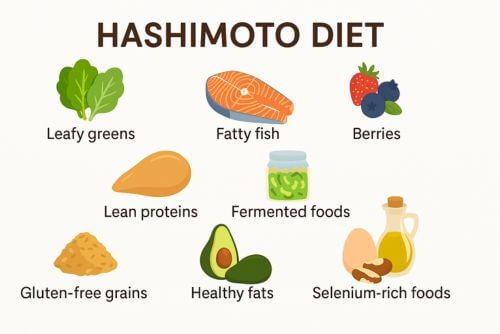
These are everyday foods that fit most Hashimoto’s plans. None of them is a thyroid cure; together they make a balanced plate that is easy to adjust if you find a trigger.
- Vegetables and fruit. Aim for a variety of colors: leafy greens, carrots, peppers, berries, apples and citrus. They bring fiber, which also helps digestion.
- Fish. Salmon, sardines and tuna give protein, omega-3 fats and selenium.
- Eggs, poultry and lentils. Steady protein at every meal helps keep energy even through the day.
- Gluten-free grains if you are avoiding gluten. Rice, quinoa, buckwheat and certified gluten-free oats.
- Olive oil, avocado and seeds. Easy sources of healthy fat. Keep nuts such as walnuts away from your morning pill.
- Fermented foods you tolerate. Plain yogurt or kefir, sauerkraut and kimchi suit many people, but skip them if they leave you bloated.
Selenium in common foods
Selenium is where a food-first approach can go wrong, because one food is extremely concentrated. The adult RDA is 55 mcg a day and the upper limit is 400 mcg a day, according to the Office of Dietary Supplements.
| Food | Selenium | Against the 55 mcg RDA |
|---|---|---|
| Brazil nut (1 nut) | about 68 to 91 mcg | more than a full day’s RDA |
| Yellowfin tuna, 3 oz cooked | 92 mcg | about 1.7 times the RDA |
| Egg, 1 large hard-boiled | 15 mcg | about a quarter of the RDA |
So one Brazil nut a day, or a couple a week, is plenty. A handful can push you past the upper limit, and long-term excess can cause hair loss, brittle nails, a garlic odor on the breath and a metallic taste.
Foods Some People with Hashimoto’s Choose to Limit
Many people with Hashimoto’s feel better after changing one or two things. The key word is feel: most of these are individual triggers, not rules. Try one change at a time.
Gluten-containing grains
Wheat, barley and rye are the first thing most people cut. If you have celiac disease, you need to avoid gluten completely and your medical team will guide you. If you do not, treat gluten as a test rather than a verdict, using the elimination method in the next section.
🌾 Thinking of trying gluten-free?
If you decide to test gluten for yourself, a plan beats guesswork. My Gluten-Free Lifestyle E-Book walks you through the swaps, label reading and meal ideas, so the trial is easier to stick to and easier to judge.
Dairy products
If milk or cheese leaves you gassy or bloated, you may be lactose intolerant, which is common and separate from Hashimoto’s. Lactose-free dairy or plant-based alternatives are an easy fix. My lactose intolerance diet list has the practical swaps. Remember that dairy is also a main calcium source, so if you cut it, ask your doctor how to keep your calcium up without taking it near your thyroid pill.
Soy and soy-based products
Soy is one of the foods MedlinePlus and NIDDK flag as able to interfere with levothyroxine. The practical rule is simple: keep soy away from the morning dose and keep your intake steady, rather than eating none for a week and a lot the next.
Seaweed and iodine supplements
Sea vegetables and kelp tablets can contain very large amounts of iodine. Unless your doctor has told you to take iodine, I would skip kelp supplements entirely and keep seaweed an occasional food.
Highly processed foods and added sugars
There is no thyroid-specific proof here, but ultra-processed snacks tend to crowd out the fiber, protein and vegetables that keep you full and steady. If this is your weak spot, my guide to a no processed food diet shows how to start without overhauling your whole kitchen.
Seed oils, nightshades and additives
These turn up on almost every Hashimoto’s do-not-eat list. I could not find solid evidence from the sources above that cutting them improves Hashimoto’s, so I would not start there. If a specific food clearly gives you joint pain or stomach upset, drop it for a few weeks and see.
How to Run a Fair Elimination Trial
Most people either give up too early or cut ten foods at once and learn nothing. This approach keeps the answer readable.
- Rule out celiac disease first if gluten is your suspect. Ask your doctor about testing before you stop eating gluten, because the standard celiac tests are designed to be done while you are still eating it.
- Change one thing. Remove one food group, such as gluten or lactose, and keep everything else the same. If you try gluten-free, my guide to starting a gluten-free diet covers the practical side, and dangers of a gluten-free diet if you are not celiac covers what to watch for.
- Track symptoms. Note energy, bloating, brain fog and sleep each day. A few lines in a notes app is enough.
- Give it enough time, then reintroduce. Stay with the change long enough to judge it, usually several weeks, then add the food back and see whether the symptoms return. If they do not, you did not need to cut it.
- Do not add supplements during the trial. If you start selenium, vitamin D and a new diet at once, you will never know which one did what.
Sample 7-Day Meal Ideas for Hashimoto’s Thyroiditis
These are meal ideas, not a prescription. They are built around whole foods, balanced protein, fiber and healthy fats, and they contain no soy. Eat breakfast at least 30 to 60 minutes after your levothyroxine, and adjust portions to your appetite and your doctor’s advice. If you also want to manage your weight, my article on calories on a hypothyroid diet explains how to set a sensible target.
Day 1
- Breakfast: Scrambled eggs with spinach and sliced avocado
- Lunch: Grilled chicken salad with olive oil and lemon dressing
- Snack: Apple slices with almond butter
- Dinner: Baked salmon with quinoa and steamed broccoli
Day 2
- Breakfast: Chia seed pudding with coconut milk and blueberries
- Lunch: Turkey lettuce wraps with avocado and shredded carrots
- Snack: One Brazil nut and a few berries
- Dinner: Stir-fried shrimp with bok choy and cauliflower rice
Day 3
- Breakfast: Smoothie with kale, banana, flaxseeds and almond milk
- Lunch: Lentil soup with gluten-free toast if you avoid gluten
- Snack: Carrot sticks and hummus
- Dinner: Grilled chicken breast with roasted sweet potatoes and green beans
Day 4
- Breakfast: Gluten-free oatmeal topped with berries and chia seeds
- Lunch: Quinoa bowl with black beans, avocado and roasted vegetables
- Snack: Hard-boiled egg and cucumber slices
- Dinner: Baked cod with wild rice and sautéed zucchini
Day 5
- Breakfast: Coconut yogurt with raspberries and pumpkin seeds
- Lunch: Tuna salad with mixed greens and sunflower seeds
- Snack: Pear slices
- Dinner: Turkey meatballs with spaghetti squash and tomato basil sauce
Day 6
- Breakfast: Sweet potato hash with eggs and kale
- Lunch: Grilled vegetable wrap in a gluten-free tortilla
- Snack: Smoothie with spinach, berries and your usual protein powder (check it is soy-free)
- Dinner: Grilled lamb chops with mashed cauliflower and asparagus
Day 7
- Breakfast: Almond flour pancakes with berries and a little maple syrup
- Lunch: Chicken and avocado salad with lemon tahini dressing
- Snack: Celery sticks with cashew butter
- Dinner: Stuffed bell peppers with ground turkey and brown rice
Lifestyle Habits That May Support How You Feel
Habits do not treat Hashimoto’s, but fatigue is the symptom people complain about most, and these are the habits that tend to help with it.
- Protect your sleep. Poor sleep makes fatigue and brain fog worse, whatever your thyroid numbers say. If tiredness is your main complaint, my article on what to eat for hypothyroidism fatigue goes deeper.
- Move in a way that does not wipe you out. Walking, swimming or gentle strength work usually suits people better than punishing workouts when energy is low.
- Keep stress in check. Short daily practices such as walking outdoors, breathing exercises or journaling are simple places to start.
- Keep your lab appointments. Dose adjustments are based on blood tests, not on how disciplined your diet is.
Common Questions About Eating with Hashimoto’s
Can Hashimoto’s be managed through diet alone?
No. If your thyroid is underactive, the recommended treatment is levothyroxine, and diet does not replace it. Never stop or change the dose without your doctor.
Can I drink coffee with Hashimoto’s?
Yes, but not at the same time as your pill. NIDDK lists espresso among the things that can reduce absorption, so take levothyroxine first, wait the 30 to 60 minutes your label or doctor advises, then have coffee with breakfast.
Should I take selenium for Hashimoto’s?
Not automatically. The evidence shows lower antibodies but no proven benefit for thyroid function or quality of life, and too much causes harm. Ask your doctor before supplementing and keep to food sources otherwise.
Is a gluten-free diet necessary?
It is essential if you have celiac disease. If you do not, it is an optional experiment, and a fair trial is described above.
Can dairy or soy affect my medication?
Soy can, so keep it away from your morning dose. Dairy matters mostly through its calcium, which should be taken at least 4 hours apart from levothyroxine if it is in supplement form such as calcium carbonate.
Is intermittent fasting safe with Hashimoto’s?
It depends on you and your medication schedule. Because levothyroxine is taken on an empty stomach and needs a gap before food, check with your doctor before changing your eating window.
The Short Version
Put your levothyroxine routine in order first, get your levels tested before you buy supplements, eat a balanced whole-food plate, and test one suspected trigger at a time. That is a plan you can keep, and it avoids both under-treating a real condition and over-restricting your diet.
This article is educational and does not replace personal medical advice. Talk to your doctor or pharmacist before changing your diet, starting supplements, or adjusting thyroid medication, especially if you are pregnant or taking other medicines.
Written by Dr. Nada, a pharmacist certified in Nutrition Science (Zewail International Academy). This article is educational and not a substitute for personal medical advice.
Last reviewed: October 2026.
References
- NIDDK. Hashimoto’s Disease. National Institute of Diabetes and Digestive and Kidney Diseases.
- MedlinePlus. Levothyroxine. National Library of Medicine.
- NIH Office of Dietary Supplements. Selenium: Health Professional Fact Sheet.
- American Thyroid Association. Clinical Thyroidology for Patients: celiac disease and levothyroxine need, summarizing Virili C, et al. Journal of Clinical Endocrinology and Metabolism, 2012.
