

If you’re living with PCOS, you’re probably familiar with how frustrating belly fat can be. You might be eating well, trying to stay active, and still notice that the weight around your lower abdomen just doesn’t budge. You’re not imagining it—and you’re definitely not alone. This is often called PCOS belly fat, and it’s closely linked to hormonal imbalances and insulin resistance.
The good news is that you’re not powerless against it. While PCOS doesn’t have a one-size-fits-all cure, the right kind of exercise can make a real difference. Not extreme workouts. Not exhausting routines. But consistent, PCOS-friendly exercises that support your hormones, improve insulin sensitivity, and help your body burn fat more effectively.
In this article, you’ll find the best exercises to reduce PCOS belly fat naturally—moves that are realistic, beginner-friendly, and easy to fit into your daily routine. These exercises are designed to work with your body, not against it, helping you feel stronger, more confident, and more in control of your health.
Contents
- 1 What Is PCOS Belly Fat and Why Is It Different?
- 2 Can Exercise Really Help Reduce PCOS Belly Fat?
- 3 Best Exercises to Reduce PCOS Belly Fat Naturally
- 4 How Often Should You Exercise If You Have PCOS?
- 5 Download Free PDF
- 6 Exercises to Avoid or Limit With PCOS
- 7 Additional Tips to Reduce PCOS Belly Fat Faster
- 8 When to Expect Results From PCOS-Friendly Exercise
- 9 Final Thoughts
- 10 Before Starting Hard Diets
- 11 Struggling with unsustainable diets and frustrated by the lack of results?
What Is PCOS Belly Fat and Why Is It Different?
If you’ve ever looked at your body and thought, “Why does my belly hold onto fat no matter what I do?”—you’re not imagining things. When you have PCOS, belly fat behaves differently than typical weight gain. And most importantly, this is not a willpower problem. It’s a hormonal one.
Understanding why PCOS belly fat is different is the first step toward choosing exercises and habits that actually work for your body.
How Hormones Influence Where Your Body Stores Fat
With PCOS, your hormones don’t always work in balance. Research shows that many women with PCOS have higher androgen levels (often called “male hormones”), which affect how and where fat is stored.
Instead of fat being evenly distributed, your body is more likely to store it around the abdomen—especially the lower belly. This pattern is sometimes called central or abdominal fat distribution and is common in PCOS, even in women who are not overweight overall.
This is why:
- Your belly may feel disproportionate to the rest of your body
- Weight gain can appear suddenly
- Losing fat from this area feels much harder than expected
The Role of Insulin Resistance in PCOS Belly Fat
One of the biggest drivers of PCOS belly fat is insulin resistance, which has been widely documented in peer-reviewed endocrinology studies.
Here’s what that means in simple terms:
- Your body produces insulin to control blood sugar
- With insulin resistance, your cells don’t respond properly
- Your body releases more insulin to compensate
- High insulin levels signal your body to store fat, especially in the abdomen
This is why PCOS belly fat can persist even when:
- You eat relatively well
- You exercise occasionally
- You’re not consuming excess calories
Insulin doesn’t just affect blood sugar—it directly affects fat storage and fat breakdown.
Why PCOS Belly Fat Feels So Stubborn
PCOS belly fat is metabolically different from other types of fat. Studies suggest it is more visceral, meaning it sits deeper around the organs rather than just under the skin.
This type of fat:
- Is more hormonally active
- Responds poorly to crash diets
- Can increase inflammation in the body
- Is linked to higher cortisol (stress hormone) levels
That’s why extreme workouts or restrictive dieting often backfire, leaving you exhausted, stressed, and discouraged—without real results.
If this sounds familiar, it’s not because you’re doing something wrong. It’s because your body needs a PCOS-specific approach.
Why the Right Exercise Approach Matters for PCOS
Not all exercise affects hormones in the same way. Research shows that moderate, consistent, and low-stress physical activity can:
- Improve insulin sensitivity
- Lower excess androgen levels
- Reduce abdominal fat over time
- Support a healthier hormonal environment
This is why PCOS-friendly exercises focus on:
- Strength training over endless cardio
- Low-impact movement instead of high stress
- Consistency rather than intensity
When exercise works with your hormones instead of against them, belly fat becomes much more responsive.
Can Exercise Really Help Reduce PCOS Belly Fat?
If you’ve tried exercising before and felt disappointed by the results, you’re not alone. Many women with PCOS put in real effort—walking, dieting, even intense workouts—yet see little change in their belly fat. So it’s completely valid to ask: does exercise actually help with PCOS belly fat, or is it a myth?
The honest answer is yes, exercise can help—but only when it’s the right type of exercise done in the right way for a PCOS body.
Why Exercise Works Differently When You Have PCOS
With PCOS, the goal of exercise goes beyond burning calories. Research consistently shows that physical activity helps PCOS primarily by improving insulin sensitivity and hormonal regulation, not by rapid weight loss alone.
When you exercise regularly:
- Your muscles become more responsive to insulin
- Your body needs to produce less insulin overall
- Lower insulin levels reduce fat storage signals
- And abdominal fat becomes easier to mobilize
This is why progress with PCOS often looks slower at first—but becomes more sustainable over time.
The Link Between Exercise, Insulin Sensitivity, and Belly Fat
Peer-reviewed studies have shown that moderate-intensity exercise, especially resistance training and low-impact cardio, can significantly improve insulin resistance in women with PCOS—even without major weight loss.
That matters because:
- Insulin resistance is strongly linked to abdominal fat storage
- Improving insulin sensitivity reduces new fat accumulation
- Over time, this helps shrink PCOS-related belly fat
In other words, exercise changes the internal environment that caused the belly fat in the first place.
Why Extreme Workouts Can Backfire With PCOS
This is where many women get stuck. High-intensity, overly frequent workouts can increase cortisol, the stress hormone. Elevated cortisol has been shown to worsen insulin resistance and promote abdominal fat storage—especially in hormonally sensitive conditions like PCOS.
Signs your workouts may be working against you:
- Feeling constantly exhausted
- Increased cravings
- No change (or weight gain) around the belly
- Irregular cycles becoming worse
That’s why PCOS-friendly exercise focuses on balance, not punishment.
What Kind of Exercise Is Most Effective for PCOS Belly Fat?
Research suggests the most effective approach combines:
- Strength training to build muscle and improve glucose uptake
- Low-impact cardio to support metabolism without overstressing the body
- Consistency over intensity, allowing hormones time to respond
This approach supports fat loss gradually while improving overall metabolic health—making results more likely to last.
What Results You Can Realistically Expect
Exercise won’t flatten your belly overnight—and it shouldn’t promise to. But when done consistently, many women with PCOS notice:
- Reduced waist circumference
- Less bloating and abdominal tightness
- Improved energy levels
- Better cycle regularity over time
These changes are signs your hormones and metabolism are moving in the right direction.
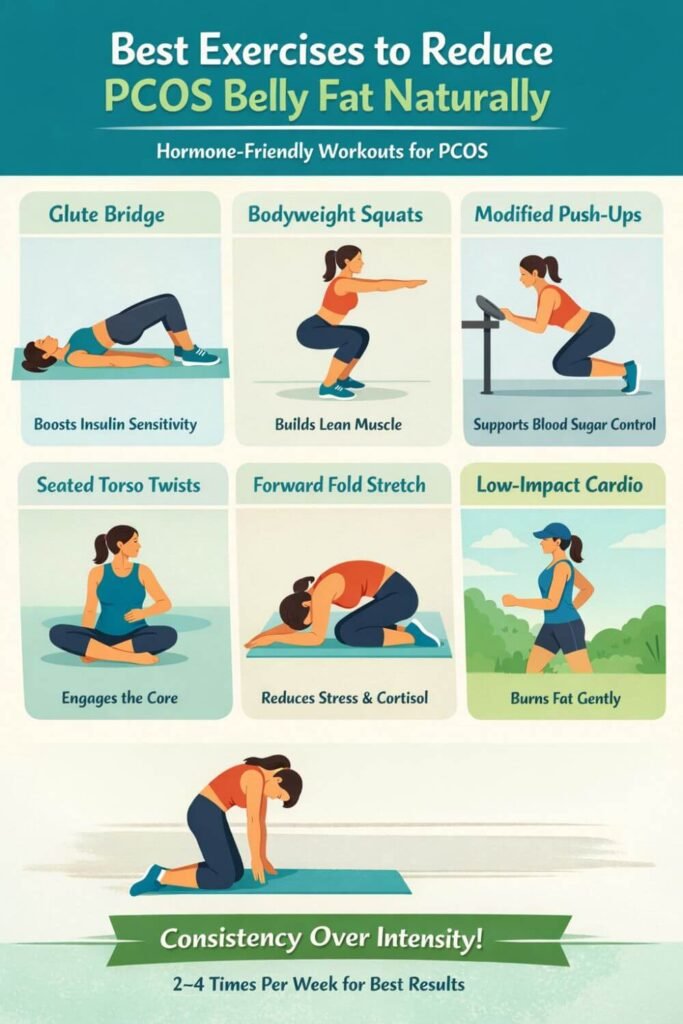
Best Exercises to Reduce PCOS Belly Fat Naturally
When it comes to PCOS, the best exercises aren’t the hardest or the most exhausting—they’re the ones that support your hormones, improve insulin sensitivity, and reduce stress on your body. The goal isn’t to punish yourself into losing belly fat, but to create the right internal environment where fat loss can actually happen.
The exercises below are chosen specifically because research shows they are effective, sustainable, and gentle enough for women with PCOS when done consistently.
1- Glute Bridge
This simple movement is more powerful than it looks. The glute bridge activates large muscle groups in the lower body, which helps improve insulin sensitivity—one of the key drivers of PCOS belly fat.
Why it helps with PCOS:
- Engages large muscles that absorb glucose efficiently
- Supports metabolic health without spiking stress hormones
- Strengthens the core and lower body safely
How to do it:
- Lie on your back with knees bent and feet flat on the floor
- Press through your heels and lift your hips
- Squeeze your glutes at the top, then lower slowly
- Aim for 2–3 sets of 12–15 repetitions
2- Bodyweight Squats
Squats are one of the best exercises for PCOS because they build muscle while keeping cortisol levels in check when done at a moderate pace.
Why it helps with PCOS:
- Builds lean muscle, which improves insulin sensitivity
- Encourages fat burning over time
- Supports overall hormonal balance
Tips for PCOS-friendly squats:
- Move slowly and with control
- Keep your chest lifted and knees behind your toes
- Focus on form, not speed
- Start with 2 sets of 10–12 reps and build gradually
3- Modified Push-Ups (Wall or Incline)
Upper-body strength training is often overlooked, but it plays an important role in improving metabolic health and body composition in PCOS.
Why it helps with PCOS:
- Builds muscle without excessive strain
- Supports blood sugar control
- Helps reduce overall body fat, including abdominal fat
How to modify:
- Use a wall, countertop, or bench instead of the floor
- Keep your core engaged and movements slow
- Perform 2–3 sets of 8–12 repetitions
4- Seated Torso Twists
This gentle movement helps activate the core while also improving mobility and circulation. It’s especially useful if you’re just getting back into exercise.
Why it helps with PCOS:
- Strengthens core muscles without stress
- Improves digestion and circulation
- Supports mind–body connection, which helps lower cortisol
How to do it:
- Sit comfortably with your spine straight
- Rotate your torso slowly from side to side
- Keep the movement controlled and pain-free
- Perform 20–30 twists total
5- Forward Fold Stretch
While stretching doesn’t burn fat directly, it plays an important role in PCOS management by reducing stress and supporting hormonal regulation.
Why it helps with PCOS:
- Helps lower cortisol levels
- Improves flexibility and circulation
- Supports recovery between workouts
How to use it:
- Sit or stand and gently fold forward
- Breathe deeply and relax your shoulders
- Hold for 20–30 seconds
- Repeat 2–3 times
6- Low-Impact Cardio (Walking or Cycling)
Low-impact cardio is one of the most effective and underrated tools for PCOS belly fat reduction.
Why it helps with PCOS:
- Improves insulin sensitivity
- Supports fat metabolism without overstressing the body
- Can be done consistently without burnout
Best approach:
- 20–40 minutes per session
- Moderate pace where you can still talk
- 3–5 times per week
Walking after meals can be especially helpful for blood sugar control.
A Gentle Reminder for You
You don’t need to do all of these exercises at once. Even 2–4 sessions per week, done consistently, can lead to meaningful changes over time. Progress with PCOS is often gradual—but it is possible, and it does count.
Your body responds best when it feels supported, not pressured.
How Often Should You Exercise If You Have PCOS?
If you’ve ever wondered whether you’re exercising too little or too much with PCOS, you’re asking the right question. When it comes to PCOS, frequency matters just as much as the type of exercise—and more is not always better.
The goal is to move your body often enough to improve insulin sensitivity and hormonal balance, without triggering stress responses that can work against you.
The Ideal Weekly Exercise Frequency for PCOS
For most women with PCOS, research supports a moderate and consistent routine, rather than intense daily workouts.
A realistic and effective target is:
- 3–5 days of exercise per week
- With at least 1–2 rest or active recovery days
This frequency has been shown to improve metabolic markers in PCOS, including insulin sensitivity, waist circumference, and overall energy levels.
How to Balance Strength Training and Cardio
A balanced routine tends to work best for PCOS because it supports hormones without overwhelming the body.
A PCOS-friendly weekly split may look like:
- 2–3 days of strength or resistance training
- 2–3 days of low-impact cardio (such as walking or cycling)
Strength training helps your muscles use glucose more efficiently, while low-impact cardio supports fat metabolism and cardiovascular health without raising cortisol excessively.
Why Rest Days Are Not Optional With PCOS
Rest is not a setback—it’s part of the strategy.
With PCOS, your body can be more sensitive to physical stress. Without enough recovery time, cortisol levels may rise, which can:
- Worsen insulin resistance
- Increase abdominal fat storage
- Lead to fatigue and burnout
Including rest days helps your nervous system reset and allows your hormones to respond positively to exercise.
Signs You’re Exercising the Right Amount
Your body often gives subtle feedback when your routine is well balanced.
Positive signs may include:
- More stable energy levels
- Better sleep quality
- Reduced bloating or waist tightness
- Improved mood and motivation
Progress with PCOS is not always immediate or dramatic—but these changes suggest you’re moving in the right direction.
Signs You May Be Doing Too Much
If you’re pushing too hard, your body may let you know.
Common warning signs include:
- Persistent fatigue
- Increased cravings
- Difficulty recovering between workouts
- Worsening cycle irregularities
If this happens, reducing intensity or adding rest days can actually improve results.
A Gentle Reminder for You
Consistency beats intensity every time with PCOS. Even shorter workouts done regularly can be more effective than long, exhausting sessions that leave you depleted.
You’re not training for perfection—you’re training for hormonal balance, sustainability, and long-term health.
Exercises to Avoid or Limit With PCOS
If you have PCOS, it’s not that certain exercises are “bad” in general—it’s that some types of workouts can place extra stress on a hormonally sensitive body. When exercise consistently raises stress hormones or disrupts recovery, it may slow progress or even worsen symptoms.
The key is learning which exercises to limit, modify, or approach cautiously, especially if you’re dealing with fatigue, insulin resistance, or irregular cycles.
Excessive High-Intensity Interval Training (HIIT)
HIIT can be effective for some people, but doing it too often may not be ideal for PCOS.
Why it can be problematic:
- Frequently spikes cortisol (the stress hormone)
- May worsen insulin resistance when overused
- Can increase inflammation if recovery is insufficient
This doesn’t mean you can never do HIIT—but daily or very intense sessions may work against hormonal balance.
A better approach:
Limit HIIT to once per week or less, and keep sessions short and well-recovered.
Long, Exhaustive Cardio Sessions
Endless cardio—such as long runs or extended high-intensity cycling—can place chronic stress on the body, especially when combined with calorie restriction.
Why it may backfire with PCOS:
- Increases cortisol over time
- Can slow metabolism when done excessively
- May lead to muscle loss instead of fat loss
If cardio leaves you drained instead of energized, that’s a sign your body may need a gentler approach.
A better alternative:
Choose moderate, low-impact cardio like walking, cycling, or swimming for shorter durations.
Overtraining Without Rest Days
PCOS bodies often need more recovery, not less.
Training hard every day without rest can:
- Disrupt hormonal signaling
- Increase fatigue and cravings
- Stall fat loss, especially around the belly
Rest days allow insulin sensitivity and muscle repair to improve—both crucial for PCOS management.
Very Heavy Lifting Without Proper Recovery
Strength training is beneficial for PCOS, but constantly lifting very heavy weights without adequate rest can be too taxing for some women.
Potential issues:
- Increased stress response
- Poor recovery between sessions
- Higher risk of injury or burnout
PCOS-friendly strength training focuses on moderate weights, controlled movements, and good form—not constant maximal effort.
Exercise Done as Punishment
This one is just as important as the physical side.
Exercising out of guilt, frustration, or pressure can:
- Increase psychological stress
- Lead to inconsistent routines
- Make exercise unsustainable long-term
PCOS responds best to supportive, consistent movement, not punishment-based routines.
How to Know If an Exercise Isn’t Right for You
Your body gives feedback—learning to listen to it matters.
Consider adjusting your routine if you notice:
- Persistent exhaustion
- Increased belly bloating or weight gain
- Poor sleep or heightened anxiety
- Worsening cycle irregularity
These signs don’t mean exercise isn’t working—they mean it needs to be better matched to your needs.
A Reassuring Note for You
You don’t have to avoid exercise—you just need to choose it wisely. Many women with PCOS see better results when they do less, but do it consistently and intentionally.
Your body isn’t fragile. It’s responsive—especially when treated with patience and care.
Additional Tips to Reduce PCOS Belly Fat Faster
Exercise lays the foundation, but with PCOS, belly fat responds best when multiple lifestyle factors work together. Small, consistent changes in daily habits can make a noticeable difference—often more than pushing yourself harder in workouts.
These tips are not about perfection. They’re about supporting your hormones in ways that make fat loss possible and sustainable.
Prioritize Blood Sugar Balance Throughout the Day
With PCOS, keeping blood sugar stable is key to reducing insulin-driven fat storage.
Simple ways to support this include:
- Eating regular meals instead of skipping them
- Pairing carbohydrates with protein or healthy fats
- Avoiding large sugar spikes, especially on an empty stomach
Stable blood sugar helps lower insulin levels, which directly supports reduction of abdominal fat over time.
Manage Stress as Seriously as You Manage Exercise
Chronic stress can keep cortisol levels elevated, and cortisol is closely linked to belly fat—especially in women with PCOS.
Stress doesn’t just come from emotions; it can also come from:
- Overtraining
- Undereating
- Poor sleep
- Constant pressure to “fix” your body
Gentle stress-reducing practices like deep breathing, stretching, walking, or mindfulness can support hormonal balance just as much as exercise does.
Focus on Sleep Quality, Not Just Sleep Duration
Poor sleep has been shown to worsen insulin resistance and appetite regulation—both major factors in PCOS belly fat.
To support better sleep:
- Aim for a consistent sleep schedule
- Reduce screen exposure before bed
- Avoid intense workouts late at night
- Create a calming nighttime routine
Even modest improvements in sleep quality can positively affect hormones and metabolism.
Eat Enough to Support Your Body
Severely restricting calories can increase stress hormones and slow metabolic progress in PCOS.
If you’re undereating, your body may respond by:
- Holding onto fat
- Increasing cravings
- Reducing energy expenditure
A well-nourished body is more willing to release fat than one that feels deprived.
Be Consistent, Not Perfect
PCOS belly fat rarely responds to short bursts of effort. What matters most is consistency over time.
That means:
- Showing up even on low-energy days
- Choosing workouts you can maintain
- Allowing progress to be gradual
Many women notice meaningful changes not in weeks, but over months—and those changes tend to last.
Work With Your Healthcare Provider When Needed
Lifestyle changes are powerful, but they’re not a replacement for medical care.
A healthcare provider can:
- Screen for insulin resistance or hormonal imbalances
- Adjust medications if needed
- Help rule out other contributing conditions
Exercise and lifestyle habits work best when combined with proper medical support.
When to Expect Results From PCOS-Friendly Exercise
If you’re hoping for fast changes, it’s completely understandable. Living with PCOS often comes with years of frustration, and you may feel eager for proof that your efforts are working. The truth is, PCOS-friendly exercise does work—but it works gradually.
Progress with PCOS looks different from typical weight-loss timelines, and that doesn’t mean it’s ineffective.
The First Few Weeks: Internal Changes Come First
In the first 2–4 weeks, the most important changes are happening behind the scenes.
You may notice:
- Slight improvements in energy levels
- Better mood or reduced stress
- Less post-meal fatigue
- Improved sleep quality
These early changes reflect improvements in insulin sensitivity and nervous system balance, even if the scale or mirror hasn’t changed yet.
Around 1–3 Months: Subtle Physical Changes
Between 4–12 weeks, many women begin to notice physical signs that their body is responding.
These may include:
- Reduced bloating or abdominal tightness
- Small changes in waist measurements
- Clothes fitting more comfortably
- Better workout tolerance
Research shows that reductions in abdominal fat and improvements in metabolic markers often occur before significant weight loss—especially in PCOS.
3–6 Months: More Visible and Sustainable Results
With consistent, PCOS-friendly exercise over several months, changes often become more noticeable and stable.
Possible outcomes include:
- Gradual reduction in belly fat
- Improved body composition (more muscle, less fat)
- More regular energy patterns
- Better cycle consistency for some women
These improvements reflect long-term hormonal and metabolic adaptation—not quick fixes.
Why Progress May Feel Slower With PCOS
PCOS affects the body’s hormonal signaling, which can slow visible fat loss—particularly around the abdomen.
Factors that influence your timeline include:
- Degree of insulin resistance
- Stress levels and sleep quality
- Consistency of exercise
- Nutrition and medical support
Slower progress does not mean failure—it means your body is recalibrating.
Signs You’re on the Right Track (Even Without Visible Fat Loss)
Sometimes progress shows up in ways that don’t involve appearance right away.
Positive signs include:
- Improved stamina during workouts
- Reduced cravings
- Better recovery between sessions
- Feeling more in tune with your body
These are meaningful markers of improvement in PCOS.
Final Thoughts
Living with PCOS can make your body feel unpredictable, and dealing with stubborn belly fat can be especially discouraging. If there’s one thing to remember, it’s this: your body isn’t broken—it’s responding to hormonal signals, and those signals can be supported with the right approach.
PCOS-friendly exercise isn’t about pushing harder or chasing quick results. It’s about consistency, patience, and choosing movement that works with your hormones rather than against them. Over time, these small, supportive choices can improve insulin sensitivity, reduce stress on your body, and create real, sustainable change.
Progress may come slowly, and it may not always show up where you expect it first—but it still counts. Every workout, every walk, every rest day you honor is part of building a healthier relationship with your body.
Most importantly, be kind to yourself along the way. Managing PCOS is not a race, and comparing your journey to someone else’s will only add unnecessary pressure. Focus on what feels sustainable for you, and don’t hesitate to seek medical guidance when needed.
With patience and consistency, improvement is possible—and you deserve to feel strong, supported, and confident in your own body.
