

If your belly suddenly feels softer, thicker, or harder to manage during menopause — even though your habits haven’t changed that much — you’re not imagining it. Many women notice weight shifting toward the midsection during perimenopause and menopause, and it can feel frustrating, confusing, and honestly discouraging.
The problem is that most advice online makes it worse. You’re told to do intense workouts, cut calories drastically, or “fight” your body harder, even when you already feel tired, stressed, or overwhelmed.
But menopausal belly fat is not simply about willpower. Hormonal changes, muscle loss, stress, sleep disruptions, and aging can all affect how and where your body stores fat.
The good news is that the right kind of movement can help — not through extreme workouts or unrealistic promises, but by supporting your metabolism, preserving muscle, improving energy, and helping your body feel stronger again.
In this guide, I’ll walk you through realistic menopausal belly workouts that are beginner-friendly, sustainable, and designed to support your body during this stage of life — whether you’re starting from the couch, walking regularly, or getting back into strength training after years away from it.
No guilt. No gimmicks. Just what actually works.
Best Menopausal Belly Fat Workouts
Now let’s get practical. Below are some of the most effective workout styles for women in menopause, along with how to approach each one in a way that’s realistic and sustainable.
1- Walking Workouts
Why it works:
Walking lowers cortisol, improves insulin sensitivity, aids digestion, and supports cardiovascular health — all without taxing your nervous system or joints. Walking for menopause weight loss is one of the most evidence-supported strategies, especially when done consistently.
Who it’s for:
Everyone. Whether you’re brand new to exercise, returning after a break, or already active and looking for recovery-day movement.
How to start:
Begin with 15–20 minutes of comfortable walking, ideally outdoors. As it becomes easy, gradually increase to 30–45 minutes. If you want to add a gentle challenge, include some hills or vary your pace — but there’s no need to “power walk” to see results.
Frequency:
Daily or most days of the week. A short 10-minute walk after meals is especially beneficial for blood sugar balance. Also, you can track how many calories you burn by just walking by using this steps to calories burnt calculator.
2- Strength Training
Why it works: Strength training for menopause is the single most effective tool for preserving muscle mass, boosting resting metabolism, improving bone density, and supporting long-term body composition changes. It directly addresses the muscle loss that accelerates during menopause.
Who it’s for: Every woman in menopause. Truly. You don’t need to be fit or experienced to start.
If you’re struggling with stubborn midsection weight gain, these foods to avoid for menopause belly fat may help you identify hidden triggers that worsen bloating, cravings, and fat storage.
How to start: Begin with bodyweight exercises or light dumbbells (5–10 lbs). Focus on compound movements like squats, deadlifts, rows, overhead presses, and chest presses. These work multiple muscle groups at once and give you the most benefit per minute.
Beginner modification: Use a chair for support during squats. Perform wall push-ups instead of floor push-ups. Start with just one set of 8–10 repetitions per exercise and build from there.
Frequency: 2–3 times per week, with at least one rest day between sessions for recovery.
If your goal is to strengthen your core and lower body at home, these exercises for flat tummy and hips focus on realistic movement and consistency instead of extreme workouts.
3- Resistance Band Exercises
Why it works: Resistance bands offer variable resistance that’s easier on the joints than heavy weights while still challenging your muscles effectively. They’re portable, affordable, and perfect for home workouts.
Who it’s for: Women who want to build strength without a gym membership, those recovering from injuries, or anyone who finds dumbbells intimidating.
How to start: A medium-tension loop band and a long resistance band can cover most exercises — banded squats, lateral walks, seated rows, overhead presses, and glute bridges. Focus on slow, controlled movements.
Frequency: 2–3 times per week, either as a standalone workout or combined with bodyweight exercises.
4- Bodyweight Workouts
Why it works: Your own body provides plenty of resistance for building strength, especially when you’re just starting out or returning to exercise. Bodyweight workouts also improve balance, coordination, and functional fitness.
Who it’s for: Women who prefer working out at home, travelers, or anyone who wants a simple routine with zero equipment.
Sample exercises: Squats, lunges (or stationary half-lunges), wall push-ups, glute bridges, step-ups using a stair, and standing calf raises.
Beginner modification: Reduce range of motion. Hold onto a counter or chair for balance. Start with 2–3 exercises and add more over time.
Frequency: 2–3 times per week.
5- Beginner-Friendly Core Exercises
Why it works: Core stability supports better posture, reduces back pain, improves balance, and helps your body move more efficiently throughout the day. While core work alone won’t eliminate belly fat, it strengthens the foundation that everything else is built on.
Who it’s for: Women dealing with back pain, diastasis recti, pelvic floor concerns, or anyone who wants to build core strength safely without crunches.
Sample exercises: Bird dog, dead bug, pelvic tilts, modified plank (on knees or forearms against a wall), and seated marches.
Frequency: 3–4 times per week, even for just 5–10 minutes at a time.
Supporting hormones through balanced meals, protein, fiber, and healthy fats can make a major difference, and this hormone balancing diet food list gives practical food ideas to start with.
6- Low-Impact Cardio
Why it works: Low impact menopause workouts elevate your heart rate, improve cardiovascular fitness, and contribute to overall energy expenditure without the joint stress or cortisol spikes of high-impact training.
Who it’s for: Women with joint issues, those who find high-intensity workouts too draining, or anyone looking for a sustainable cardio option.
Options: Swimming, water aerobics, cycling (stationary or outdoor), elliptical, rowing machine, or even dancing in your living room.
Frequency: 2–3 times per week for 20–30 minutes, or more if it feels enjoyable and not exhausting.
7- Pilates-Style Movements
Why it works: Pilates emphasizes controlled movement, deep core engagement, breath coordination, and alignment — all of which are incredibly beneficial during menopause. It builds strength without bulk, improves posture, and can feel meditative.
Who it’s for: Women who enjoy mindful, precise movement. Especially helpful for those dealing with back pain, stiffness, or stress.
How to start: Look for beginner mat Pilates routines. Focus on exercises like the hundred (modified), single leg stretch, spine stretch, and side-lying leg lifts. Prioritize form over speed.
Frequency: 2–3 times per week.
Chronic stress and elevated cortisol can make fat loss feel much harder, so this low cortisol diet meal plan focuses on calming, blood-sugar-friendly meals that support recovery and energy.
8- Chair Workouts for Beginners
Why it works: Chair-based exercises remove the barrier of getting down on the floor and offer stability for women with balance concerns, mobility limitations, or chronic pain. They’re a legitimate and effective way to build strength and move your body.
Who it’s for: Women who are newer to exercise, dealing with significant joint pain, recovering from surgery, or simply more comfortable exercising with support.
Sample exercises: Seated marches, chair squats (sit-to-stand), seated leg extensions, seated arm presses with light weights, and seated torso twists.
Frequency: 3–5 times per week. Even 10–15 minutes counts.
9- Short Workouts for Tired or Busy Women
Why it works: On days when energy is low, motivation is gone, or time is tight, a short workout still counts. Ten minutes of intentional movement is infinitely better than skipping entirely because you can’t commit to 45 minutes.
Who it’s for: Every woman who’s ever thought, “I just don’t have the energy today.” That day still has room for movement — it just looks different.
How to approach it: Set a timer for 10–15 minutes. Pick 3–4 exercises and rotate through them with rest as needed. A quick routine might include: glute bridges, wall push-ups, standing marches, and a 30-second plank hold. Done.
Frequency: Use these as backups on low-energy days. Any day you move is a successful day.
Many people worry that one unhealthy meal cancels out their exercise progress, but this article on whether eating junk food after a workout ruins it explains what really matters for long-term results.
10- Mobility and Stress-Reducing Movement
Yoga, tai chi, gentle stretching, and breathwork all deserve a place in your menopause fitness routine. They calm the nervous system, reduce cortisol, improve flexibility, and help you sleep better — all of which indirectly support healthier body composition.
A Note About Over-Exercising
Here’s something that doesn’t get said enough: more exercise is not always better during menopause. Excessive high-intensity training can elevate cortisol, increase inflammation, disrupt sleep, and leave you feeling depleted rather than energized. If you’re pushing yourself through brutal workouts and feeling worse — more bloated, more exhausted, more frustrated — it may be time to pull back and focus on quality over quantity.
A hormonal belly fat workout should leave you feeling strong and restored, not wrecked.
Simple Menopause Workout Routine for Beginners
If you’re looking for a menopause workout plan that’s realistic and won’t leave you dreading your alarm clock, here’s a gentle weekly framework to start with. Adjust it based on how you feel — this is a guide, not a rigid prescription.
Monday: 25-minute walk + 10 minutes of core stability exercises (bird dog, dead bug, pelvic tilts)
Tuesday: 20–30 minutes of strength training — focus on lower body (squats, glute bridges, lunges or step-ups, calf raises)
Wednesday: 30-minute walk at a comfortable pace. Add gentle stretching or yoga if time allows.
Thursday: 20–30 minutes of strength training — focus on upper body (wall push-ups, seated rows with a band, overhead press, bicep curls)
Friday: 20-minute walk + Pilates-style core work (modified plank, side-lying leg lifts, spine stretch)
Saturday: Something enjoyable — a longer walk, swimming, cycling, dancing, gardening, or a restorative yoga session.
Sunday: Rest or gentle stretching. Let your body recover.
The key isn’t perfection. It’s showing up more often than not and choosing movement that feels supportive rather than punishing. If you miss a day, you haven’t failed — you’ve just had a day off.
If you feel overwhelmed trying to organize workouts, this step-by-step guide on how to make a workout plan for a woman can help you build a realistic routine based on your goals and fitness level.
Exercises That Help Strengthen the Core During Menopause
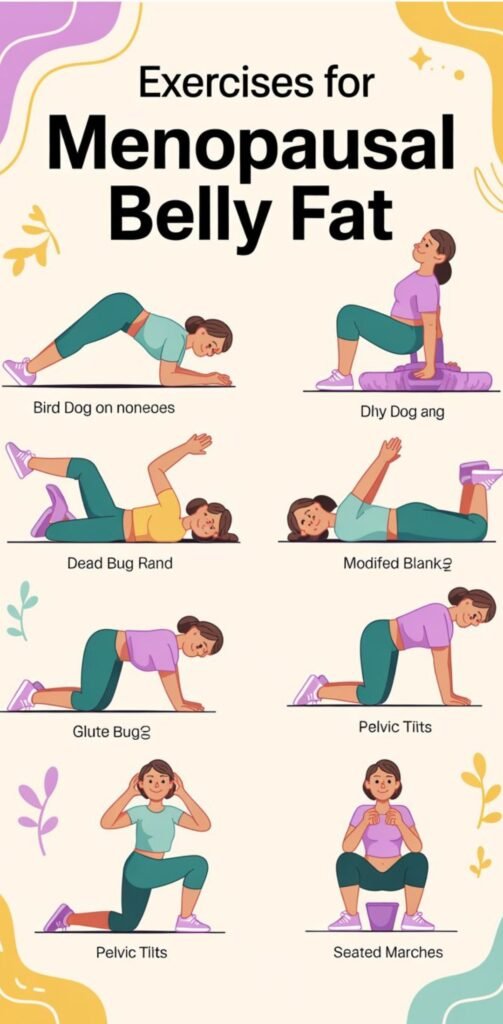
Let’s talk about core work specifically, because it’s an area where a lot of women either avoid exercise entirely (because crunches feel awful) or do the wrong movements for their body right now.
Spot reduction — the idea that you can burn fat from a specific area by exercising that area — is a myth. No amount of crunches will selectively remove belly fat. But strengthening your core is still incredibly important during menopause. A strong core improves posture (which can make your midsection look and feel better immediately), reduces lower back pain, supports your pelvic floor, and helps you move through daily life with more ease.
Here are some of the best exercises for menopausal belly support:
1- Bird Dog
Start on all fours. Extend your right arm forward and your left leg back, keeping your hips level and your core gently engaged. Hold for a breath, return, and switch sides. This exercise builds stability without compressing your spine.
2- Dead Bug
Lie on your back with your arms extended toward the ceiling and your knees bent at 90 degrees. Slowly lower your right arm overhead while extending your left leg toward the floor. Keep your lower back pressed gently into the mat. Return and switch sides. This is one of the safest and most effective core exercises, especially for beginners.
3- Modified Plank
Place your forearms on the floor (or your hands on a wall or countertop for an even gentler version) and hold your body in a straight line. Engage your core without holding your breath. Start with 10–15 second holds and work up gradually.
4- Glute Bridge
Lie on your back with your knees bent and feet flat. Press through your heels to lift your hips, squeezing your glutes at the top. This strengthens your glutes, hamstrings, and deep core while being gentle on the back.
5- Pelvic Tilts
Lie on your back with knees bent. Gently flatten your lower back into the mat by tilting your pelvis slightly upward. Hold for a few seconds, then release. This simple movement activates your deep core muscles and can relieve lower back tension.
6- Seated Marches
Sit tall in a sturdy chair. Lift one knee at a time toward your chest in a controlled marching motion. This engages the lower abdominals and hip flexors and is a wonderful option for women with mobility limitations.
Start with whatever feels manageable — even 5 minutes of these exercises, 3–4 times a week, will build noticeable strength over time.
Mistakes That Can Make Menopause Belly Fat Worse
Sometimes the things we do with the best intentions end up working against us. If you’ve been trying to lose belly fat during menopause and nothing seems to budge, one of these common mistakes might be part of the picture.
1- Overtraining
More is not always more. Excessive exercise — especially high-intensity training done too frequently — can raise cortisol levels, increase inflammation, and actually encourage your body to hold onto belly fat. If you feel depleted after every workout, it’s time to scale back.
2- Not eating enough protein
Protein is essential for maintaining and building muscle, which is your best friend during menopause. Many women undereat protein without realizing it. Aim for a source of protein at every meal — eggs, Greek yogurt, chicken, fish, legumes, tofu, or cottage cheese.
Runners often need a different balance of carbohydrates, protein, and fats depending on training intensity, and these macros for runners can help you fuel performance and recovery more effectively.
3- Chronic unmanaged stress
You can have the perfect workout plan and still struggle with belly fat if your stress levels are constantly elevated. Cortisol and belly fat are closely linked. Stress management isn’t a luxury — it’s a necessity.
4- Skipping strength training
If your routine is all walking and cardio with no resistance work, you’re missing a critical piece. Muscle mass is what keeps your metabolism functioning well. Without it, even maintaining your current weight becomes harder over time.
5- Poor sleep
This isn’t something you can always control, especially during menopause. But prioritizing sleep hygiene — keeping your room cool, limiting screens before bed, establishing a wind-down routine — can make a meaningful difference in how your body stores and releases fat.
6- Extreme dieting or severe calorie restriction
Drastically cutting calories slows your metabolism, increases cortisol, leads to muscle loss, and almost always backfires. Your body needs adequate fuel to function, recover from exercise, and maintain hormonal balance.
7- Only doing cardio
Cardio has its place, but a routine built exclusively on running, cycling, or aerobics without any strength component will not address the muscle loss that’s driving metabolic slowdown. The best exercise for menopausal belly fat combines resistance training with moderate, enjoyable cardio.
Creating structure can make exercise feel much less overwhelming, and this guide on how to make a workout plan for a woman shows how to organize strength training, cardio, and recovery in a sustainable way.
Moving Forward With Kindness
🌸 Pair This With a Full 28-Day Reset
Movement is one piece — the 28-Day Menopause Reset Journal pairs gentle daily habits like these with food and mindset prompts built for this exact stage, so everything works together instead of in pieces.
Get the Menopause Reset Journal — $5 →If you’ve read this far, you already care about your health. That matters more than you might think.
Menopause changes your body in ways that can feel confusing, frustrating, and sometimes unfair. But it doesn’t take away your ability to feel strong, energized, and at home in your body. It just means the path looks a little different now.
The best menopausal belly fat workout isn’t the hardest one or the trendiest one. It’s the one that supports your muscles, calms your stress response, fits into your life, and leaves you feeling better — not worse — when you’re done.
Start small. Walk a little more. Pick up some weights. Do a few minutes of core work on the living room floor. Rest when you need to. And let go of the idea that you have to earn your health through suffering.
You don’t need a dramatic transformation. You need a sustainable rhythm — movement that feels like something you’re doing for yourself, not to yourself.
That’s not just good fitness advice. During menopause, it’s the only advice that actually works.
