
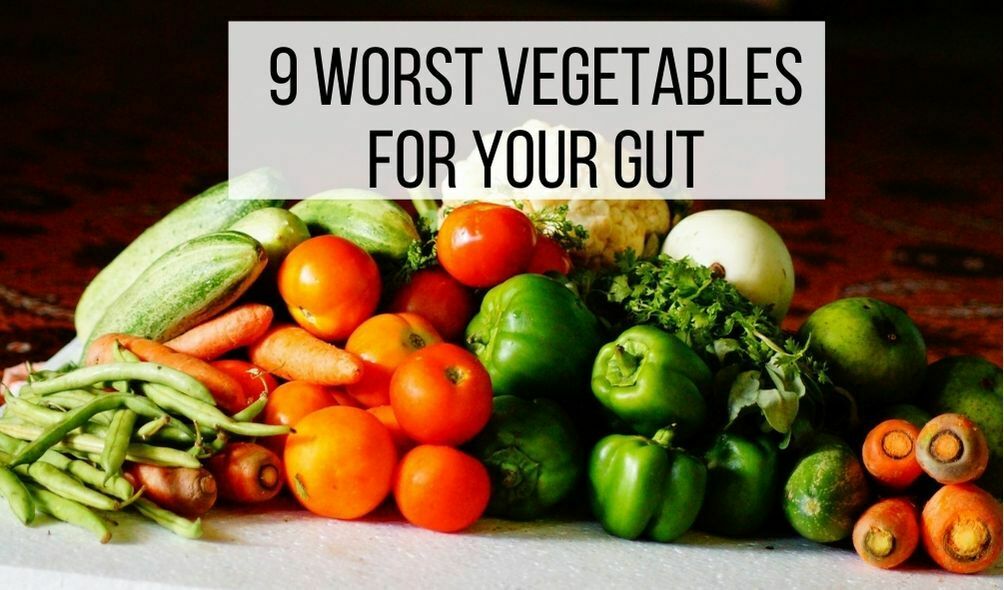
You cut out the obvious stuff weeks ago. No fizzy drinks, no takeaway, vegetables at every meal — and you are still unbuttoning your jeans by three in the afternoon. That is the frustrating part of gut trouble: the foods that set it off are usually the ones you added because you were being good.
Here is the part that surprises most people. Two vegetables that get blamed constantly on gut-health lists — eggplant and citrus — are not the problem. Monash University, the group that actually built the FODMAP testing system, lists eggplant as a low-FODMAP alternative and puts oranges, mandarins, lemons, limes and grapefruit on the safe list too (Monash University). If you have been avoiding aubergine and oranges for the sake of your stomach, you can have them back.
The nine below are the ones with actual laboratory testing behind them. I have a certification in nutrition science and a medical background, and the thing I keep coming back to is that this is not a list of bad foods — it is a list of foods worth testing on yourself, in a specific order, for a limited time.
Why healthy vegetables wreck some stomachs
The trigger is a group of carbohydrates called FODMAPs — short-chain sugars your small intestine struggles to absorb. They carry on into the large intestine, where two things happen: they pull water in, and your gut bacteria ferment them into gas. Water plus gas in a tube is exactly the pressure, bloating and cramping you feel.
Four subgroups do the damage, and knowing which is which saves you from cutting food you never needed to cut:
- Fructans — the big one for vegetables. Onion, garlic, cabbage family.
- GOS — galacto-oligosaccharides, mostly legumes and peas.
- Polyols — sugar alcohols like mannitol and sorbitol. Mushrooms and cauliflower.
- Excess fructose — more fruit than vegetable, but it stacks with the rest.
Two things follow from this. First, dose matters enormously — a tablespoon of onion in a sauce is not the same as half an onion in a stir-fry. Second, FODMAPs stack. A meal with a little of four different triggers can hit harder than a meal with a lot of one. This is why people swear a food is “fine sometimes” and swear off it the next week: they are not imagining it, they are hitting a threshold. If you want the timing side of it, I have written separately about how long FODMAP symptoms usually last once a trigger is in your system.
The 9 worst vegetables for gut symptoms
1. Onion — the single most reliable trigger
If you only test one food, test this one. Onion is dense in fructans, and unlike most triggers it hides everywhere: stock cubes, gravy, jarred sauce, spice blends, soup, anything labelled “seasoning”. Shallots, leeks and spring onion bulbs belong in the same family.
Cooking does not help. Fructans are water-soluble, not heat-sensitive, so slow-frying onion for forty minutes leaves the fructans exactly where they were. What does work is infusion: fry onion in oil, then lift the pieces out. The flavour compounds are fat-soluble and come with you; the fructans stay behind in the discarded onion. Green spring onion tops are a genuine free pass.
2. Garlic — same problem, smaller and sneakier
Garlic is fructan-rich in tiny amounts, which is what makes it brutal. One clove in a family-sized dish is enough to set off a sensitive gut. Garlic powder and garlic salt count, and so does most restaurant food.
The infused-oil trick works here too, and garlic-infused oil is sold in most supermarkets now. Buy it rather than making it — home-infused garlic oil stored at room temperature carries a botulism risk that is small but not worth taking.
3. Brussels sprouts
Monash lists Brussels sprouts among the high-FODMAP vegetables, and the fermentation they cause is the reason for their reputation. Portion is the lever: a couple of sprouts alongside other food is a different proposition from a bowl of them as the side dish. If you are testing, test them alone rather than buried in a roast dinner where four other triggers are competing.
4. Cabbage
Also on the Monash high-FODMAP list. Raw cabbage in a slaw tends to be harder work than cooked, partly because the portion is usually bigger and partly because chewing raw shreds does less than you would hope. Cooked, in smaller amounts, is where most people find their limit.
5. Broccoli — and the stalk is the culprit
Broccoli sits on the high-FODMAP list, but the plant is not uniform. The fructans concentrate in the stalk far more than the florets, which is genuinely useful: plenty of people who react to broccoli soup, where the whole thing goes in the blender, are fine with a modest serving of florets. Try the heads before you write off broccoli entirely.
6. Cauliflower
Cauliflower is high FODMAP in Monash’s classification, and it has had an unfortunate second life as the low-carb substitute for everything. Cauliflower rice, cauliflower pizza base and cauliflower mash all deliver a much larger serving than anyone used to eat as a side vegetable — which is how a person on a “clean” diet ends up more bloated than before they started.
7. Mushrooms
Mushrooms are the polyol entry on the list — mannitol, a sugar alcohol. Polyols are poorly absorbed by almost everyone, not just people with sensitive guts, which is why mannitol and sorbitol turn up as laxative ingredients. Canned mushrooms are often better tolerated than fresh, because some of the mannitol leaches into the brine and gets poured away.
8. Green peas
Peas are on the high-FODMAP list and are easy to overlook because they arrive as a scattering rather than a portion — a handful in a curry, a spoonful in fried rice, a scoop next to a roast. They add up quietly across a day, which makes them a classic culprit when someone cannot work out what changed.
9. Artichoke
Globe artichoke is one of the most fructan-dense foods tested, and Jerusalem artichoke is worse — it is so high in inulin that it is used as a raw material for prebiotic fibre supplements. Marinated artichoke hearts on an antipasti platter or a pizza are the usual way people meet it without noticing.
Four more from the same Monash list are worth knowing if your symptoms will not settle: asparagus, beetroot, fennel and okra. Before you reach for another snack, it is also worth seeing the worst food for gut health beyond the vegetable aisle, because for a lot of people the real trigger was never a vegetable.
What to eat instead
Removing food without replacing it is how people end up eating chicken and rice for a month. These are the swaps Monash lists as low-FODMAP alternatives, so you are trading sideways rather than downwards:
| Instead of | Use |
|---|---|
| Onion and garlic | Garlic-infused oil, green spring onion tops, chives |
| Cauliflower rice | Carrot or courgette ribbons |
| Mushrooms | Eggplant — low FODMAP, and it browns just as well |
| Cabbage slaw | Carrot, capsicum and lettuce |
| Green peas | Green beans |
| Broccoli soup (whole stalks) | Small serving of florets only |
| Apple or pear | Orange, kiwifruit, strawberry, grape |
Eggplant earning a place in that right-hand column is the detail most gut lists get backwards. It is one of the more useful vegetables you have when everything else is off the table, because it takes on flavour and gives you bulk on a plate that is otherwise looking thin.
How long to cut them out — and why forever is the wrong answer
This is where most people go wrong, and it is the most important part of the article.
The low-FODMAP approach was designed as three phases, not as a permanent diet. The restriction phase is meant to run four to eight weeks — no longer. Around three-quarters of people with IBS who respond will notice improvement within six weeks. Then comes reintroduction, where you challenge one FODMAP group at a time over roughly three days each to find out which ones are actually your problem. Finally personalisation: the long-term pattern that keeps symptoms quiet while you eat as broadly as you can (StatPearls, NIH).
Skipping the reintroduction phase is the single most common mistake, and it costs you twice over. FODMAPs are prebiotics — they feed your bacteria. Restriction consistently reduces Bifidobacteria, one of the groups you actively want. And cutting wheat and dairy long-term quietly removes folic acid, B vitamins, iron and the most bioavailable calcium in most people’s diets, because fortified grains and dairy were carrying that load.
The same source is blunt that this should be supervised, ideally by a registered dietitian, precisely because unsupervised versions drift into permanent over-restriction. If you cannot access one, at minimum diarise your start date and hold yourself to eight weeks.
Adding food back in helps more than taking it out
Here is a finding worth sitting with. Stanford researchers put 36 healthy adults through a ten-week trial comparing two diets: high fibre, or fermented foods — yogurt, kefir, kimchi, kombucha. The fermented-food group increased overall gut microbial diversity and showed decreases in 19 inflammatory proteins in their blood, with four types of immune cell showing less activation. The high-fibre group’s diversity stayed flat on average and their inflammatory markers did not drop (Stanford Medicine).
That is not a licence to eat kimchi and ignore everything above — during an active elimination phase some fermented foods are themselves high FODMAP, and the trial was in healthy adults, not people with IBS. But it reframes the goal. The point of removing triggers is to calm things down enough that you can widen your diet again, not to keep narrowing it. Plain yogurt and kefir are the easiest place to start, and I have listed a few more in superfoods for gut health that genuinely earn the name.
Four mistakes that keep people bloated
- Cutting everything at once. You end up with no information and a miserable diet. Test one group at a time.
- Ignoring portion size. Most of these foods have a tolerable serving. “Never again” is usually the wrong conclusion; “not that much” is usually the right one.
- Forgetting the sauce. Onion and garlic in stock, gravy and jarred sauce undo an otherwise careful week.
- Ramping fibre up too fast when you swap. Mayo Clinic’s guidance is to add fibre slowly over a few weeks and drink enough water with it, because too much too quickly causes the exact gas, bloating and cramping you were trying to fix (Mayo Clinic).
If your problem is the opposite one and things are moving too slowly, the fix is different — high-fibre foods for constipation covers that properly. And on a genuinely bad day, getting unbloated quickly is a separate short-term problem with its own answers.
Questions people actually ask
Is eggplant bad for your gut?
No. Monash lists eggplant as a low-FODMAP alternative. It appears on gut-health “avoid” lists constantly, and as far as the FODMAP testing goes, that is simply wrong.
Are oranges and citrus hard to digest?
Oranges, mandarins, lemons, limes and grapefruit are all on Monash’s low-FODMAP fruit list. Citrus can aggravate reflux for some people, which is a different mechanism and a different problem — but it is not a FODMAP issue.
Does cooking reduce FODMAPs?
Not by heat alone. Fructans are water-soluble, so boiling and draining removes some, and infusing into oil then discarding the solids works well for onion and garlic. Roasting or frying does not reduce them.
How long before I notice a difference?
Most people who respond notice something within two to six weeks. If eight weeks of genuine restriction changes nothing, FODMAPs are probably not your problem, and continuing to restrict is doing you harm rather than good.
Can I stay low FODMAP permanently?
You should not. It reduces beneficial bacteria and puts several nutrients at risk. The diet is a diagnostic tool with an end date, not a lifestyle.
Where to start this week
Pull onion and garlic first — including the hidden versions in stock and sauces — and hold it for two weeks. That one change resolves symptoms for a surprising number of people, and it is far less disruptive than dismantling your whole diet. If nothing shifts, then work through the rest of the list properly, with a start date and an end date written down.
One caution worth taking seriously: persistent digestive symptoms deserve a proper diagnosis before you start eliminating food. Bloating and changed bowel habits overlap with coeliac disease, inflammatory bowel disease and other conditions that a restrictive diet can mask rather than treat — and coeliac testing in particular becomes unreliable once you have already cut wheat. Talk to your doctor first, especially if you have weight loss, bleeding, or symptoms that woke you at night.
