
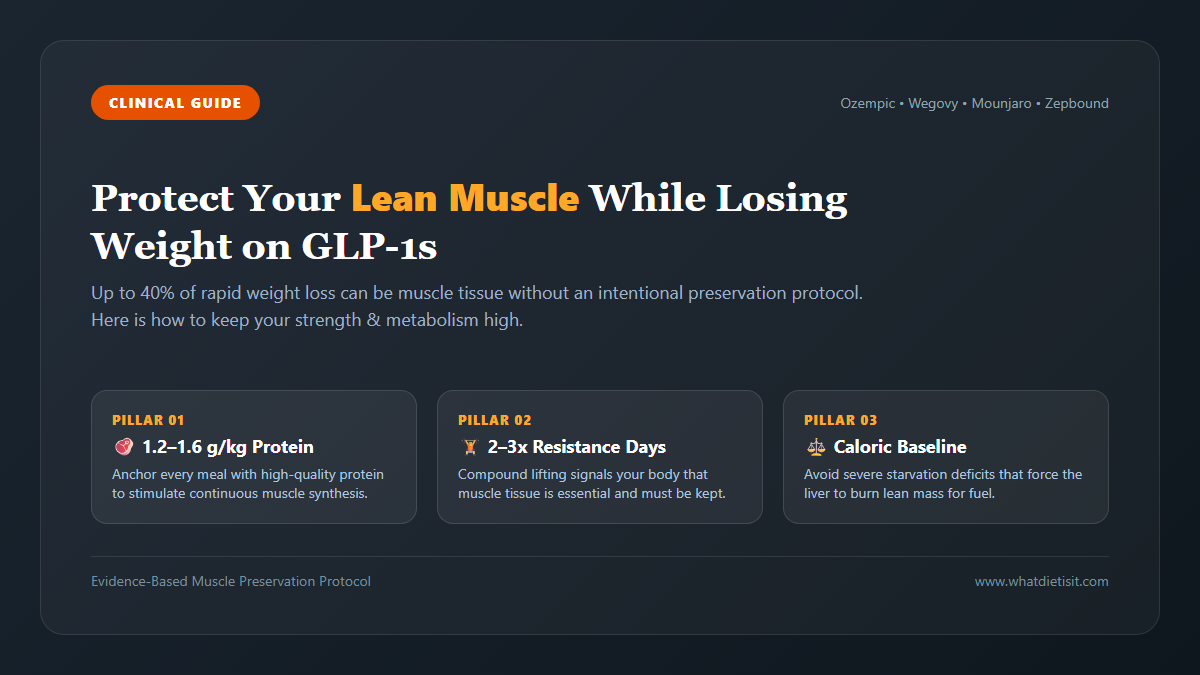
Quick answer: Yes, part of the weight you lose on Ozempic, Wegovy, Mounjaro or Zepbound can be muscle and other lean tissue. You can limit it with three things: enough protein (often about 1.2 to 1.6 g per kg of body weight during weight loss), resistance training two to three times a week, and not letting your food intake drop so low that your body has to break down muscle for fuel.
Educational content only. Check with your doctor before starting a new exercise program, especially if you have heart, joint or kidney problems.
You’re losing weight on a GLP-1, the scale is finally moving, and then you read a headline saying a big chunk of it might be muscle. It’s a fair worry. Muscle is what keeps you strong, steady on your feet and able to carry your shopping up the stairs, and it plays a big role in blood sugar control and in keeping weight off later.
The good news is that muscle loss isn’t a fixed side effect you have to accept. It responds strongly to what you eat and how you move. This guide explains what the research actually shows, who is most at risk, and a practical protein and strength plan you can start this week, even if you’ve never set foot in a gym.
Do You Really Lose Muscle on GLP-1 Medications?
Some lean-mass loss happens with almost any significant weight loss, whether it comes from a diet, surgery or medication. When you carry less weight, your body needs a little less muscle and supporting tissue to move it around. The question is how much, and whether you can shift the balance toward fat.
Here’s what body-composition scans in the major trials found:
| Trial | Share of weight lost that was lean mass |
|---|---|
| STEP 1 body-composition substudy (semaglutide 2.4 mg) | Roughly 40% |
| SURMOUNT-1 DXA substudy (tirzepatide) | About 25%; the other 75% was fat |
In the SURMOUNT-1 substudy, people on tirzepatide lost 33.9% of their fat mass and 10.9% of their lean mass over 72 weeks, and the placebo group lost a similar fat-to-lean ratio. In other words, the drug didn’t selectively attack muscle. It simply produced a lot more weight loss, so the lean loss added up to more kilograms.
Two important caveats. First, “lean mass” on a scan isn’t only muscle; it also includes water, organs and connective tissue, so these numbers overestimate true muscle loss. Second, most trial participants weren’t following a structured protein and strength program. That is exactly the gap you can close.
Who Is Most at Risk?
- Adults over 50, because muscle naturally declines with age (sarcopenia) and is harder to rebuild.
- Women around and after menopause, who face falling estrogen and faster age-related muscle and bone loss.
- People eating very little, for example skipping meals entirely because the appetite is gone.
- People who don’t do any resistance exercise. Walking is great for health, but it doesn’t send a strong enough signal to keep muscle.
- People losing weight very fast, especially at higher doses with big drops in food intake.
Signs you may be losing muscle
You don’t need a lab to notice warning signs. Watch for stairs or getting up from a chair feeling harder than before, grip feeling weaker (jars, bags), your usual workouts getting tougher instead of easier, feeling unusually tired or cold, or the scale dropping fast while your waist barely changes. Any of these is a cue to look hard at your protein and training.
Pillar 1: Eat Enough Protein
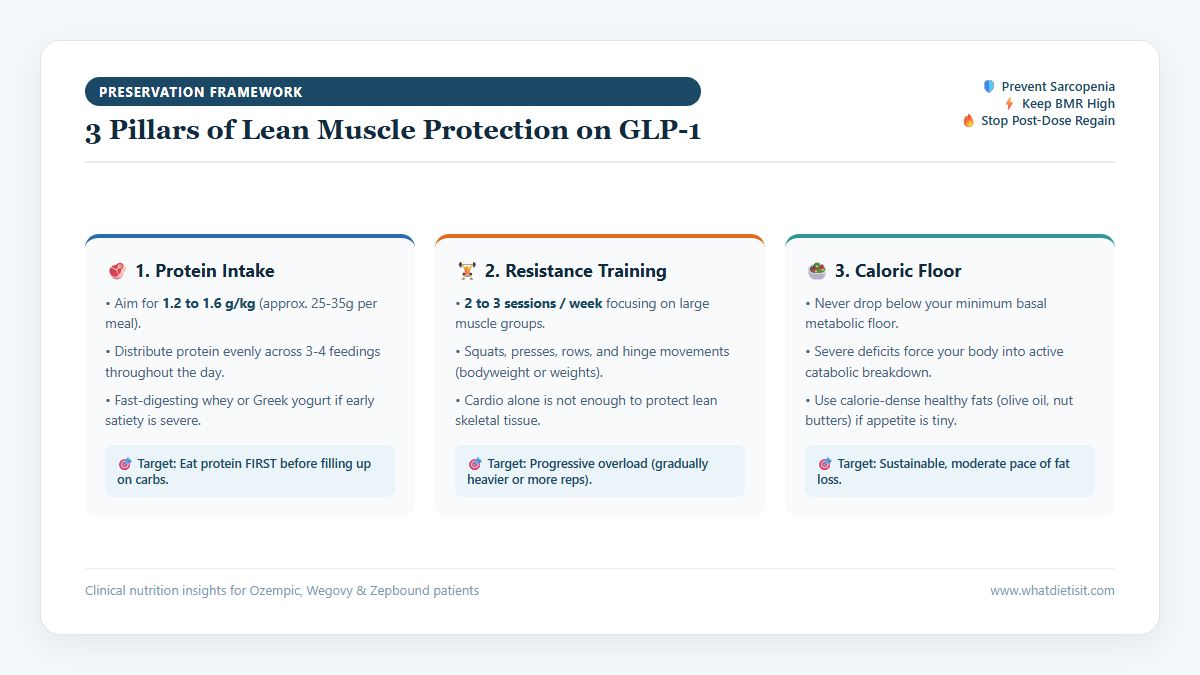
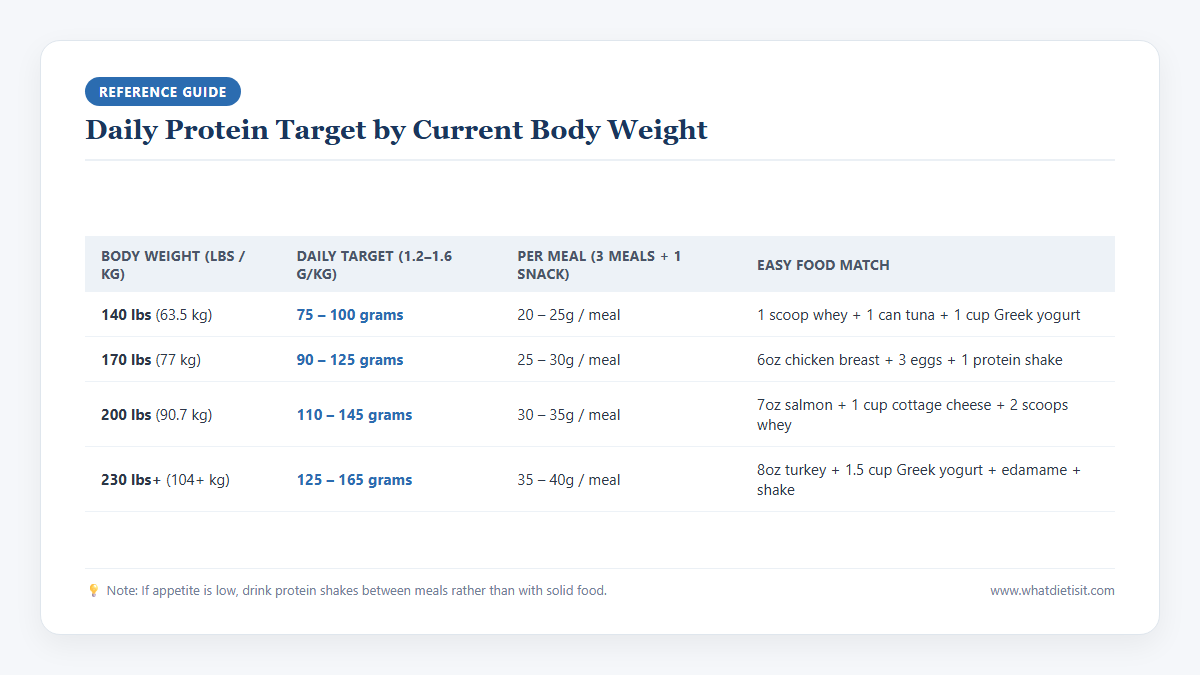
Protein supplies the amino acids your muscles need to repair and maintain themselves, and a smaller appetite makes it easy to fall short without noticing. The 2025 joint advisory from the American College of Lifestyle Medicine, the American Society for Nutrition, the Obesity Medicine Association and The Obesity Society notes that higher targets of about 1.2 to 1.6 g per kg of body weight per day have been proposed during active weight reduction, and around 1.2 to 1.7 g/kg during strength training. It also recommends eating protein foods first at a meal, so they don’t get crowded out.
For people with obesity, using your full current weight can overestimate needs, which is why many clinicians base the number on an adjusted or goal weight, landing most people somewhere around 80 to 120 g a day. The easiest way to find a sensible starting point is the protein calculator.
Spread it through the day
Your body uses protein best in solid doses across the day rather than one big serving at dinner. Aim for roughly 25 to 40 g at each main meal, plus a protein snack if you need it. Here’s what a 110 g day can look like on a small appetite:
| Meal | Food | Protein |
|---|---|---|
| Breakfast | 200 g Greek yogurt, berries, 1 tbsp chia seeds | 20 g |
| Lunch | 2-egg omelet with feta and spinach, 1 slice whole-grain toast | 20 g |
| Snack | Protein shake | 25 g |
| Dinner | 120 g grilled chicken or fish, vegetables, small portion of rice | 35 g |
| Evening | Half a cup cottage cheese | 12 g |
Best protein sources when you can’t eat much
Choose foods that pack a lot of protein into a small volume: Greek yogurt, cottage cheese, eggs, chicken, turkey, fish, canned tuna, lean beef, tofu, tempeh and lentils. Animal proteins and soy are rich in leucine, an amino acid that helps switch on muscle building. On low-appetite days, a shake is a practical way to protect your intake. These protein shakes for GLP-1 users are easy on the stomach, and these high-protein bowls are an easy way to build full meals.
Hitting Your Protein Target Every Day
The GLP-1 Kickstart Kit is a 28-day, protein-first meal plan for people on Zepbound, Ozempic, Mounjaro and Wegovy, with 21 quick recipes, a side-effect playbook and printable trackers, built specifically to protect your muscle while the medication handles your appetite.
Get the Kickstart Kit: $27Pillar 2: Resistance Training
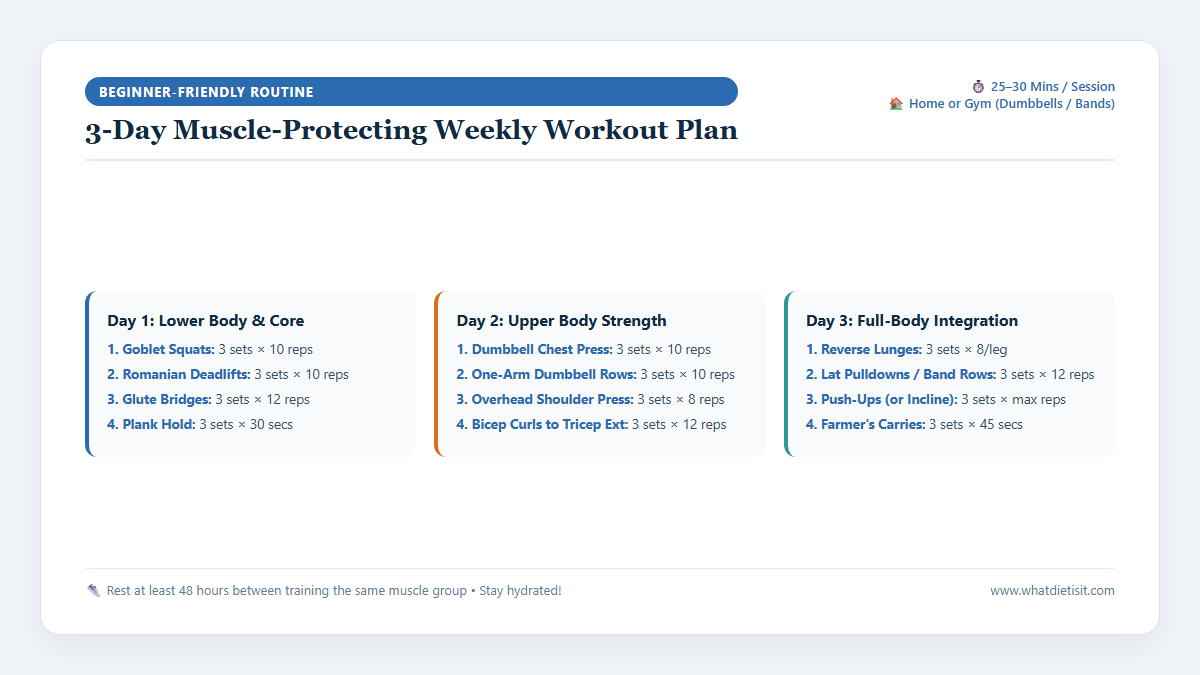
Protein is the building material; resistance training is the instruction to use it. Research on calorie restriction consistently shows that people who lift weights while losing weight keep more lean mass than people who diet alone, and the joint GLP-1 advisory pairs protein with structured strength training for exactly this reason. You don’t need a gym. You need muscles working against resistance that gets gradually harder.
A beginner plan you can do at home
Do this two or three times a week on non-consecutive days. Start with a weight or variation that feels challenging by the last two reps but lets you keep good form.
| Exercise | Weeks 1 to 2 | Weeks 3 to 4 | Weeks 5 to 8 |
|---|---|---|---|
| Sit-to-stand or goblet squat | 2 sets of 10 | 3 sets of 10 | 3 sets of 12, add weight |
| Wall or incline push-up | 2 sets of 8 | 3 sets of 8 | 3 sets of 10, lower the incline |
| Band or dumbbell row | 2 sets of 10 | 3 sets of 10 | 3 sets of 12, heavier band |
| Hip bridge | 2 sets of 12 | 3 sets of 12 | 3 sets of 12, single-leg or weighted |
| Farmer’s carry | 2 walks of 30 sec | 3 walks of 30 sec | 3 walks of 40 sec, heavier |
The key idea is progressive overload: every week or two, do a little more, whether that’s an extra rep, a heavier weight, or a harder variation. Keep a simple log in your phone. Getting stronger is the best sign you’re keeping muscle, even when the scale is dropping. If you’re in perimenopause or menopause, these gentle strength exercises for menopause are a good place to start.
What about cardio?
Keep walking. Daily steps support heart health, blood sugar and mood, and they help with the constipation many GLP-1 users deal with. Just treat walking as a partner to strength training, not a replacement for it.
Putting it together: a muscle-protecting week
Here is how the pieces fit into a normal week. Nothing here takes more than 30 to 40 minutes a day.
| Day | Movement | Food focus |
|---|---|---|
| Monday | Strength session A, short walk | Protein at every meal, carbs around the workout |
| Tuesday | 30-minute walk | Hit your protein target, extra vegetables |
| Wednesday | Strength session B | Protein first at each meal |
| Thursday | 30-minute walk or easy bike | Plan an easy protein backup for injection day if relevant |
| Friday | Strength session A | Protein at every meal |
| Saturday | Longer walk, hike or active outing | Flexible meals, still protein first |
| Sunday | Rest or gentle stretching | Meal prep proteins for the week |
If three strength days feel like too much, start with two and add the third once the habit sticks. Consistency over months beats a perfect week followed by nothing.
Pillar 3: Don’t Undereat
GLP-1s can suppress appetite so strongly that some people end up eating far too little. When intake drops very low, your body is more likely to break down muscle for energy, and you’ll feel it in your energy and your workouts. Eat regular meals even when you’re not hungry, prioritize protein at each one, and include some carbohydrates around your workouts so you have the energy to train. If you’re not sure what a reasonable intake is, the TDEE calculator gives you a baseline to discuss with your doctor.
A steady pace of loss is kinder to muscle than a crash. If you’re dropping weight very quickly and feel weak, that’s worth raising at your next appointment rather than celebrating.
Other Things That Help
- Sleep: muscle repair happens largely during sleep. Seven to nine hours supports recovery and appetite regulation.
- Vitamin D and calcium: important for muscle and bone. The joint advisory suggests clinicians consider supplements for at-risk nutrients like vitamin D, calcium and B12, based on individual needs.
- Creatine: one of the most researched supplements for strength and lean mass when combined with resistance training, including in older adults. It isn’t right for everyone, particularly people with kidney disease, so check with your doctor first.
- Fiber and fluids: not directly about muscle, but constipation and dehydration will quickly derail your training plans.
Special Situations
If you are in perimenopause or menopause
Falling estrogen speeds up both muscle and bone loss, so this group has the most to gain from protein and strength training while on a GLP-1. Lift at least twice a week, include weight-bearing movement like brisk walking, and make sure calcium and vitamin D are covered through food or, if your doctor recommends it, supplements. If you are also dealing with midlife weight changes, this guide to a menopausal diet for weight loss fits well alongside a GLP-1.
If you are over 60
Older adults often need more protein per meal to get the same muscle-building response, so aim for the upper end of the 25 to 40 g range at each meal. Balance and fall prevention matter too: add simple balance work like standing on one leg near a counter, and consider a few sessions with a physiotherapist or qualified trainer to learn good form safely.
If you are vegetarian or vegan
You can absolutely protect muscle on a plant-based diet. Build meals around tofu, tempeh, edamame, lentils, beans and seitan, and if you eat dairy and eggs, use them generously. Because plant proteins are less concentrated, pairing two sources at a meal and adding a soy or pea protein shake makes your target much easier to reach on a small appetite.
How to Tell If Your Plan Is Working
The scale alone can’t tell you whether you’re losing fat or muscle. Use a few simple markers instead:
- Strength log: are your reps or weights going up, or at least holding steady?
- Waist measurement: a shrinking waist with steady strength is a great sign you’re losing mostly fat.
- Everyday function: stairs, carrying bags, getting off the floor.
- Body-composition scans (optional): a DXA scan gives the most accurate picture. Home smart scales are less reliable, but tracking their trend over months can still be useful.
Why Muscle Matters Even More When You Stop
Muscle isn’t just about looking toned. It’s metabolically active tissue that helps you use glucose and supports your daily energy needs. That becomes critical if you reduce or stop your GLP-1 later. Studies show that weight tends to return after these medicines are stopped, and walking into that phase with more muscle and a strength habit already in place gives you a real advantage. If you’re planning ahead, The After Plan covers muscle preservation for the months after your last dose, and the Complete GLP-1 Journey Bundle gives you both the on-medication and after-medication plans together.
Frequently Asked Questions
How much muscle do you lose on Ozempic?
In the STEP 1 body-composition substudy, roughly 40% of the weight lost with semaglutide 2.4 mg was lean mass. Lean mass includes water and other tissue, not only muscle, and people in the trial weren’t following a specific protein and strength program. With both, you can likely do better.
Does Mounjaro or Zepbound cause less muscle loss than Ozempic?
In the SURMOUNT-1 substudy, about a quarter of the weight lost with tirzepatide was lean mass. Studies used different methods and populations, so direct comparisons aren’t reliable. Protein and resistance training matter more than which drug you’re on.
How much protein should I eat on a GLP-1?
Targets of about 1.2 to 1.6 g per kg of body weight per day have been proposed during active weight loss, often calculated from an adjusted weight for people with obesity. For many people that’s around 80 to 120 g a day. Your doctor can personalize it, especially if you have kidney disease.
Can I build muscle while losing weight on Ozempic?
Beginners, in particular, can often gain strength and sometimes muscle while losing fat, as long as protein intake is high enough and training is consistent and progressive.
Is walking enough to protect muscle?
Walking is excellent for your health but doesn’t provide enough resistance to maintain muscle on its own. Add two or three strength sessions a week.
I think I’ve already lost muscle. Can I get it back?
Yes. Muscle responds to training at any age, and people who are new to strength work usually see strength gains within the first several weeks, often before any visible change. Start with the beginner plan above, raise your protein to your target, and track your lifts. If you’re older or have been very inactive, a few sessions with a physiotherapist can help you progress safely. The earlier you start, the easier it is, so don’t wait until you’ve finished losing weight.
The Bottom Line
Losing some lean mass on a GLP-1 isn’t inevitable at the levels seen in trials. Eat protein first at every meal, reach your daily target, lift something two or three times a week and make it gradually harder, and don’t let your intake crash. Do those consistently, and you’ll finish your weight loss stronger, not just smaller.
References
- Mozaffarian D, et al. Nutritional priorities to support GLP-1 therapy for obesity: a joint advisory. 2025.
- Look M, et al. Body composition changes during weight reduction with tirzepatide in the SURMOUNT-1 study. Diabetes, Obesity and Metabolism, 2025.
- West S, et al. Weight regain after cessation of medication for weight management. BMJ, 2026.
